More here.Trump shouts out Roger Clemens, who was in attendance at the Trump rally in Texas pic.twitter.com/9fec4CZgUZ
— Aaron Rupar (@atrupar) January 30, 2022
January 29, 2022
Fat Billy Goes To Trump's Texas Whine-A-Thon/Public Therapy Session


January 27, 2022
Event Promotion Implies Dodgers And Angels Are Hosting A Fundraiser For January 6 Insurrection Organizer Who Courts Neo-Nazis (Both Teams Have Been Silent For 2 Days)
The flyer makes it look as though the Dodgers and Angels are hosting a fundraiser for a seditious neo-Nazi. However, it appears that Paul Gosar (six of his siblings called him a "traitor" and endorsed his opponent) has simply purchased a bunch of tickets that he hopes to give out to donors.The Los Angeles @Angels and @Dodgers are hosting a spring training/campaign fundraising event in Tempe for white nationalist-affiliating, January 6-orchestrating representative Paul Gosar. Tickets go for $1500 and will “benefit Paul Gosar for Congress.” (h/t @z3dster) pic.twitter.com/8dHXWW6Ugv
— AZ Right Wing Watch (@az_rww) January 26, 2022
My question is: How quickly are the teams speaking out against their logos being used to promote this racist garbage and forcing Gosar to remove the logos from his announcement?
Answer? Not fast enough.
As I publish this post, it has been close to 48 hours since AZ Right Wing Watch first tweeted the news. Numerous fans sent the tweet to both teams, but neither team has made a public announcement.
Sam Blum, The Athletic (Jan. 26 8:22 PM tweet):
This advertisement for an event w/ Rep. Paul Gosar (extremely controversial/conspiratorial politician) is posted on WinRed. It's a real ad.There is also some confusion over the announced date of the event, since the teams do not play each other on February 27.
IMPORTANTLY: The Angels tell me they have "no affiliation with this event & are working to have our marks removed from the advertisement."
I didn't think to look this up because why would that be wrong? But the Angels and Dodgers aren't even playing each other on 2/27https://t.co/WavHo5zOAX
— z3dster (@z3dster) January 26, 2022
Unless his copy confused the Padres for the Angels or 3/27 for 2/27
They Dodgers are playing the Angels on March 20,27,28,29 https://t.co/PocJQKGyWB pic.twitter.com/MJh8LHKMhM
The slow pace at which MLB and the Players Union are working to end MLB's lockout likely means that nothing will be happening on either February 27 or March 27. The Dodgers and Angels should still made a very public announcement against Gosar using their trademarked logos to make his event look more legitimate.
January 25, 2022
David Ortiz Is A First-Ballot Hall Of Famer (And Now It's Official)

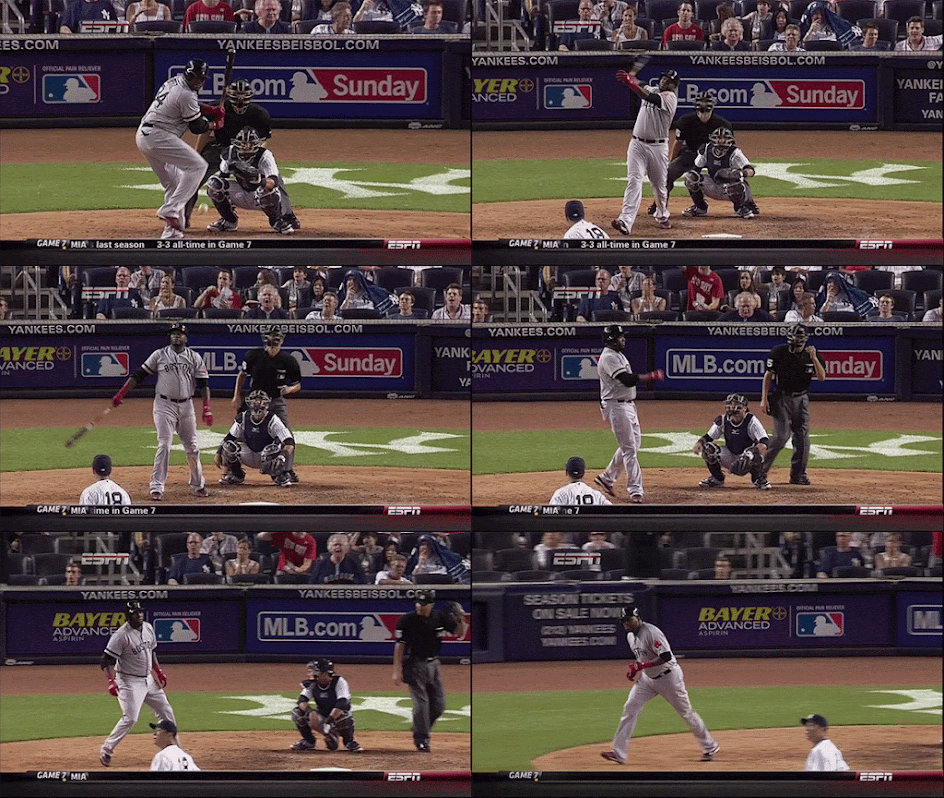
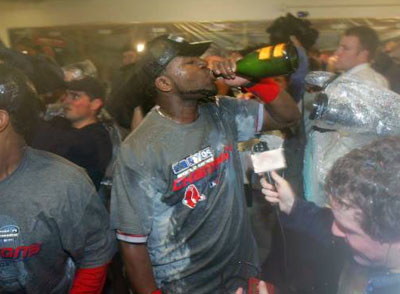
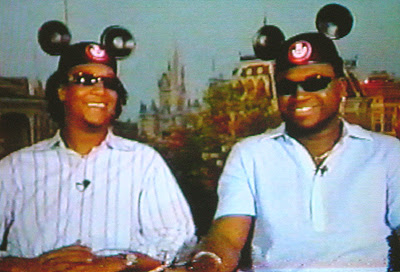
David Ortiz was elected to baseball's Hall of Fame on the first ballot. Big Papi was the only player elected by the Baseball Writers' Association of America to be named on 75% of the ballots.
Ortiz was named on 307 of 394 ballots (77.9%) and will be inducted with six others on July 24, 2022. The Golden Days and Early Baseball Era committees selected Jim Kaat, Tony Oliva, Bud Fowler, Gil Hodges, Minnie Miñoso and Buck O'Neil.
Barry Bonds finished second (66%), Roger Clemens was third (65.2%), and Curt Schilling was fifth (58.6%). All three players failed to receive the necessary 75% in their tenth and final years on the ballot.
Ortiz spent his first six major league seasons in the Twins organization before being released on December 16, 2002. About one month later, on January 22, 2003, the Red Sox (at the urging of pitcher Pedro Martinez) signed Ortiz as a free agent to a one-year, $1.25 million contract.
Ortiz did not become a fixture in Boston's lineup until May, but once he was given a chance, he provided powerful evidence he belonged. From May 14 to June 14, Ortiz batted .433 in 19 games, with an OPS of 1.174. Only two of his 29 hits were home runs, he also smacked 12 doubles and drew five walks while striking out only nine times. The taters came later: eight in July, 11 in August, and eight in September.
"I was the type of player that I know I've got the talent, but all I was looking for was the opportunity to be an everyday player. Thank God at some point it came true, once I got to the Red Sox, and the rest is history. I feel so thankful and grateful for being able to accomplish what I was able to accomplish and, thank God, have the career I have.
The Large Father's heroics in his first five seasons in Boston were many. From his legendary clutch performances in the magical and still-hard-to-believe-it-happened 2004 postseason to setting a Red Sox single-season record with 54 home runs in 2006 (which led the American League, as did his 137 RBI, 119 walks, and 355 total bases) to leading the led Red Sox to another championship in 2007.
His performance in the 2013 World Series was transcendent: 11-for-16, with eight walks. a .688 batting average (the best average in WS history of anyone with 16+ PA) with and a 1.948 OPS. In 25 plate appearances, he struck out only once as Boston won its third World Series championship in a decade.
In his final season – 2016, at age 40 – Flo led both leagues with 48 doubles, a .620 slugging, and a 1.021 OPS. He also topped the AL with 127 RBI.
To the very end, pitchers were wary of facing him in clutch situations. Ortiz led the AL in intentional walks in three of his final four seasons.
In three World Series, Ortiz hit .455 (#5 all-time), with 14 RBI and 14 runs scored in 14 games. He also had 14 walks - and only five strikeouts. with a 1.372 OPS (#4 all-time).
Ortiz's Ranking (World Series, Season)
#2 Batting average: .688 (#1 of anyone with 16+ PA)
#2 On-base percentage: .760 (#1 of anyone with 16+ PA)
#8 Slugging percentage: 1.188 (#2 of anyone with 25+ PA)
#7 OPS: 1.948 (#2 of anyone with 25+ PA)
#7 Walks: 8 (Of the 16 players with 8+ walks, Ortiz had the fewest plate appearances (25))
(All stats from 2013 World Series)
(All stats from 2013 World Series)
Ortiz's Ranking (World Series, Career)
#5 Batting average: .455
#6 Slugging percentage: .795
#2 OBP: .576 (#1 of anyone with 31+ PA)
#2 OBP: .576 (#1 of anyone with 31+ PA)
#4 OPS: 1.372 (#1 of anyone with 31+ PA)
Ortiz also holds the all-time Division Series (26 seasons, since 1995) records for best average (.714), on-base (.846), slugging (1.571, tied), and OPS (2.418), all accomplished in 2007.
Ortiz really made his mark among Red Sox fans in walkoff situations. From 2003-16, Ortiz came to the plate 106 times (in 85 games) with a chance to win the game. He went 27-for-79 (.342), with 12 home runs. Ortiz had 20 career walkoff hits (23.5% of games), including the postseason, with thirteen of those coming in a three-season stretch (2004-06).
Here's a mind-boggler: Ortiz delivered a game-winning hit in six consecutive games in which he had a chance for a walkoff hit: his final opportunity in 2005 and his first five chances in 2006 (I cite #6 below). I'm not completely sure, but I feel confident that's unprecedented in baseball history.
In June 2017, I wrote:
Back in 2005 and 2006, when Ortiz came to the plate at Fenway Park with a chance to win the game, he never made an out. That is barely an exaggeration. When I compiled the data for the first version of this post (August 1, 2006), I noted that from the end of the 2004 regular season through July 2006, Ortiz came to the plate 19 times in a walkoff situation – and made only three outs. He had a .786 batting average (11-for-14) with seven home runs and 20 RBI!
His July 31, 2006 home run off Cleveland rookie Fausto Carmona (later known as Roberto Hernandez) may be my favourite non-playoff Ortiz walkoff hit. Big Papi was on an amazing streak of winning games and had hit an extra-inning game-winner only two days earlier. With Boston down by two runs and two men on in the ninth, I probably would have bet my year's salary on Ortiz winning the game if someone had asked. It felt like everyone in Fenway Park knew it would happen, including Carmona. Maybe especially Carmona. The Cleveland pitcher threw two balls to build a little tension and then – BAM! – Ortiz crushed a three-run homer to center. All I could do is stare at the TV and laugh.
Ortiz – being human – couldn't keep batting almost .800 in walkoff situations. And at times, he was (admittedly) no longer that guy, the slugger who made pitchers quake in their cleats, but his past heroics remained in the back of everyone's mind when he spat in his batting gloves, clapped those big mitts together, and dug in. For years, a game-winning hit always seemed (to me, anyway) extremely likely.
Of course, the walkoff opportunities listed below tell only a small part of Ortiz's story. But it is a huge part of Big Papi's legend . . .
I also noted that those walkoff stats do not count the numerous home games in which Ortiz tied the score or gave the Red Sox the lead in the 7th or 8th innings and they also do not include any clutch hits on the road. Additionally, home games Ortiz could only tie in the bottom of the 9th (or extra innings) are not included.
A personal Ortiz memory: On May 1, 2013, I was on the field at Skydome, waiting to have a quick chat with Ortiz, to explain that I was (along with Bill Nowlin) writing a book about the 2004 postseason and we would love to have him sit down with Bill at Fenway Park at some point. (Two weeks earlier, on April 19, I had met Kevin Youkilis in the Yankees locker room before finding a quiet place to talk about his memories of his rookie season.) About a dozen Red Sox players milled about nearby; some were running sprints off the first base foul line. At some point I looked up towards the infield and Ortiz was walking in my direction. No one was close enough to me to hear my audible intake of breath. Seeing Jacoby Ellsbury or Koji Uehara was cool, but they didn't come close to jolting my senses or get my heart racing. Ortiz was something else entirely; he seemed larger, more majestic than anyone else (because he was), like a mythic creature emerging from dense fog. The Red Sox PR person went up to Ortiz and then motioned us towards the dugout. I took a seat. Ortiz sat on my right and listened to my spiel about the book project and our wish for a bit of his time in the near future. He listened politely, nodded and said a few words of agreement, and shook my hand. That was it. I did not have a ticket to the game, but I hopped into the stands and selected a seat from which to watch the Red Sox cruise to a 10-1 win. (Bill talked to Ortiz on May 24.)
The 2004 season changed Red Sox fans (and Red Sox fandom) forever. Because of that, there will never be another player who can match David Ortiz for Red Sox heroics at the plate. My interest in the Hall of Fame has shrunk to pretty much zero, but I'm still thrilled to see Ortiz get elected – and on the first ballot.


January 13, 2022
Jon Lester Has Retired After 16 Seasons
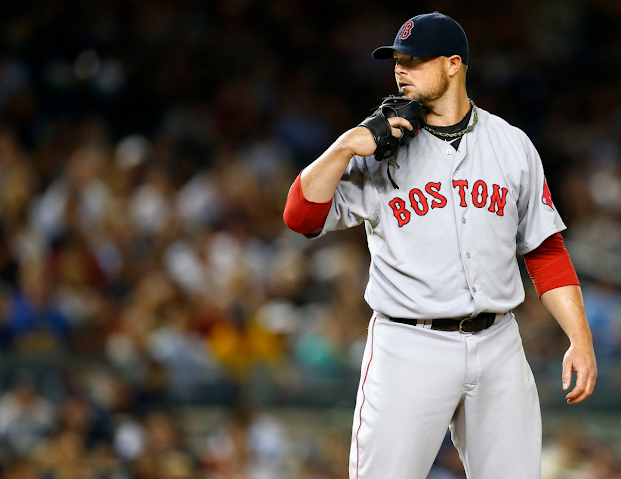
Lester, who turned 38 last Friday, was a member of three World Series champions: the 2007 Red Sox, 2013 Red Sox, and 2016 Cubs.
It's kind of run its course. It's getting harder for me physically. The little things that come up throughout the year turned into bigger things that hinder your performance.
I'd like to think I'm a halfway decent self-evaluator. I don't want someone else telling me I can't do this anymore. I want to be able to hand my jersey over and say, "Thank you, it's been fun."Throughout his career, Lester was extremely durable, making 31+ starts for 12 consecutive seasons (2008-19). Lester is one of only nine lefthanders in MLB history to have 12 seasons (not necessarily consecutive) with 31+ starts.
Lester was also remarkable consistent. His ERA was 3.64 both for his nine seasons in Boston and his six years in Chicago and his won-loss percentage for both teams was .636. Since the win stat has yet to be outlawed (a boy can dream), I'll also report that Lester (200-117) has the fourth-best winning percentage (.631) of any lefthander with 200+ wins, behind Whitey Ford, Lefty Grove, and Randy Johnson.
In 26 postseason games, Lester posted a 2.51 ERA over 154 innings. His ERA was 2.66 in seven postseason-clinching games.
Lester pitched in six World Series games, with a 1.77 ERA and 0.925 WHIP. For the Red Sox, he won the clinching Game 4 of the 2007 sweep of the Rockies and he won both of his starts (Games 1 and 5) in 2013 against the Cardinals. In 2016 with the Cubs, he lost Game 1, won Game 5 (when Chicago was down 1-3, on the brink of elimination) and pitched three innings of relief in Game 7 (and would have got the W if Aroldis Chapman had not blown the save and vultured the victory for himself).
Four mlb.com writers discuss Lester's chances of being inducted into the Hall of Fame.
Lester had 42 hits in his major league career, but none of them came in a Red Sox uniform. In 41 plate appearances with Boston, he was 0-for-34. He did walk once and drive in a run, though; both came in the same game, on June 27, 2010.
Lester was first mentioned at Joy of Sox on December 20, 2003 (when the blog was roughly four months old!), as a prospect being named as part of the (thankfully) aborted Slappy-for-Manny trade.
Lester had 42 hits in his major league career, but none of them came in a Red Sox uniform. In 41 plate appearances with Boston, he was 0-for-34. He did walk once and drive in a run, though; both came in the same game, on June 27, 2010.
Lester was first mentioned at Joy of Sox on December 20, 2003 (when the blog was roughly four months old!), as a prospect being named as part of the (thankfully) aborted Slappy-for-Manny trade.
Lester made his debut (after waiting out a near five-hour rain delay) on June 10, 2006 and he pitched a no-hitter against the Royals on May 19, 2008. (That is also the Red Sox's most recent no-hitter.)
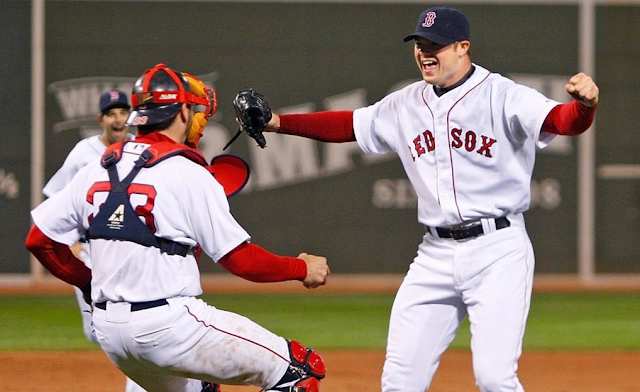
My favorite Jon Lester moment. pic.twitter.com/rGnvj6o5RF
— Don Orsillo (@DonOrsillo) January 12, 2022
Jon Lester’s retirement allows me to revisit one of those moments that I’ll never not tear up for: Teets greeting Lester with a massive hug after his no-hitter.https://t.co/DJSX3lzgw3pic.twitter.com/6lmEKRZdBk
— Red (@SurvivingGrady) January 13, 2022
From the championships to the no-hitter, to your work in the community— thank you, Jon.
— Red Sox (@RedSox) January 12, 2022
Congrats on a legendary career! pic.twitter.com/0y0wYixqN1
Raising a glass to Jon Lester in celebration of a legendary career.
— Chicago Cubs (@Cubs) January 12, 2022
200 wins, 3 rings, a 2.51 postseason ERA and countless lives touched by your generosity.
We are so fortunate to have you in the Cubs family. Enjoy retirement! pic.twitter.com/WvxTkn8Afx
January 10, 2022
The One In Which I Praise The New York Yankees
The New York Yankees have hired Rachel Balkovec as the manager for the 2022 Tampa Tarpons (Low-A Southeast). Balkovec will be the first female manager in affiliated professional baseball.
Balkovec said (in 2019) she had "aspirations of being in a more leadership role from a broader standpoint . . . [possibly as] director of baseball operations or farm director or GM." Lindsey Adler of The Athletic added that Balkovec is comfortable with advanced analytics and fluent in Spanish.
Mark Polishuk (MLB Trade Rumors) recaps Balkovec's work history:
Beginning as a strength and conditioning coordinator in the Cardinals' farm system from 2011-15, she then moved to a similar role with the Astros from 2016-18, working with both Houston's Latin American prospects and then the Astros' Double-A affiliate. She has spent the last two seasons working within the Yankees' minor league system as a hitting coach, following some time spent working with Driveline and in the Netherlands working with the Dutch national teams.
Never let it be said that I'm unreasonable when it comes to discussing those neo-Nazi Brownshirts.

Craig Calcaterra's latest Cup of Coffee includes news of Genevieve Beacom, a 17-year-old left-hander, who become the first woman to pitch for a professional team in Australia when she tossed a scoreless inning for the Melbourne Aces, managed by Peter Moylan (a 12-year MLB veteran).
Calcaterra notes: "As a bunch of people who watched video of Beacom said over the weekend, her mechanics are very much like Jon Lester's. Very economical and efficient as she mixed in fastballs and curves."
Seventeen-year-old Genevieve Beacom speaks on her professional debut with the Aces as the first women pitcher to pitch for a professional baseball team in Australia #GenevieveBeacom pic.twitter.com/YF1qNbYCit
— Melbourne Aces (@MelbourneAces) January 8, 2022
HISTORY.
— MLB Network (@MLBNetwork) January 10, 2022
We’ll chat with Genevieve Beacom on Monday’s #MLBTonight at 6pm ET! https://t.co/uNdeIxwIdZ
December 31, 2021

December 20, 2021
Mets Hire A Familiar Face


HEY, BLOG BOY! . . . I'M BACK! . . . AND MY BINDERS ARE BIGGER THAN EVER! . . . HEY! YOU GOT WRITER'S BLOCK ON THIS THING OR WHAT? IT FINALLY DAWNING ON YOU THE YEARS YOU'VE WASTED YAPPING ABOUT THOSE BOSTON LOSERS? WELL, QUIT FUCKING MOPING AND PAY ATTENTION TO THE MASTER! YOUR SHITTY TEAM WILL KNOW WHICH END IS UP SOON ENOUGH.
December 18, 2021
Post Update: Second Box Score For 209-10 Win in 1869
A small update to my post of January 31, 2020, in which I expressed my amazement that a team could score 209 runs but not score in every inning.
December 9, 2021
Taijuan Walker Is Curious
You sending me a plaque or anything cool? https://t.co/3CzIS1d1vB
— Taijuan Walker (@tai_walker) December 9, 2021
December 1, 2021
MLB Locks Out Players; First Work Stoppage In 26 Years
A potentially long winter began just after midnight on Thursday, as Major League Baseball locked out its players, a move the Players Association called "drastic and unnecessary".
The lockout is baseball's first work stoppage since the 1994-95 strike. MLB and the Players Association held two meetings on Wednesday. The second session lasted only seven minutes.
All transactions involving players on 40-man rosters and other union members are not permitted until the next CBA is signed. Before the midnight expiration, however, the Red Sox made a couple additional deals. Jackie Bradley will be returning to Boston, as the Red Sox traded Hunter Renfroe to the Brewers for JBJ and two prospects. Boston also signed pitcher Rich Hill.
Besides the economic issues being discussed, the union proposed two ideas for an expanded postseason. One would involve realignment: two divisions (of eight and seven teams, respectively) in each league. (The realignment is interesting.)
The lockout is baseball's first work stoppage since the 1994-95 strike. MLB and the Players Association held two meetings on Wednesday. The second session lasted only seven minutes.
All transactions involving players on 40-man rosters and other union members are not permitted until the next CBA is signed. Before the midnight expiration, however, the Red Sox made a couple additional deals. Jackie Bradley will be returning to Boston, as the Red Sox traded Hunter Renfroe to the Brewers for JBJ and two prospects. Boston also signed pitcher Rich Hill.
Besides the economic issues being discussed, the union proposed two ideas for an expanded postseason. One would involve realignment: two divisions (of eight and seven teams, respectively) in each league. (The realignment is interesting.)
Commissioner Rob Manfred released some bullshit statement. I did not read it. If you want to, it's here. There are many things that could improve major league baseball. Manfred's resignation is at the top of that list.
MLB Knowingly Used Two Types Of Baseballs Last Season And Lied About It (And Is Still Lying About It); CBA Expires Tonight, Immediate Lockout Expected
MLB knowingly used two different types of baseballs last season, according to Business Insider. Some of the balls were more livelier than others. Apparently, only league officials were aware of this secret. Players, managers, coaches, scouts, and front office officials all kept in the dark.
The story is behind a paywall, so I am relying on Craig Calcaterra's recap (my emphasis):
MLB's statement [in response] is that, because of the pandemic, the lighter, shorter-flying ball the league said it was going to use everywhere was unable to be produced in sufficient numbers to supply a whole season's worth of balls so the league had to use the heavier, livelier balls of the past to fill out the season's inventory. Per [Business Insider's] and [astrophysicist Dr. Meredith] Willis' investigation, however, that's not true. Rawlings began making the new ball in October 2019, well before MLB's official announcement about the change and the company went back to producing the old ball in January 2020, before the pandemic hit America. As such, the use of the older, higher-flying ball was not a pandemic-related necessity at all. It was, it seems, a conscious choice on the part of the league to make it so that two different sets of baseballs were in play.
The fact that the league used different balls in the same season, and that they quite obviously lied about it until they were caught red-handed, opens up a TREMENDOUS can of worms, of course.
Did the league know which balls were going where? Did they send deader balls to certain series and livelier balls to others? Players have long suspected that the league manipulates such things to suit its interests. The league — and many others — have brushed this off as conspiracy theory stuff but . . . is it? We know now it was possible. And we now know that the league has been untruthful about the topic in general. If you're a player, what are you to think?
This is a big story, folks. It should have big repercussions. Repercussions which could extend to the ongoing CBA talks which, by definition, cover matters of fairness and competitive integrity and which always hinge on one side's trust of the other.
This story is not good for MLB, obviously, but it is especially that it is breaking right now, as the current CBA expires at 11:59 tonight. The Athletic reports that "all signs point to a work stoppage". MLB is "expected to lock out players [on Thursday] and shut down the business of the offseason until a new CBA is signed".
The Red Sox have signed lefty James Paxton to a $10 million contract for 2022, with a two-year club option. Paxton, 33, had TJ John surgery last April and won't be back until midseason some time.
Paxton has pitched only 21.2 innings over the last two seasons, including 1.1 innings for the Mariners last year. From 2016-19, Paxton was decent (with one very good season), posting ERA+s of 107, 140, 108, and 116.
Also: The Mets signed Max Scherzer for three years at $130 million. Scherzer is durable and a horse, but he will also turn 38 next July. An average of $43.3 million per season! Good god.
November 29, 2021
What's Rob Manfred's Latest Plan To Ruin Baseball?
Jesse Rogers, ESPN:
Major League Baseball's expanded playoff proposal, as part of a new collective bargaining agreement between owners and players, includes the ability for division winners to pick their wild-card opponent, according to sources familiar with the negotiations.
The format would call for 14 teams -- seven from each league -- to make the playoffs, four more than currently play in the postseason. The three division winners in each league would be joined by four wild-card teams to make up the playoff field. Here's how it would work:
• The team with the best record in each league would get a bye into the best-of-five division series.
• The remaining two division winners would get to pick their wild-card opponent from the bottom three wild-card teams. The division winner with the second-best record would pick first, then the No. 3 seed in the league would pick its opponent from the final two wild-card teams. The wild-card team with the best record would play the wild-card team that wasn't picked by a division winner.
• Once matchups are set, the higher-seeded teams would host all three games in a best-of-three wild-card round.
• Winners in the wild-card round would advance to the division series and the playoffs would continue as they have in the past. . . .
Players contend it could disincentivize teams from spending and/or pushing for more wins knowing they might make the postseason with, say, 80 to 83 victories. Or less.
The league believes the incentives for the top seeds -- like having a bye or picking your opponent -- will keep teams aggressive both in the winter and during the season. . . .
The playoff proposal has been on the table for months as the sides negotiate a new collective bargaining agreement. The old one expires at midnight on Dec. 1.
14 out of 30 teams make the playoffs in this bullshit scenario. That's half of all teams, more or less.
It's a fucking joke.
November 27, 2021
Not Playing The Game The Right Way: Pace Of Play & Long At-Bats In The 1860s
In A Game Of Inches: The Stories Behind The Innovations That Shaped Baseball: The Game On The Field, Peter Morris uncovers the first examples (or first known examples) of numerous baseball customs and their developments, most of them (obviously) from the 19th Century. (Morris has written or co-written eight other baseball books.)
The Game On the Field's Table of Contents runs for more than 13 pages and includes 406 subsections. A sampling: catchers signaling to pitchers, home team batting last, choking up, bunts, getting deliberately hit by pitches, swinging multiple bats in the on-deck circle, windups, change of pace, knuckleball, getting batters to chase, keeping a book on hitters, stretches by first basemen, left-handed outfielders, catching from a crouch, infield depth, cutoff and replay plays, basket catches, hidden-ball trick, 3-6-3 double play, delayed double steals, fake to third throw to first pickoffs, pitchouts, hit-and-run, double switches, platooning, intentional walks, don't give him anything to hit on 0-2, first-base coaches, verbal and physical abuse of umpires, appeals on check swings, ball and strike signals, last gloveless player, gloves being left on the field, catchers' masks and shin guards, batting gloves, uniformity of uniforms, and calling time.
Here's one amusing entry (my emphasis):
1.10 Balls and Strikes. As a result of the pitcher's limited role in very early baseball [a "feeder" tossing the ball to the batter, though some pitchers were soon sending the ball in "with exceeding velocity"], batsmen accumulated no balls while strikes were recorded only on a swing and a miss. The premise was that each batter got to strike the ball once and that the pitch was the prelude to the fundamental conflict: the batter's effort to make his way home before the fielders could put him out.
This changed forever when pitchers began to enlarge their role. As noted in the previous entry [1.9 Pitchers Trying to Retire Batters], pitchers were using speedy pitching and spinning their pitches as early as 1856. Other pitchers hit upon the simpler and maddeningly effective approach of deliberately throwing wide pitches to tempt batters to swing at pitches that were difficult to hit squarely. Not only was no skill required for this tactic, but there was also no penalty in the game's rules.
Batters retaliated by playing what was known as the "waiting game" and not swinging at all. This earned them rebukes from journals like the New York Clipper, which wrote in 1861: "Squires was active on the field, but in batting he has a habit of waiting at the bat which is tedious and useless" (New York Clipper, August 14, 1861). Two years later the Clipper added, "The Nassaus did not adopt the 'waiting game' style of play in this match as they did in the Excelsior game. We would suggest to them to repudiate it altogether, leaving such style of play to those clubs who prefer 'playing the points,' as it is called, instead of doing 'the fair and square thing' with their opponents" (New York Clipper, October 31, 1863).
But these were appeals to the gentlemanly spirit, and that spirit was giving way to competitive fervor. While the rules had allowed umpires to call strikes since 1858, few did so, and players were increasingly taking the view that any tactic they could get away with was acceptable.
The result was gridlock. Bob Ferguson recalled in an 1884 interview that "a pitcher had the perogative of sending as many balls as he wanted to across the plate until the batsman made up his mind to strike at one. In an ordinary game, forty, fifty and sixty balls were considered nothing for a pitcher before the batsman got suited" (St. Louis Post-Dispatch, July 10, 1884). Ferguson wasn't exaggerating.
Writing in 1893, Henry Chadwick described the first game of the Atlantics of Brooklyn in 1855: "It will be seen that it took the players over 2 hours to play three innings [2:45], so great was the number of balls the pitcher had to deliver to the bat before the batsman was suited (Sporting Life, October 28, 1893). Baseball historian William J. Ryczek reported that the third game of an 1860 series between the Atlantics and Excelsiors saw Jim Creighton deliver 331 pitches and Mattie O'Brien throw 334 pitches in three innings. Ryczek also cited a tightly contested game on August 3, 1863, in which Atlantics pitcher Al Smith threw 68 pitches to Billy McKeever of the Mutuals in a single at bat (William J. Ryczek, When Johnny Came Sliding Home, 45).
This presented a grave dilemma for the game's rule makers. The pitcher was not supposed to have such a large role, so almost everyone agreed that something must be done to effect "the transfer of the interest of a match from the pitcher to the basemen and outerfielders" (New York Clipper, May 7, 1864). . . . [T]hey attempted to address the problem with a series of tweaks.
In 1864 the concept of called balls and called strikes was added to the rulebook along with a warning system by which the count began only when the umpire decided that either the pitcher or the batter was deliberately stalling. . . .
The umpire thus had a great deal of discretion and, if he believed that the pitcher was trying to pitch fairly, the pitcher could "send a score or more unfair balls over the base before the umpire picked out the three bad ones" (John H. Gruber, "Bases on Balls," Sporting News, January 20, 1916).
This was an imaginative approach, similar to a parent threatening a child with punishment while at the same time explaining that it can be averted if the child just goes back to playing appropriately. Unfortunately this carrot-and-stick approach led only to more creative efforts to grab the carrot while avoiding the stick. . . .
Making the umpire responsible for making such subjective determinations put him in an untenable position. A typical example took place in a July 20, 1868, match in which the Detroit Base Ball Club hosted the Buckeye Club of Cincinnati. When the umpire did not appear, that role was filled by Bob Anderson, a highly respectable citizen who around 1859 had helped found the Detroit Base Ball Club. Steeped in the gentlemanly tradition, Anderson occasionally called balls but never strikes. The visiting players took advantage of this by standing at the plate for up to fifteen minutes before swinging at a pitch. As a result, darkness fell with only seven innings having been played. Most of the crowd had departed long before than.
A match in Rochester, New York, on August 9, 1869, saw the umpire similarly allow a tedious number of pitches to pass without issuing a warning. One spectator became so exasperated that he finally read the rules aloud to the umpire (Rochester Evening Express, August 10, 1869). . . .
It thus became clear that the warning system had failed to accomplish its purpose, and there was a gradual acceptance that the increase in the pitcher's role was permanent. . . .
The rules were modified several times between 1867 and 1875 in hopes of finding a more satisfactory system. In 1875 the rule was again changed ["when nine balls have been called, the striker shall take first base"] . . . Beginning in 1879, each pitch had to be declared a ball or a strike except for a two-strike warning pitch. Since 1881 the umpires has been obliged to call every pitch one way or the other.
The number of balls and strikes allowed changed frequently over the next decade as rule makers sought the ideal balance between hitters and pitchers. Further confusing matters was a peculiar rule that a batter could be thrown out after a base on balls if he walked to first base instead of running. (John H. Gruber, "Bases on Balls," Sporting News, January 20, 1916). (This explains why they were not known as walks until later!)
In 1889, three strikes and four balls were finally settled upon as the parameters for an at bat. And it was not until the early twentieth century that fouls began to count as strikes, a rule change that will be discussed under "Deliberate Fouls," (2.3.2).
November 26, 2021
Red Sox Sign Michael Wacha
Jeff Passan (ESPN) reports:
Right-hander Michael Wacha and the Boston Red Sox are finalizing a one-year contract, sources familiar with the deal tell ESPN. Wacha, 30, was solid in a starting role for Tampa Bay last season and is expected to bring depth to the Red Sox's rotation. Deal is pending a physical.
My reaction: "Okay." (wanders off)
Wach'a ERA "in a starting role for Tampa Bay last season" was 4.53 (and 5.05 overall). His ERA+s in 2019, 2020, and 2021 were 88, 65, 78. Describing Wacha as "solid" is debatable. There is this, however, from Aaron Gleeman of The Athletic, so who knows:
Tampa Bay didn't really fix Wacha, who has a 5.11 ERA since 2019 and a 4.62 ERA since 2016, but the Rays may have unlocked some upside late in the year when they convinced him to ditch a high-usage cutter that had been clobbered all season. Wacha shelved it in mid-August and then finished with a 3.20 ERA and 45-to-7 strikeout-to-walk ratio in his final 39 innings.Wacha Wacha Wacha!

November 21, 2021
"In The Place Of These Glorious Scenes [Of One Of The Old-Time Seasons],
What Have We Now? Money, Money, Money!"
Just think of one of the old-time seasons, when the coming encounter of two of the crack nines of the principal clubs who met at the Elysian Fields was a topic in the city as general as was any important subject affecting the politics of the country. Then the meetings, too. The crowd used to get over early to get good places, and considerable fun used to be had in getting the field cleared for play. Then came the contest, with its earnest work to win, and the exciting scenes in critical emergencies. And after the battle was over, there came the gathering of the contestants, with "Three cheers for the Eagles!" "Now, then, three rousers for the Gothams!" "Altogether for the umpire, boys!" with a tiger. And then came the adjournment to the club rooms, where good cheer and hospitality prevailed, and kindly greetings marked the intercourse of the rival clubs.
In the place of these glorious scenes, what have we now? Money, money, money! Service sought for dollars and cents! A gather of gamblers whose blasphemy and obscenity is copied by the outside crowd of juvenile roughs, until the atmosphere of a ball ground becomes foul with vile language. Then, too, the various phases of latter-day professionalism, with the fraud-tempting pool-selling and the bought-and-sold "exhibition" games–what a contrast does this present to the glorious days of ten short years ago!
New York Sunday Mercury, February 9, 1873
After Arrest For Battering An Umpire, Player Given Choice Of Jail Or Fine
Timothy Flood, a second baseman for the 1899 St. Louis Perfectos and the 1902-03 Brooklyn Superbas, was arrested on November 19, 1905 for assaulting an umpire.
The "belligerant" player was given the choice of three days in jail or a "nominal" fine of $5.00. His friends in the courtroom quickly paid the five clams.

h/t @BaseballandLaw
If you are wondering how Flood was playing baseball in mid-November, he was a member of the Los Angeles Angels of the Pacific Coast League. The six PCL teams played between 204 and 225 games that season. The Angels finished in first place with a 120-94 record. (In 1906, the Fresno team was known as the Raisin Eaters!)
November 19, 2021
Cleveland's Guardians Nickname Is Official, The First Pure MLB Name Change In 57 Years


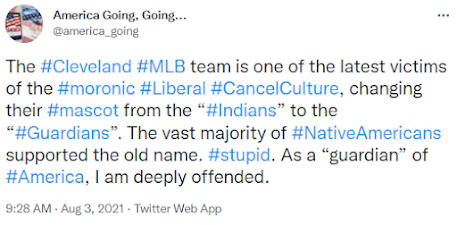
The Cleveland baseball team is now officially known as the Cleveland Guardians.
A team changing its nickname while remaining in the same city is extremely rare. It has been almost 60 years since the Houston Colt .45s became the Astros. Any other nickname changes since then have been only slight revisions to an existing nickname or accompanied by a geographical move.
After 10 years as the Devil Rays, Tampa Bay scaled back its name to the Rays before the 2008 season. The franchise enjoyed an unrelated change of fortune. The Devil Rays had a .399 winning percentage and never made the postseason. In 14 seasons as the Rays, the team is .545, with seven postseason appearances two AL pennants.
The Cincinnati Reds changed their name to Redlegs for five seasons during the McCarthy era (1954-58) to avoid any association with communism. (Was anyone at the time really confused on this issue?) Rick Walls, executive director of the Reds Hall of Fame:
It was at the height of the fear of communism taking over the world. The Reds didn't want the headline with the "Cincinnati Reds". They were fearful. And a lot of people called them the Redlegs going back to the Red Stockings. Redlegs made a lot of sense for them.
Many fans and sportswriters did not stop calling them Reds. The team removed "Reds" from its home uniforms in 1956; the road jerseys that year featured only a logo of the mustachioed mascot Mr. Redlegs. McCarthy died in 1957 and the Reds name was restored in 1959, but it did not appear on the uniform until 1961.
The Philadelphia Phillies were briefly known as the Blue Jays in 1944 and 1945 and Oakland owner Charles Finley changed the team's official name from "Athletics" to "A's" in 1972. It was switched back in 1981.
As mentioned, the Astros were known as the Colt .45s for the first three years of their existence (1962-64). The name was often shortened to "Colts", to avoid possible legal issues with the firearm manufacturer and to inspire thoughts of young horses. This mlb.com article cites NASA's presence in Houston, as well as the Colt Firearms Company wanting a share of the team's merchandising revenue, as reasons for the change. The team has also bounced around a bit:
1962-1968: National League
1969-1993: National League West
1994-2012: National League Central
2013-2021: American League West
Most nickname changes (as opposed to small revisions) in the last 70 years have accompanied a geographical move.
After 1953: St. Louis Browns became Baltimore Orioles.
After 1960: Washington Senators became Minnesota Twins. (But, confusingly, the following season the American League still featured a Washington Senators team. Those Senators were an expansion team and, after 11 seasons, they decamped to Texas and became the Rangers. (The Rangers' nickname is associated with white supremacy and racist, murderous gangs of terrorists and vigilantes.))
After 1969: Seattle Pilots became Milwaukee Brewers.
After 2004: Montreal Expos became Washington Nationals.
And so, the Guardians Era begins . . .
Ominous sign. The Guardians sign at the team shop broke off. pic.twitter.com/9ONnOhYboG
— Tom Withers (@twithersAP) November 19, 2021


November 18, 2021
Shohei Ohtani Is Unanimous Choice As AL MVP
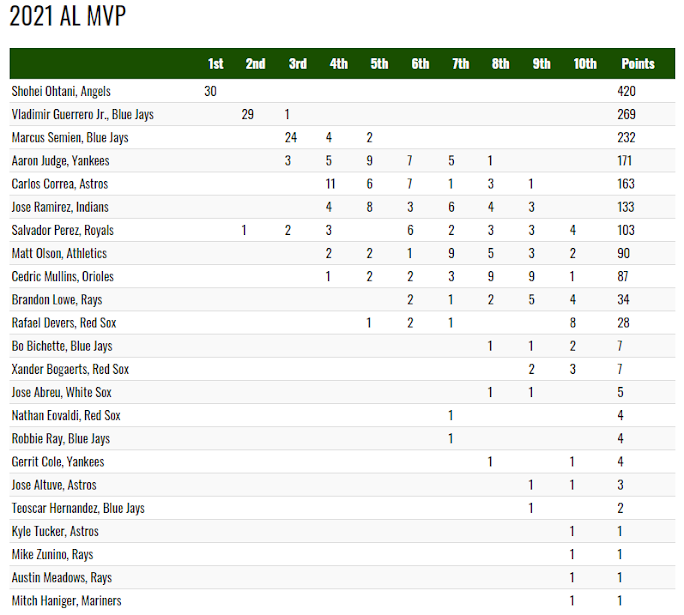
Shohei Ohtani is the unanimous choice for American League Most Valuable Player in 2021.
Ohtani received all 30 first-place votes . . . so hats off to the AL voters: good job not fucking up.
The unanimous vote was well-deserved since Ohtani had a truly unprecedented season at the plate and the mound. The only possible "modern" comparisons are more than 100 years old: Babe Ruth's 1918 and 1919 seasons, but Ruth was a true two-way player for only portions of each of those seasons.
Ohtani batted .257, with a .372 on-base average (5th in the AL) and a .592 percentage (2nd). He hit 46 homers (3rd in AL), 26 doubles, eight triples (1st), scored 103 runs (8th), knocked in 100 runs, and stole 26 bases (5th). He was also 2nd in OPS (.965), 2nd in extra-base hits (80), 2nd in Runs Created (122), 3rd in walks (96), tied for 4th in total bases (318), 7th in times on base (238), and 1st in fewest AB per HR (11.7), 1st in Win Probability Added (5.1), and 1st in intentional walks (20).
Ohtani also made 23 pitching starts, with a 3.18 ERA and 1.090 WHIP. He struck out 156 batters in 130.1 innings (10.8 K/9). His record was 9-2. Ohtani did not pitch enough innings to qualify among the league leaders, but his ERA would have been 3rd-best, his ERA+ 4th-best, WHIP 4th-best, and his 6.8 H/9 2nd-best.
From May 5 to August 18, Ohtani made 15 starts and had a 2.71 ERA. If you toss out one horrible start in that stretch against the Yankees, his ERA in the 14 other starts is 2.00 (actually, 1.996108).
Ohtani led MLB with 9.1 Wins Above Replacement (the same total as Ruth had in 1919), with a large margin between himself and Zack Wheeler's second-best 7.7. Marcus Semien was at 7.3 WAR and Vladimir Guerrero Jr. was at 6.8.
Seemingly every week during the season there was news of Ohtani reaching an unprecedented milestone or two. He became the first player in AL or NL history with at least 45 homers, 25 stolen bases and five triples in a season. No player had ever hit more than 30 homers while making at least 15 starts on the mound. In July, he was the first player elected to the All-Star Game as both a starting pitcher and a position player.
Ohtani also won his first Silver Slugger Award, was named the MLBPA Player of the Year, as well as the Player of the Year by Baseball America, Baseball Digest, and The Sporting News.
Sarah Langs (mlb.com) wrote about "15 of the coolest, craziest Ohtani facts" from 2021. I'm snipping only eight:
• Multiple times in '21, Ohtani entered a pitching start leading MLB in home runs. Before him, nobody had done that since Babe Ruth on June 13, 1921, according to the Elias Sports Bureau.
• It isn't just about pitching prowess and slugging for Ohtani, though: There's speed, too. He became the first player in MLB history (pending inclusion of Negro Leagues stats) to rack up at least 20 homers, steals and pitching appearances in a season. The next-most home runs for anyone with 20 steals and games pitched? That would be eight, by Bob Caruthers in 1887. Again, simply incomparable.
• There are so many historic combinations of stats that demonstrate Ohtani's unique, never-before-done season that we can't possibly list them all. But one other combo worth noting is his 30-plus homers and 30-plus strikeouts on the mound. And again, Ohtani had 46 homers and 156 strikeouts -- nowhere even close to those modest qualifiers. The prior most strikeouts in a 30-homer season was three, by Babe Ruth in 1930 (49 homers). The prior most homers in a 30-strikeout season was 29, by Ruth in '19, when he struck out exactly 30 batters.
• Ohtani finished the season with 46 homers, third most in MLB, and eight triples, which was tied for the most with Bryan Reynolds and David Peralta. He became the first player to finish in the top three in both home runs and triples in a season, including ties, since Jim Rice in 1978.
• On May 12, Ohtani batted leadoff for the first time all season, and he did it the day after a pitching start. He became the first player to start a game on the mound, then bat leadoff in his team's next game since Ray Caldwell on July 25-26, 1916. Caldwell started for the Yankees, then batted leadoff, then played center field the next day, according to Elias.
• On June 29 at Yankee Stadium, Ohtani hit two homers. The next day, he started on the mound, becoming the fifth player to hit at least two homers in a game and then start the team's next game on the mound, joining 1930 Babe Ruth, 1887 John Clarkson, 1886 Bob Caruthers and 1883 Monte Ward, according to the Elias Sports Bureau.
• On Aug. 12, Ohtani started the game in the leadoff spot and got the pitching win. The only other player to do that since at least 1906 was Charlie Jamieson on Aug. 19, 1918.
• Ohtani hit 25 home runs with a 110 mph exit velocity or harder, four more than anyone else. He also hit six that traveled at least 450 feet, tied for third most this season.
Also: Three Red Sox players received MVP votes. Rafael Devers finished 11th, Xander Bogaerts was 13th, and Nathan Eovaldi was 15th. . . . Devers's fifth-place vote came from Peter Abraham of the Globe.
November 15, 2021
Julio Lugo Has Died, One Day Before His 46th Birthday
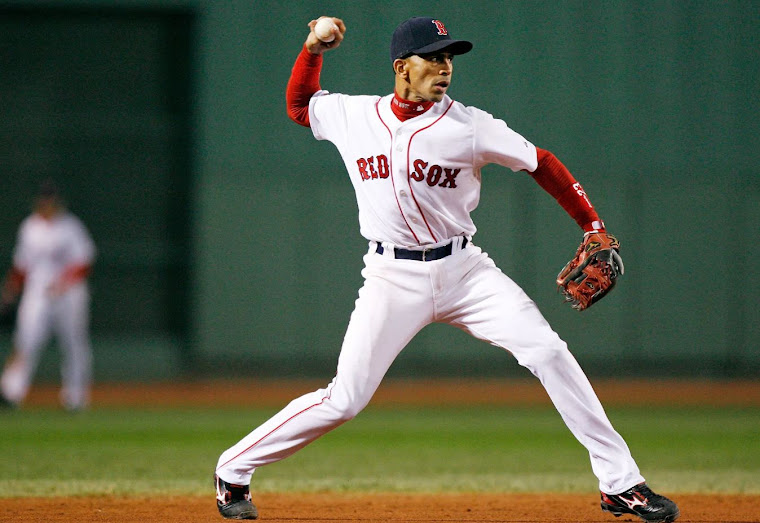
Julio Lugo, a member of the Red Sox's 2007 World Champion team, has died at age 45. (Tomorrow would have been his 46th birthday.)
Lugo's sister, Rina Lugo, told ESPN he suffered an apparent heart attack while leaving a gym in the Dominican Republic. Lugo was taken to a hospital in Santo Domingo, but could not be revived.
Lugo debuted with the Astros in 2000, playing for seven teams over the next 12 seasons. He signed with the Red Sox in December 2006, after four seasons with Tampa Bay. As Boston's shortstop the following season, Lugo's regular season stats were hard on the eyes (.237/.294/.349), though he did steal 33 bases and drive in 73 runs, both the second-highest totals of his career. He was no slouch in the Red Sox's four-game World Series sweep of the Rockies (5-for-13, three walks, no strikeouts, .962 OPS).
JoS gave Lugo the nickname "Secret Weapon" after he was described as such (for unknown reasons) in a May 2009 MLB.com headline.
The Red Sox mourn the loss of former shortstop and 2007 World Series Champion Julio Lugo.
— Red Sox (@RedSox) November 15, 2021
We send our thoughts and love to the Lugo family. pic.twitter.com/CBtKLitXMf
Julio Lugo will always be a champion and forever engraved in our minds from this Mother’s Day miracle.
— Shawn (@PalmerGuyBoston) November 15, 2021
Rest In Peace Julio Lugo. pic.twitter.com/w1z5Z4ETQv
Eduardo Rodriguez Signs Five-Year Deal With Tigers
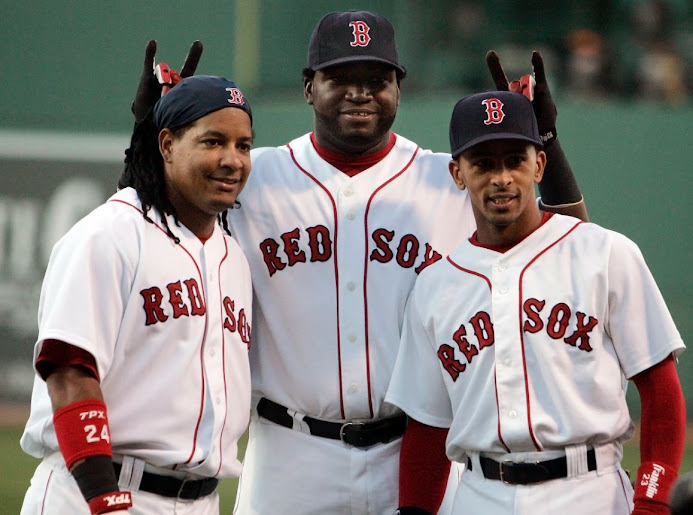
Eduardo Rodriguez has reportedly agreed to a five-year, $77 million contract with the Tigers.
MLB.com reports the deal includes an opt-out after the second season (2023), as well as incentives.
Rodriguez finished the 2021 season with a 4.74 ERA in 31 starts, but he was fourth among AL starters with both a 3.32 FIP (Fielding Independent Pitching) and 10.6 strikeouts per nine innings.
The Red Sox had made an $18.4 million qualifying offer to Rodriguez for 2022 – above the average annual amount of the Tigers deal ($15.4) – so either Boston did not want to give him five years or Rodriguez simply wanted to leave.
Losing a solid starter is never good, but I'm not too upset over this. Rodriguez had his moments (and he was a huge heist from the Orioles, costing only two months of Andrew Miller!), but he never made the expected progression to a dependable ace. His inconsistency and tendency to nibble led to long counts and far too many outings where he was near 100 pitches by the fifth inning. I wish him well in Detroit.
Subscribe to:
Posts (Atom)
