October 12, 2010

Doubles

The 2010 Red Sox hit 358 doubles. Only five teams in baseball history -- and only two non-Red Sox teams -- have hit more doubles in one season.

Boston hit 39 more than the second-place team (Blue Jays, 319) and a whopping 131 more than the lowly Padres (227).
 1   376   2008   Rangers
2 373 1930 Cardinals
373 1997 Red Sox
373 2004 Red Sox
5 371 2003 Red Sox
6 358 1930 Cleveland
358 2010 Red Sox
8 357 1936 Cleveland
357 2003 Blue Jays
357 2006 Rangers
11 355 1921 Cleveland
Adrian Beltre led all MLB hitters with 49, which was also good for the 9th-best season in team history.

The Red Sox record is also the MLB record: 67, by Earl Webb, at age 33, in 1931. Webb hit 20 more doubles than any other player that year. It's one of the least-known "unbreakable" records; no one has hit as many as 60 doubles in 74 years. (Here is the SABR bio for the Earl of Doublin'.)

My Work Has Nothing To Do With Computers

I recently purchased a computer, and am still learning how to use the canned programs that come with it. The main thing that you are struck with in the process of learning about a computer is how totally, incredibly stupid it is. ... You give it a series of a hundred or a thousand sensible commands, and it executes each of them in turn, and then you press a wrong key and accidentally give it a command which goes counter to everything that you have been trying to do, and it will execute that command in a millisecond, just as if you had accidentally hit the wrong button on your vacuum cleaner at the end of your cleaning, and it had instantly and to your great surprise sprayed the dirt that you had collected back into the room. And you feel like, "Jeez, machine, you ought to know I didn't mean that. What do you think I've been doing here for the last hour?" And then you realize that that machine has not the foggiest notion of what you are trying to do, any more than your vacuum cleaner does.

The machine, you see, is nothing; it is utterly, truly, totally nothing. And all of the fascination and the speculation about the computer, about "what it is going to do" and "how it will change things" in baseball and in other areas is completely misguided, because it is not going to do anything and it is not going to do change anything.

We are going to do things with the computer. You and I are going to change the world, and we're going to change baseball, and we're going to use the computer to do it. Machines have no capabilities on their own. Your car cannot drive to Cleveland. What machines do is extend our capabilities. ...

We are going to change our lives, using the computer, far more than we have changed our lives using the automobile, far more than we have changed our lives using the television machine. I have no doubt that this is true, because the computer extends our capabilities, for good or evil, in far more sweeping and comprehensive ways than the automobile, which in truth expands only our ability to move around, or the television, which expands only our ability to observe. I am not afraid on balance. ...

There is, you see, no such thing as "computer knowledge" or "computer information" or "computer data". Within a few years, everyone will understand that. The essential characteristics of information are that it is true or it is false, it is significant or it is trivial, it is relevant or it is irrelevant. In the early days of the automobile, people would say that they were going to take an "automobile trip". That lasted about ten years; after that, people went back to taking trips as they had before. ... After the novelty wore off people still traveled in automobiles, but they ceased to identify the trip with the machine and returned to identifying it with its purpose. ...

Computer people are not going to be running baseball in a few years ... The rise of the computer age is not going to put computer specialists into positions of power any more than the rise of the auto age put auto mechanics and bus drivers into positions of power. Don't worry about it.

I am engaged in a search for understanding. That is my profession. It has nothing to do with computers. Computers are going to have an impact on my life that is similar to the impact that the coming of the automobile age must have had on the professional traveler or adventurer. The car made it easier to get from place to place; the computer will make it easier to deal with information. But knowing how to drive an automobile does not make you an adventurer, and knowing how to run a computer does not make you an analytical student of the game.
The Bill James Baseball Abstract: 1984 (pp. 165-66)

October 11, 2010

Dice Throws Strikes. It Is A Fact.

A reader named Amanda emailed:
Peter Abraham said today: "Watching Dice-K pitch is painful. He's not willing to throw strikes."

I thought I read somewhere on your site where dicek actually wasn't as bad as other pitchers on the sox staff (strikes/balls).
I did post about that, back on August 10. Among the facts I passed along were, as of that point in the season, Matsuzaka has thrown a higher percentage of his pitches for strikes than every other Red Sox starting pitcher except Tim Wakefield. Matsuzaka also got ahead of batters 0-2 more often than any other Boston starter.

Looking through the comments to that post, I see that I sent the URL to Abraham (thinking he might want to cite it in a pre-game blog post) and he and I emailed back and forth a little bit. So Abraham is (or was, in August) aware of the facts -- yet he still insists that Matsuzaka is "not willing to throw strikes".

Here are the complete 2010 totals:

Percentage Of Pitches Thrown For Strikes:
             PIT    STR      %
Wakefield 2150 1441 67.023
Lackey 3584 2264 63.170
Matsuzaka 2611 1645 63.003
Beckett 2166 1343 62.004
Buchholz 2798 1731 61.866
Lester 3356 2067 61.591
Percentage Of 0-2 Counts
             PA   0-2      %
Wakefield 610 164 26.885
Matsuzaka 664 169 25.452
Buchholz 711 168 23.629
Lester 861 195 22.648
Beckett 577 115 19.931
Lackey 930 205 19.631
Don't you hate it when Matsuzaka goes to a 3-0 count on opposing batters? Well, in 2010, Lester did it more often.
             PA   3-0     %
Lester 861 42 4.878
Matsuzaka 664 31 4.669
(Note: While Lester issued 13 four-pitch walks and Matsuzaka handed out 12, Lester also faced almost 200 more batters. So, thumbs down to Dice for that.)

Lester led the staff with 30 three-pitch strikeouts, but Dice was a close second with 27. Wakefield had 23, Beckett had 18, and Lackey and Buchholz each had 13.

Clay Buchholz led the starters with the most pitches per batter:
             PA   PIT   P/PA%
Buchholz 711 2798 3.935
Matsuzaka 664 2611 3.932
Lester 861 3356 3.898
I have no problem with Abraham writing "Watching Dice-K pitch is painful". That is his opinion, and on some nights, I wholeheartedly agree. However, when Abraham states "He's not willing to throw strikes", he does not have the facts on his side.

Buchholz's Record-Setting Season

Clay Buchholz had a magnificent season. His 2.33 ERA was 2nd in the AL and 3rd in MLB.

He benefited from some good luck, more than his rotation mate Jon Lester did, which I'll mention below, but the fact is his ERA was 2.33.Buchholz is the 31st Red Sox starter to finish a season with an ERA as low as 2.33. As you might expect, 24 of those 31 seasons occurred from 1901-1919, aka Ye Olde Deadball Era. Since 1920, Buchholz is only the fourth Boston starter to have such a low ERA:
1944 - Tex Hughson      2.26
1990 - Roger Clemens    1.93
1999 - Pedro Martinez   2.07
2000 - Pedro Martinez   1.74
2002 - Pedro Martinez   2.26
2003 - Pedro Martinez   2.22
2010 - Clay Buchholz    2.33
Buchholz's 187 ERA+ was the best in MLB. (ERA+ takes into account the parks a pitcher pitches in and the context of his league; 100 is average.) Josh Johnson of the Marlins led the National League at 182 and Seattle's Felix Hernandez was third at 174.

Buchholz is the youngest starter in Red Sox history to have an ERA+ over 185 (min. 115 innings and 75% of games as a starter):
                         Age   ERA+
1901 - Cy Young           34   217
1908 - Cy Young           41   195
1936 - Lefty Grove        36   189
1939 - Lefty Grove        39   185
1990 - Roger Clemens      27   213
1999 - Pedro Martinez     27   243
2000 - Pedro Martinez     28   295
2001 - Pedro Martinez     29   190
2002 - Pedro Martinez     30   202
2003 - Pedro Martinez     31   211
2010 - Clay Buchholz      25   187
(Age is as of June 30 of any season.)

In 1912, Smoky Joe Wood was 22 years old and went 34-5, 1.91. However, since this was the Deadball Era, his ERA+ was "only" 179, second in the AL to Walter Johnson's 1.39 ERA / 243 ERA+.

Fangraphs recently referred to Buchholz as a prime example of someone who put up a "shiny ERA without necessarily having the underlying performance to match".

Buchholz did have a fair amount of good luck. He and Lester had identical WHIPs (walks and hits allowed per inning), but Lester's ERA was nearly a full run higher (3.25). Why?

The more I look at their stats, I see that Buchholz and Lester were nearly identical.
         H/9 BB/9  K/9 HR/9  AVG  OBP  SLG BABIP WPA  WAR
Buchholz 7.4  3.5  6.2  0.5 .226 .303 .312 .263  3.6  5.4
Lester   7.2  3.6  9.7  0.6 .220 .303 .325 .291  3.5  5.0
They were both among the top six pitchers in the AL in fewest hits and HR allowed per nine innings. Lester had a clear advantage in strikeouts; his 9.7/9 led the AL, actually.

The key difference is their batting average on balls in play, especially since (because of the difference in strikeouts) 71% of the batters Buchholz faced put the ball in play compared to only 61% for Lester.

The AL average BABIP in 2010 was .294 -- and Boston pitchers came in at .295. Buchholz's BABIP was the third lowest in the AL; Lester was 24th. However, pitchers generally have little control over their BABIP*, so someone with a very low or very high BABIP can be expected to regress to the mean the following season. (Which might bode well in 2011 for John ".320 BABIP" Lackey. ... Maybe.)

* In 1999, Pedro had one of the greatest pitching seasons of all time -- yet he had a .325 BABIP! In 2000, he was even better -- and his BABIP went way down to .237. In 2001, it was back up to .310.

Also, Buchholz's stats with men on base and RATS were much better than Lester's.

Bases Empty
           AVG   OBP   SLG  BABIP
Buchholz  .243  .315  .350   .288
Lester    .206  .294  .286   .298
Men On Base
           AVG   OBP   SLG  BABIP
Buchholz  .202  .287  .256   .230
Lester    .240  .316  .379   .284
RATS (Runners At Third and/or Second)
           AVG   OBP   SLG  BABIP
Buchholz  .161  .273  .212   .188
Lester    .225  .314  .382   .258
Fielding Independent Pitching removes fielding and the vagaries of BABIP from consideration and measures the things for which a pitcher is specifically responsible. While not perfect, it is considered to be a better measure than ERA of how well a pitcher actually did -- presenting his performance as a context-neutral ERAesque number.

Buchholz's FIP in 2010 was 3.62, while Lester's was 3.14 (6th best in the AL). Again, I assume the difference is Lester's higher strikeout rate, since allowing fewer balls in play will mean fewer chances for hits to fall in.

All of this is not meant to denigrate Buchholz's 2010 performance. On my BBA ballot, which I will be posting about later as the full results are announced, I had him 2nd for the Walter Johnson Award (the BBA's version of the Cy Young Award). But if Buchholz's 2011 ERA shoots up to 3.50, he may still be pitching nearly as effectively as he did this year.

October 10, 2010

Twins: Lost Leads Against Yankees

The Yankees' sweep of the Twins in the ALDS extended Minnesota's post-season losing streak to 12 games. Since Game 1 of the 2003 ALDS, the Twins' playoff record is a dismal 1-15.

Much has been made of the many times the Twins have lost a lead to New York. before last night's game, Minnesota had been ahead in seven of their last eight playoff games against the Yankees -- and eventually lost each of the seven games.

But what is a "lead"? There is a huge difference in losing a 1-0 lead in the first inning or blowing a 7-2 advantage in the bottom of the ninth. So I went back to look.
2004 ALDS
Game 2 - Led 3-1 in 2nd inning, lost lead
Led 6-5 in 12th inning, lost 6-7 (12)
Game 3 - Never led, lost 4-8
Game 4 - Led 5-2 after 7 innings, lost 5-6 (11)

2009 ALDS
Game 1 - Led 2-0 in 3rd inning, lost 2-7
Game 2 - Led 1-0 in 6th inning, lost lead
Led 3-1 in 9th inning, lost 3-4 (11)
Game 3 - Led 1-0 after 6 innings, lost 1-4

2010 ALDS
Game 1 - Led 3-0 after 5 innings, lost 4-6
Game 2 - Led 1-0 after 3 innings, lost 2-5
Game 3 - Never led, lost 1-6
Some of those are pretty bad (both games in 2004 and Game 2 in 2009), but nearly all of the others -- from only looking at the linescores -- do not stand out in any way other than the fact they they are/were cumulative. (The Twins were also swept in the 2006 ALDS against Oakland. They never led in the series, losing 2-3, 2-5, and 3-8.)

Tom Powers of the Pioneer Press has no idea how the Twins' front office will correct the team's flaws.
Where do you find confidence and guts? Where do you find clutch ability? Where do you find playoff fire?
Where, indeed.

October 9, 2010

Red Sox Send Four To Pawtucket

The Red Sox have sent four players to Pawtucket, removing them from the 40-man roster: LHP Rich Hill, RHP Robert Manuel, and catchers Dusty Brown and Kevin Cash.

They will become free agents five days after the end of the World Series.

Bloomberg Planning NYY Victory Parade

New York City Mayor Mike Bloomberg said on Friday morning that he has begun planning the Yankees' victory parade.
I'm sort of trying to figure out where the parade should start.
Joe Girardi says that "there's a lot of planning that goes into something like that ... they just can't do it overnight", which is certainly true. Doesn't mean you have to talk about it publicly. The Post notes that "those who lived through the Yankees' 2004 ALCS collapse against the Red Sox aren't icing the champagne and beer".The Yankees lead the Twins 2-0 and can move onto the ALCS with a win tonight, but as George King reports, the specter of 2004 looms over the franchise.
They are nine innings away from advancing via a sweep, yet 2004 is alive, if not well, in the Yankees universe.

"We had the Red Sox's number for a hundred years and they found a way," general manager Brian Cashman said of the 2004 ALCS, in which Boston erased a 3-0 deficit to get to the World Series and leave a fleshy scar on the Yankees' skin that still is visible today.
(The Red Sox erased a 3-0 advantage. If you want to refer to a deficit, then it's 0-3 -- because deficits are negative. ... Like when people say so-and-so has had a "meteoric rise" to fame. Meteors don't rise. They fall.)

Yankee Stadium garages have increased parking prices 74% for the ALDS -- from $23 to $40. ... Money Fact: Cap'n Intangibles and Slappy McBluelips are making more than the entire Rangers roster.

This MLB.com article is headlined: "When Playoffs Come, Jeter Flips The Switch". Except that he really doesn't. He's good, but his batting average and on-base percentage are actually a little bit lower in the playoffs -- and that difference was more obvious before he had the worst batting season of his career. For example, Mr. November had a .179 OBP against the Diamondbacks in 2001.

October 8, 2010

Umps Wasting No Time In Blowing Calls

Three days into the post-season and the list of bad calls by various umpires is growing -- and threatening to overshadow some amazing pitching performances (Roy Halladay's no-hitter against the Reds and Tim Lincecum's 2-hit, 14 K complete game against Atlanta).

Rangers/Rays, Game 2: Texas's Michael Young goes around on a pitch for strike three with one out in the fifth, but 1B umpire Jerry Meals says Young checked his swing. Young hits the next pitch for a three-run dong, boosting the Rangers' lead to 5-0. They win 6-0.Afterwards, Young says he would not have argued if Meals had rung him up, which sounds like an admission that he had whiffed.

Yankees/Twins, Game 1: New York RF Greg Golson catches Delmon Young's sinking line drive for what should have been the final out of a 6-4 win for the Yankees. RF umpire Chris Guccione has the play directly in front of him and he rules Golson trapped the ball. And so Jim Thome bats as the potential tying run in a game that should have been over. Thome pops up, saving the umpires further embarrassment.

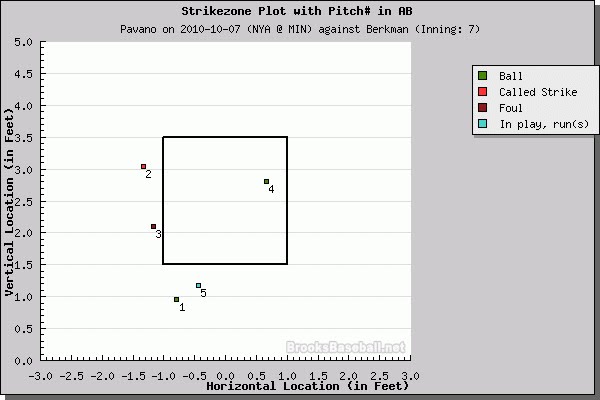
Yankees/Twins, Game 2: Carl Pavano struck out Lance Berkman in the seventh inning, but plate umpire Hunter Wendelstedt called it a ball (pitch 4 below).Berkman hit a double to deep left-center on the next pitch to break a tie and give New York a 3-2 lead. Berkman later scored -- and the Yankees won 5-2.

Wendlestedt also ejected Twins manager Ron Gardenhire shortly after the Berkman at-bat. I am going to assume this Gardy rant from 2009 was in the back of Wendlestedt's mind yesterday.

Atlanta/Giants, Game 1: San Francisco's Buster Posey is thrown out trying to steal second base, but umpire Paul Emmel -- positioned so he can't see either the tag or Posey's foot at the bag (off to the right-hand side of this picture) -- called him safe. Posey scored the only run of the game as the Giants won 1-0.A less than obvious blown call happened in game 1 of the Rangers/Rays series. After Tampa Bay loaded the bases in the first inning, Carlos Pena appeared to have been hit by a pitch. Plate umpire Tim Welke said the ball hit Pena's bat and called a foul ball. Pena eventually struck out, as did Rocco Baldelli, and the Rays did not score. They lost the game 6-1. (Some replays indicated the pitch may have not hit anything.)

I have no idea what has to happen to make MLB adopt the technology that it already uses to make sure that calls are made correctly and umpires are held accountable. Yahoo!'s Jeff Passan wrote about the wonders of pitchf/x, which provides data on every pitch thrown in the major leagues:
Pitchf/x is the enemy of umpires because it holds them accountable and highlights their mistakes. And Thursday night, Hunter Wendelstedt made an unconscionable number of errors for a playoff umpire. ...

The Berkman pitch was one of 31 wrong calls by Wendelstedt. Thirteen other times he called a ball on a pitch inside the strike zone, one of them on a cutter to Derek Jeter that literally was in the center of the strike zone, at the belt, halving the plate. And 17 times -– most of them actually benefitting Pavano -– Wendelstedt called a strike on a pitch outside the zone.
Red are called strikes, green are balls. Luuuuuv that Jeter pitch!

October 6, 2010

Head Rubs

A sizeable collection of Adrian Beltre head-rubbing videos.

Example
Also: Post-season game threads will be at the AltSite, thanks to Ish, Zen, and Tim.

Halladay No-Hits Reds in NLDS1

Philadelphia's Roy Halladay pitched only the second no-hitter in post-season history, beating the Cincinnati Reds 4-0 in NLDS 1.
CIN - 000 000 000 - 0  0  1
PHI - 130 000 00x - 4 5 0
Halladay (9-0-0-1-8, 104) became the fifth pitcher in baseball history to throw two no-hitters in one season -- and the first to have one in the regular season and one in the playoffs. The only baserunner was a two-out walk to Jay Bruce in the fifth inning.

Don Larsen's perfect game for the Yankees against the Dodgers in Game 5 of the 1956 World Series was the only post-season no-hitter until today.

Earlier this afternoon, Cliff Lee (7-5-1-0-10, 104) shut down the Rays and the Rangers won 5-1. ... The Yankees beat the Twins 6-4.

And it took only until the bottom of the first inning of the first game of the post-season for the first questionable (or wrong) call from an umpire.

October 5, 2010

Review: Four Days In October

Kristen Cornette (aka RedSoxDiehard) was at a special screening of Four Days In October at Fenway Park on Sunday. The one-hour film details the Red Sox's unprecedented comeback in the 2004 ALCS (October 17-20, 2004) and airs tonight on ESPN. (Get the various air dates/times and see three trailers here.) Her review:
Watching "Four Days in October" is like finding the special edition version of your favorite movie. You've watched it countless times, memorized the lines to the point where you can recite them along with the movie, and talk about the characters as if they're not only real but are your close personal friends. And now here it is on DVD, still containing everything you know and love about the movie, but with brand new deleted scenes to discover and commentary from the actors to fill in the back story.

That's how I felt as I watched the latest installment in ESPN's "30 for 30" series. Every winter for the past five years I've rewatched the final four games of the 2004 ALCS. There's not much trivia about those games that you can get past me; the scores, the pitchers, and the play-by-play are all easily recalled. But this day-by-day account of the Red Sox' historic comeback brought a new perspective to the story I know so well, by weaving together just enough game footage to tell the full story, clubhouse antics filmed by the players themselves, and interviews with the games' participants that made me fall in love with them all over again.

We see David Ortiz dance in the clubhouse after Game 5, shouting, "I'm the (bleeping) curse!" We see Terry Francona shoo Mike Timlin and his camcorder out of his office, telling him, "You're going to be in the bullpen tonight, seventh inning." ("Aw," replies Timlin, "I thought I'd be starting Game 7.") We hear Curt Schilling take over the intercom on the team plane and announce, "Why not us?" And we see Kevin Millar tell Dan Shaughnessy that anything can happen in a seventh game, adding, "We could even have you out there in Game 7."

The only parts of the film that seem out of place are the scenes with Bill Simmons and Lenny Clarke. Clarke is over-the-top as usual, but I find him to be tolerable in small doses, and this movie doesn't cross that threshold. Their scenes are set in a bar, and the pair reminisce with the same "Hey, remember that play?" feel as I would have discussing the game with my co-workers. Still, the player interviews are so humorous and insightful in their own right that they could have easily replaced the Simmons and Clarke spots.

"Four Days in October" is more than just the story of the greatest comeback in the history of sports. For Red Sox fans, it's an entertaining and funny trip down memory lane, and it premieres at the end of a disappointing 2010 campaign when we could really use an emotional boost. It will certainly become part of my annual off-season viewing routine.
Times:
October   5  ESPN           8 PM
ESPN2 11 PM
October 7 ESPN Classic 11 PM
October 11 ESPN2 7 PM
November 7 ESPN Classic 9 PM
November 18 ESPN Classic 11 PM

October 4, 2010

Greener Fields

Many fans quote from A. Bartlett Giamatti's The Green Fields Of The Mind as the days get shorter and most teams are headed home, but I've found in recent years that his essay has lost a lot of its power. This may be sacrilegious.

It is still a stupendous piece of work -- and no collection of writing about the sport can seriously call itself a "best of" without it. Baseball remains designed to break your heart and I'm still not that grown-up or up-to-date.

Despite the timelessness of Giamatti's thoughts, what we need from baseball and what it deigns to offer us -- strictly on its own unknowable schedule* and without one speck of concern for our emotional well-being -- the essay feels rooted in a pre-2004 Red Sox mentality. It's too damn fatalistic, right down to the mention of Dame Mutability, her guiding hand translating hope into memory, and the "rough justice" of losing out to the Yankees.

* Actually, I don't think baseball has a schedule at all. Things just happen.

But how could it not be? First of all, the game he describes in such detail was played on October 1, 1977. And second, Giamatti is writing as much about mortality as he is about baseball (maybe more). We will not always have "the memory of sunshine and high skies". We cannot resist the corrosion. There will be a final at-bat -- and we will be struck out.A wise man once said, "It used to be like that, and now it goes like this." And so it has, for me.

Nearly six years ago, an 11-day stretch of baseball changed me (and you) forever. I did not realize it for many months, but my brain had been re-wired -- jolted into a new, improved state of being -- and while I can remember those old feelings, I can no longer feel them.

So I'll share this, from an excellent interview with Roger Angell:
Baseball is meant to be watched all the way through. Sure, it's boring. There are boring innings and sometimes there turn out to be bad games, but you're not going to have a feeling for the good games unless you're willing to watch. ...

[E]ach have formal chapters. There are wonderful beginnings that don't stand up and boring beginnings that are great in the end. You just don't know. They're both, baseball and reading, for people who aren't afraid of being bored.

October 3, 2010

W-L Contest, Playoffs, Upcoming Stuff

Lord Lynch's W-L prediction was the worst of the 32 entries, but he came out on top.

Looking at the not-needed tie-breakers, LL may have underestimated the team's runs scored by 98, but he was only two runs short of the run differential of +74.
Example
Wednesday, October 6
ALDS:  Rangers at Rays (1:30)
Yankees at Twins (8:30)

NLDS: Reds at Phillies (5:00)
Thursday, October 7
NLDS:  Atlanta at Giants (9:30)
Example
I hope to post a couple of book reviews soon, including The Red Sox and Philosophy: Green Monster Meditations, which is part of Open Court's "Popular Culture and Philosophy" series.

A few days ago, I mentioned the idea of having a "live" game thread of the 2004 ALCS comeback during the winter and a few people liked the idea. If you have the DVDs, would you be interested in such a thing? And if you do not have the DVDs, why not?

Four Days In October - New Trailer

The Red Sox hosted a preview of "Four Days In October", the ESPN special about the last four games of the 2004 ALCS, this evening. (RedSoxDiehard is attending the screening and will share her report tomorrow.)

To keep you teary-eyed until the show airs on Tuesday night, that ESPN link has a second trailer!

This one is the Kevin Millar Show -- with Cabin telling the CHB, as the Red Sox are warming up before Game 4, exactly how it's gonna go down!
CHB: It's embarrassing, man.

KM: What's embarrassing?

CHB: You guys are better than this.

KM: Well, I mean, you know, it happens. It's baseball.

***

KM: We wanted to go to the championship series and lose. That was our job. If we can get swept ...

CHB: Come on.

KM: But let me tell you, don't let us win today ...
CHB: Okay. That's a start.

KM: Then we got Pedey tomorrow. Then we got Schill in Game 6 ... In Game 7, anything can happen. We could have you out there. I'll put you at second base. You know, in Game 7, anything can happen. Dan Shaughnessy, hitting 9th. Then you can take that fraud comment back*, and then we'll be in the World Series. This is it! (starts pounding his glove in time with his words) Don't. Let. The. Sox. Win. This. Game!
[* CHB's column before Game 3 began: "They have one more game to make their case. Are the 2004 Red Sox a happy-go-lucky (then suddenly unlucky) pack of frauds who failed to show up for the biggest series of their lives? Or are they full of the stuff that makes a team special and historic?"]

Also from that column: "If the Sox lose to the Yankees again tonight, they effectively are done for the season. ... Game 3 will dictate how this Red Sox team will be remembered."]

G162: Red Sox 8, Yankees 4

Yankees - 011 000 011 - 4  8  1
Red Sox - 200 023 10x - 8 8 2
Jed Lowrie hit two home runs, scored three runs, and drove in three runs as the Red Sox closed out the 2010 season with a win over the second-place Yankees.

Boston finished the injury-riddled season with a 89-73 record -- only the second time in the past nine years they have failed to win as many as 93 games. They scored 818 runs, their lowest total since 2001, and 54 fewer than last year. The 744 runs allowed was eight more than last season.

David Ortiz went 3-for-3, including a bunt single. J.D. Drew hit a two-run dong in the first.

The Red Sox stole four bases in the sixth inning on two double steals. With Daniel Nava batting, Ryan Kalish stole second and Bill Hall stole third. Then, with Eric Patterson at the plate, Nava stole second and when Dumbo's threw down, Kalish stole home.

Lackey (7.2-6-3-2-10, 118) pitched quite well (best stuff of the year?). Daniel Bard came into the eighth inning with the bases loaded (and the potential tying run on deck) and got Posada on a groundout. Jonathan Papelbon needed 29 pitches to nail it down in the ninth.
Example
Dustin Moseley / John Lackey
Patterson, 2B
Lowrie, SS
Drew, RF
Ortiz, DH
Hall, 3B
Kalish, CF
Varitek, C
Nava, LF
Anderson, 1B
A win would give Boston a 9-9 tie in the season series -- for the third straight year! Also, if the Red Sox win, Lord Lynch wins the W-L contest.

Tampa Bay and New York are both 95-66. If they are tied after today, the Rays, because of their 10-8 edge against the Yankees during the season, win the East. The Rays/Royals play at 2 PM.

John Lackey Hates Making Excuses

You could count on two things after John Lackey turned in a crappy start in 2010. He would insist that (a) he did not pitch as bad as we all had just watched him pitch and (b) he had perhaps his best stuff of the season.

Lackey's first season in a Red Sox uniform was not quite as glorious as expected. His Hits/9, WHIP, opponents' batting average and on-base percentage are all the worst of his nine-year career. He has the lowest K/9 since his rookie season of 2002 and depending on how he does today, he may set a career high in walks. He is 8th in MLB in most earned runs allowed. He turns 32 on October 23 and his 5/82.5 contract runs through 2014.

Lackey's history of minimizing his own suckitude and blaming others for his poor performance is well known. You may remember his whiny comments after he and his Angels lost the 2008 ALDS to Boston:
We are way better than they are. We lost to a team not as good as us. ... The last two days, we shouldn't have given up anything. ... [On Sunday] they scored on a pop fly they called a hit, which is a joke. [On Monday], they score on a broken-bat ground ball and a fly ball anywhere else in America [except in Fenway Park]. And [Pedroia's] fist-pumping on second like he did something great.
Lackey won't win the 2010 Cy Young Award, but he is a shoo-in for this year's CYA -- the Cover Your Ass award.

End of April: Lackey has a 5.09 ERA after four starts. He has three quality starts and an ugly outing against the Rays on April 19, in which he allowed eight runs on nine hits before leaving in the fourth inning.
Everything has been fine outside of that game. I've been pretty happy with how I've pitched.
May 16 at Detroit: Lackey walks four Tigers in the first two innings, and allows nine hits in seven innings. The Red Sox lose 5-1.
I threw the ball a lot better than the [stat] line will show. I mean, you have that infield single to get their first run. ... If a couple of things went a little different, it could have been a different outcome.
May 21 at Philadelphia: The Red Sox lose 5-1 to the Phillies, as Lackey allows six hits and four runs. In his last three starts, he has allowed 17 hits, 12 walks, and 15 runs.
I gave up the one homer that probably doesn't go out anywhere but here ... [A] break here or there and it could have been a lot different. ... It's been a little tough luck here and there and lack of execution a little bit, too.
Is Lackey concerned about walking so many batters?
Not at all. ... I think only one of them scored. That's all that matters.
May 26 at Tampa Bay: Red Sox rout the Rays 11-3. Lackey allows eight hits and four walks in 6.1 innings, but gives up only two runs.
Honestly, that's probably the best I've thrown the ball.
June 1 vs Oakland: The Red Sox win 9-4 and Lackey gets the win. He is tagged for 12 hits in six innings, but allows only four runs.
Honestly, it's a little frustrating, 'cause I thought I did better than what some of the numbers are going to show. We won the game, so who really cares? ... I pitch to contact and I haven't had the greatest luck with some of that. I've had a lot of balls on the ground that have gotten through, a few balls kind of fell in tonight ...
Lackey is averaging 4.4 walks per nine innings, the highest rate of his career, and nearly double his 2009 rate. He's also averaging two fewer strikeouts per nine innings (5.1) than he did last season.
[I]t's no big deal. I've looked at some of those walks and they weren't really walks. I've gone back and looked. My control is not as bad as it seems.
Lou Merloni, WEEI, June 7:
Lackey can be very emotional on the mound whether it's reacting to a call he didn't like or showing displeasure when one of his teammates make an error behind him. ... I talked to Lack about that and he swears that he's not trying to show anybody up, but let's just say this, it doesn't look good. Showing up Darnell McDonald is one thing, but when you slam your glove to the ground after a Dustin Pedroia error ... not good.
June 23 at Colorado: Lackey allows 10 hits and five runs in 6.2 innings. The Rockies beat the Red Sox 8-6.
I honestly felt probably about as good as I have all year. ... I feel like they hit some pretty good pitches tonight.
July 4 vs Baltimore: Lackey pitches 7.1 innings against the Orioles, allowing eight hits and three runs, and the Red Sox lose 6-1. Terry Francona: "I thought today was the best stuff he's had all year.
Yeah, he was probably right. ... We are right there in the race, and I think I've been part of that. Out of my 17 starts, my four losses are about the only ones I didn't give us a chance to win in.
July 10 at Toronto: The Red Sox lose 9-5 as Lackey allows three runs to the Blue Jays in the first inning and finishes with six walks.
It would have been [a decent performance] if they hadn't had that lucky hit down the line, let's be honest. That's kind of the way things have been going for me.
July 17 vs Texas: Lackey does well (7-7-2-2-3, 115) and the Red Sox win 3-2.
About as good as I've been this year, for sure. Even the hits I gave up for the runs, I threw them right where I wanted to. ... They were strong enough to kind of get them over the infield.
August 2 vs Cleveland: Lackey allows nine hits, five walks and six runs as the Red Sox lose 6-5.
First three innings, probably some of the best stuff I've had all year. ... Fifth inning, I got a little unlucky, giving up a run there.
August 7 at New York: Lackey allows eight hits and five runs in six innings and the Red Sox lose to the Yankees 5-2. Lackey gives up four consecutive singles in the fifth that results in two runs and breaks a 2-2 tie.
In the fifth inning I made a lot of good pitches and, honestly, they kind of nickel-and-dimed me to death there. ... I definitely feel like I threw the ball better than the numbers would indicate. I had good stuff.
Does Lackey feel like he's been the victim of bad luck and unfortunate bounces all season?
Maybe a little, but I don't know what I can do. ... It is what it is.
August 18 vs Los Angeles: The Red Sox win 7-5, but Alberto Callaspo hits a three-run home run off Lackey down the right field line.
I don't think that's a homer in a whole lot of places. It is what it is. It's probably the only place that's a homer.
August 23 vs Seattle: Lackey is no match for the Mariners (8-6-3-2-2-10) and the Red Sox win 6-3.
It's been a strange year. ... It seems like there's been one or two times where I've given up some runs that haven't happened in the past. For the most part, I've given us a chance to win quite a bit. ... The first six innings are probably the best I've felt location-wise.
August 29 at Tampa Bay: Lackey allows five runs in 6.1 innings and the Red Sox lose 5-3. Boston is now 14-13 in Lackey's starts and he has allowed an AL-high 201 hits in 176 innings.
I felt way too good to give up five runs, for sure. I gave up probably three hard-hit balls all night. ... [I] probably threw the ball as good as I've thrown the ball in years. ... I definitely feel like I've thrown the ball better than what the numbers are this year. But at this point, I can't do too much about it.
Mike DiGiovanna, Los Angeles Times, July 26, 2008:
John Lackey hates making excuses...

October 2, 2010

G161: Red Sox 7, Yankees 6 (10)

Yankees - 121 000 200 0 - 6  7  4
Red Sox - 101 101 020 1 - 7 11 2
Bill Hall doubled to dead center to start the 10th inning and he scored on Eric Patterson's single to center.

Boston had tied the game with two runs in the eighth, the second coming on an 11-pitch bases-loaded walk by Kevin Cash.

Matsuzaka (5-3-4-5-6, 104) allowed the leadoff runner to reach base in all five of his innings.
Example
Since the first game went 4:18, the second game will not start at 9, as scheduled.

Globe, 8:53 PM: Start time will be 9:15. Between games, Terry Francona said that Mike Lowell will not play in the final two games of the season.
Example
A.J. Burnett / Daisuke Matsuzaka
Patterson, 2B
Lopez, 3B
Drew, DH
Anderson, 1B
Kalish, CF
Nava, LF
Reddick, RF
Navarro, SS
Cash, C
(I did not make that up.)

G160: Yankees 6, Red Sox 5 (10)

Yankees - 003 020 000 1 - 6 11  0
Red Sox - 201 000 110 0 - 5 11 2
A check swing grounder by Derek Jeter in the 10th inning got past Jonathan Papelbon's glove and Bill Hall's bare-handed grab attempt, and Brett Gardner scored from second base.

The Red Sox -- Felipe Lopez, Ryan Kalish, Eric Patterson -- went quietly in the bottom of the 10th against Mariano Rivera. J.D. Drew, a better hitter than any of the three guys who actually batted in the inning, watched the end of the game from the on-deck circle; he was going to pinch-hit for Kevin Cash.

Dumbo Posada tried very hard to give the game to Boston -- the runs in the seventh and eighth both scored on wild pitches that the Yankee catcher botched. A third run nearly scored on Posada's throwing error after the eighth-inning wild pitch, but Josh Reddick was thrown out trying to score from second by Ramiro Pena, with Kerry Wood making the tag.

Mike Lowell hit a two-run double to right-center in the first, walked and scored in the third, and singled high off the Wall in the fifth.
Example
Andy Pettitte / Tim Wakefield
McDonald, CF
Lowrie, SS
Martinez, C
Ortiz, DH
Lowell, 1B
Hall, RF
Nava, LF
Navarro, 3B
Lopez, 2B
First game of a Saturday doubleheader. Fox gets its broadcast at 4 -- and the nightcap will start about 9 PM.

Marco Scutaro will not play in the remaining games.

Also today: Rays (0.5 GB)/Royals.
Example
October 2:

1953 - Carl Erskine (9-6-2-3-14) of the Dodgers sets a World Series record with 14 strikeouts in Game 3 against the Yankees at Ebbets Field.

1963 - Sandy Koufax (9-6-2-3-15) of the Dodgers breaks Erskine's record by striking out 15 batters in Game 1 at Yankee Stadium.

1968 - Bob Gibson (9-5-0-1-17) of the Cardinals breaks Koufax's record by striking out 17 Tigers in Game 1 at Busch Stadium. That remains the record.

Before 1953, the record had been 13, set by Howard Ehmke of the A's in Game 1 in 1929 -- though not on October 2.

No Offense

I read something last night -- the 1908 Cardinals lost 33 games by the score of 1-0.

That seemed off-the-charts amazing, so I checked out the team's game log at B-Ref ... and it is not quite as amazing. It turns out that Cardinals team was shut out 33 times, by any score. (They lost seven 1-0 games.) That is the major league record for most shutouts suffered in one season. The AL record is 30 games, by the 1909 Senators.

(This year, the Dodgers have been shut out 17 times.)

Both of those teams also hold their respective league's record for fewest runs scored in a season: St. Louis with 372 and Washington with 380. (The 2001 edition of The Sporting News Complete Baseball Record Book says 380, but B-Ref has 382.)

I looked a little closer at Washington's season. They finished 42-110, with a dismal .276 winning percentage that put them 56 GB the Tigers. And they may actually have had some good luck, since they out-performed their expected record by two games!

The Senators' on-base percentage was .276 -- which was actually higher than their .275 slugging percentage. Of course, this was the Deadball Era -- the AL averages were only .303 and .309, respectively. But, still.

In games the Senators allowed more than one run, they were 21-104, .168. Now that is having little margin for error.

Walter Johnson had a 2.22 ERA that season and a 13-25 record. In a low-scoring era, Johnson had an ERA+ of only 109*. In 2010, that would be equal to Livan Hernandez (3.73, 109 ERA+) or maybe Gavin Floyd (4.08 ERA, 107 ERA+) or Jeremy Guthrie (3.83, 111 ERA+).

* But he was only 21, in his third season. He became Walter Effin' Johnson the following year.

I checked another team from the same time period that I thought might be even worse: the 1916 Philadelphia A's. After winning the 1910, 1911, and 1913 World Series, and winning the AL pennant in 1914, Connie Mack dismantled his team, and they sunk quickly into the basement*.

* - They were 99-53 in 1914, but were swept in the World Series by the "Miracle" Boston Braves. (This WS may not have been totally on the level, though you could say that about any of the WS at that time.) In 1915**, however, the A's finished dead last, 43-109. And they were even worse in 1916.

** - The Federal League also began operations in 1915, hoping to be a third major league. Teams offered players much more money and many jumped to the new league, including two A's pitchers, Chief Bender, the team's top starter in 1914, and Eddie Plank. The Feds lasted only two seasons and it was not pretty when the various players tried coming back to the AL and NL.


The 1916 A's finished 36-117, .235. After May 8, they won two consecutive games only twice, sweeping doubleheaders on August 12 and October 3.

On the morning of June 3, the A's were 15-24, nine games out of first place. Philadelphia won only four of their next 61 games -- a .066 winning percentage -- and on August 8, they were 19-80, 38.5 GB. There was a 20-game losing streak in there, as well.

Finally, when the 1916 A's allowed more than one run, they were 20-114, .149, even more pathetic than the 1908 Senators.

October 1, 2010

G160: Yankees at Red Sox, PPD

10:35 PM: Postponed. Doubleheader on Saturday.
4 PM: Andy Pettitte / Tim Wakefield
9 PM: A.J. Burnett / Daisuke Matsuzaka

Tickets from Friday will be honored for the 9 PM game.
9:50 PM: Still delayed.

Start of game delayed by rain.
Yankees -
Red Sox -
Example
Andy Pettitte / Daisuke Matsuzaka
McDonald, CF
Drew, RF
Ortiz, DH
Lowell, 1B
Lowrie, SS
Varitek, C
Hall, LF
Lopez, 2B
Navarro, 3B
Tampa Bay and New York will be in the playoffs, but the East is still up for grabs. Both teams are 94-65. Also at 7: Rays/Royals.
Example
October 1:

1932 - Babe Ruth calls his shot against Cubs pitcher Charlie Root in the fifth inning of Game 3 of the World Series at Wrigley Field.2004 - Ichiro Suzuki breaks George Sisler's 84-year-old record of 257 hits in a single season. Ichiro will finish with 262 hits; from July 18 to September 4 -- 46 games -- he batted .490.