Showing posts with label dfw. Show all posts

April 13, 2020

Infinite Boston

[Draft Post, July 16, 2012]

William Beutler:
In July of what might have been Year of Glad, one year ago this week, I traveled to Boston, Massachusetts with the express purpose of visiting as many of the landmarks and lesser known precincts that appear in, or provide inspiration for, the late David Foster Wallace's 1996 novel Infinite Jest as I could manage on a Thursday–Sunday trip. My reasons for doing so will become apparent at a later date, but for now I am pleased to present what I am calling "Infinite Boston": a ruminative travelogue and photographic tour of some fifty or so of these locations, comprising one entry each non-holiday weekday, from now until sometime in early autumn.
Main link
Intro post
First installment
Twitter

Beutler found and photographed about 100 physical locations which are mentioned or alluded to in IJ, or provided inspiration for fictional places. Some of what he will be posting pictures of: Ennet House, Comm. Ave., Ennet's T-stop, 412 Brainerd Rd., Poor Tony's childhood home, St. Columbkill's, what might have served as the inspiration for Antitoi Entertainment, Ryle's Tavern, Shattuck Shelter, and Kenkle & Brandt's Roxbury Crossing apartment.

Beutler acknowledges that he is not the first person to come up with this idea (a week or two after Wallace's death in September 2008, the Boston Globe printed a map of Boston with a handful of IJ-specific sites), but no one has gone into this much depth.


May 23, 2016

Another Infinite Jest Reading Group: "Poor Yoricks' Summer"

In June 2009, Matthew Baldwin organized "Infinite Summer", an online group reading of Infinite Jest, the acclaimed novel by the late David Foster Wallace. I did not take part in IS, but the project inspired me a few months later to gather some of the Joy of Sox crowd and try an off-season read of the book. I called it "Infinite Winter" - and it (sadly) fizzled out at about page 400 (of 1,078). (A different and much more successful online reading experience entitled Infinite Winter wrapped up about one month ago.)

Now Philip Miletic, as part of his dissertation at the University of Waterloo, is organizing "Poor Yoricks' Summer", yet another online reading of Infinite Jest.
[Y]ou are all invited to join Poor Yoricks' Summer, an Infinite Jest reading group that is led by Canadians, from the West coast to the East coast (you will meet the guides in the first week of June). First time readers are more than welcome, as are second and third and fourth (and so on) time readers. ... This is not only a time to read a really big book together; it's also a time to share with others your thoughts and feelings about one of those really big books you like or have been hearing so much about. ...

You can use the hashtag #infsum (I prefer to continue the excellent conversations on #infsum rather than trying to jumpstart a new one). And we're over at twitter at @poor_summer.
Led by Canadians! How can I resist?

Miletic's reading schedule will be modelled on Infinite Winter, which covered approximately 75 pages per week. That is really a breakneck speed for this detailed novel, but I understand the need to move things along. You can't have the experience last a year or more and expect people to stick with it. Like the hosts of the previous reads, Miletic will have a group of "guides" posting their thoughts and observations.

January 15, 2016

Infinite Jest 20th Anniversary Edition: Fan-Designed Cover Contest Winner Announced

For the 20th anniversary of the publication of David Foster Wallace's Infinite Jest, Little, Brown held a contest for the cover design.

Michael Pietsch, CEO of Little, Brown parent Hachette Book Group, and DFW's editor for IJ:
The internet has made it possible to see the massive amount of creative response readers have to Infinite Jest. I'd seen a lot of art connected to the book online, and it seemed that allowing readers who have loved it to submit cover designs for the anniversary edition was a way of honoring and highlighting all that creativity.
The winner is Joe Walsh, a designer in Ohio. The edition will be released February 23.


Walsh shared his creative process (with many drawings) here.

I am disappointed in this cover, though I'll buy the edition because (a) it's my favourite book of all time and (b) there is a new introductory essay by Tom Bissell.

Chris Ayers at Poor Yorick Entertainment posted some of the entries while the contest was still going on. I really liked Ayers's submission:


If Little, Brown wanted something video cartridge-related, they should have chosen The Made Shop's entry:


It's beautiful - and the infinity loop of the tape makes far more sense than the eye on the winning entry. I don't understand the inclusion of the eye at all.

The Made Shop should release a dust-jacket-sized version that readers could print out and use.

July 10, 2012

Review: Infinite Jest, The Audio Book

In March, Hachette Audio released an audio version of David Foster Wallace's 1996 novel, Infinite Jest, in two versions, as an audio download (56 hours) and as a Playaway - an iPod-sized device that runs on a battery.

Hachett advertises the recording as "unabridged", but, as I'll explain shortly, the audio book is definitely not unabridged. In fact, roughly 10% of the novel - the famous endnotes - is missing.

Note: My review of the recording (I received a Playaway from Hachette) is at the bottom of this lengthy post. But first - Wallace's novel is read by Sean Pratt, who was also kind enough to answer a few of my questions by email.

1. When did you come into the project?

I first heard about it from the producer, John McElroy, in 2009, when he mentioned the possibility that he'd be producing IJ for Hachette. We talked about the project for over nine months, until it was green-lighted.

2. Are you a big fan of Wallace and/or the book?

I'd heard of DFW and IJ, of course, but like most people, I'd never read any of his work. Once, I knew we were a "go" for the project, I did watch some interviews, etc. on YouTube as well as read about the book itself. I thought both he and his work were very interesting and complex.

3. What are some of the other books you have narrated?

I've done a LOT: about 660 titles in 16 years. They include almost every genre you can think of....and some I'd rather not discuss... :-) Favorites would be Ben Hur, Raintree County, Searching for Bobby Fischer, Michael Burlingame's Bio of Abraham Lincoln, The Drunkards Walk, many of the Robert Heinlein books, and A Death in the Family.

4. How did doing this book differ from the others? If you have done non-fiction books, then this one is quite different, with a non-linear manuscript, nearly 400 endnotes/digression, and a cast of hundreds. How was it decided how to read it, techniques to use ...?

It's unlike anything I've narrated! Period. Is it like anything you've read?

The demands are enormous. Wild syntax. Serpentine sentences. Unattributed dialogue. Foreign language (some of it made-up). Crazy characters who come and go, willy nilly. Yikes! But I can always tell when an author has taken the time to read their work aloud in order to hear what the words sound like. The flow is always better, the tempo is consistent and the words and phrases have a real melody to them. When you narrate a well written book, like IJ, it's like a surfer catching a wave; it just carries you along. Without doubt, though, it's the most difficult, most rewarding book I've worked on.

5. How many hours a day did you work? How long did the project take? (Is that different than other books?)

First of all, the decision was made not to read the endnotes. As a narrator, that seems right to me. IJ is difficult enough to follow, at times, without creating yet another level to distract the listener. Don't get me wrong, the endnotes are great, but given the constraints of our format, I can't see how they'd have worked. I know that's not what DFW's biggest fans want to hear, but as a performer, that's what I believe. What we have here is the pure narrative as it unfolds.

Second, to some extent, you need to trust the narrator to make choices. They're not always the choices the director or another actor would make, but they're his. John gave me a lot of leeway on my performance. Still, there were moments where I understood his reservations and made adjustments. One, actually involved DFW's use of abbreviations. I wanted to spell all of them out for the listener as a courtesy; it's hard to comprehend what's going on in an audiobook when you're not spelling things out. I mean, while most people know what "i.e." or "Dr." means, not many know "e.g", "Q.v.", "c", "A.D.A" or some of the more idiosyncratic ones that DFW came up with. But John convinced me that they were many instances where they needed to be kept "as is" and so that's what we did; that's why they call it a collaboration.

6. With so many uncommon words (Madame Psychosis's radio show has a ton of them), did you have phonetic cheat sheets? Multiple takes?

If you count "scoring" the text - when to breath, what's the most important word or phrase in each sentence, is this parenthetical phrase more or less important than the main sentence, circling words to be looked up later, etc - that takes a significant period of prep, especially for so long a novel. Our recording sessions ran five to six hours, with breaks every hour or so.

7. With two-page sentences and odd sections (i.e., James Incandenza's filmography), what kind of a challenge was this book? (Did you have phonetic cheat sheets?)

On two-page sentences: That's where the scoring comes in. They're too hard to tackle, otherwise.
On keeping characters straight: I had separate sheets with all the characters and their voice notes, a pronunciation guide, and a blank sheet to take notes on.

And as I said, note 24 (J.O.I's filmography) isn't included in the recording. It's a PERFECT instance of why the endnotes present such a challenge for the audiobook format: a long list of discrete subjects, punctuated with technical language, and parodic precis of each film. Works on the page, but man, it would be quite another experience to listen to it.

8. Did you listen to Wallace reading from IJ and, if so, how did that influence your approach? (I heard a small part of The Pale King being read (the opening section) and I thought the reader lacked DFW's voice's warmth.)

In general, I don't listen to the author because...

1) For good or ill, I want my interpretation to be first and foremost in my head. Does an actor watch Oliver's Hamlet before he starts rehearsals? I sure wouldn't!

2) Authors and narrators have very different jobs: one writes, the other reads aloud. I think if you'd listened more to Robert Petkoff's performance (which I thought was great, incidentally), you'd see where he takes it. As an actor, his range is necessarily broader than Wallace's, and that makes all the difference.
In another interview, Pratt conceded that "I had no idea what I was getting into when I agreed to it ... Not just the length, but the depths of people's devotion [to the book]. ... It was the hardest book I ever had to narrate... it was maddening, engaging, enlightening, frustrating and entertaining."

For those people unaware of Infinite Jest, here's Hachette's description:
A gargantuan, mind-altering comedy about the Pursuit of Happiness in America set in an addicts' halfway house and a tennis academy, and featuring the most endearingly screwed-up family to come along in recent fiction, Infinite Jest explores essential questions about what entertainment is and why it has come to so dominate our lives; about how our desire for entertainment affects our need to connect with other people; and about what the pleasures we choose say about who we are. Equal parts philosophical quest and screwball comedy, Infinite Jest bends every rule of fiction without sacrificing for a moment its own entertainment value. It is an exuberant, uniquely American exploration of the passions that make us human - and one of those rare books that renew the idea of what a novel can do.
As Pratt noted, this audio book does not include the 388 endnotes - which are nearly 10% of the book. I think that is a huge mistake, because they are not necessarily any harder to read or understand than the main portion of the book. Hachette includes a PDF file of the endnotes with the audio download, but that's not much help if you are listening while in transit, or blind. At Goodreads, someone quipped, "That is like reading Finnegans Wake and not including the words that make no sense."

Hachette spokeswoman Megan Fitzpatrick told The Huffington Post that the decision to ignore the endnotes was an "incredibly difficult decision for all involved, and we debated different options for a long time before beginning production. Because some of the endnotes are pages-long digressions, if we had them read in line with the main narrative, we would have run the risk of making the already complex story unfollowable for listeners."

Nick Maniatis of The Howling Fantods website wrote in mid-April that the "endnotes are essential to the enjoyment and understanding of this novel [and] there is much significant material missing if the endnotes are excluded". I agree. While some endnotes are simply casual asides offered by the narrator, many others include key information to the book's many subplots.

Roughly one month later, Maniatis spoke with Hachette Book Group's Vice President of Audio, Anthony Goff, who confirmed that the audio endnotes will be recorded and available. Maniatis reported on May 24 that Goff "understand[s] that having recorded end notes are essential to Infinite Jest".
By way of explanation it was made clear that current audio book technologies (both in file size support by digital delivery, and sheer file management if end notes are recorded as individual files make it very difficult to do things exactly as they would like. i.e. 450-ish files if the content was produced in order to allow readers to skip end notes - though why you'd want to skip them when the first 350 pages are already dizzying is another question - the novel trains the reader to cope...

The Audible UK version of the original audio book will become available for purchase around September (pdf end notes), and the 6 hours of recorded end notes are expected to be available in the summer for everyone (for an additional, smaller, cost).

The end notes will not be integrated, but it does sound like Hachette Books have long term plans for making this work as the technology allows it. Maybe some enterprising person (or Hachette Books...) will take note of where each end note occurs so people who've purchased the whole text can integrate them somehow.
I note that the issue of the limitations of current technology was not mentioned during the initial complaints about the missing endnotes, although, in retrospect, it was hinted at. Statements from Hachette mentioned "the complexity of the endnote issue" and conceded that it was "unable to include them".

Once the endnotes are released, however, I have no idea how a listener would use them with the original release. Do you need to switch between two devices? How would it work with separate mp3 audio files? Because new chapters or sections of the book often begin within a track, I don't see why endnotes could not similarly be included within the respective tracks. Not every endnote would need its own track.
So (finally) what do I think of the actual in-hand recording?

I love it. I love the fact that Infinite Jest exists in an audio format at all. (I wish they had used the original hard cover art for the Playaway rather than the 10th anniversary paperback version.) The reading, while abridged, is thoroughly enjoyable. Any fan of Infinite Jest should be thrilled with Pratt's performance.

(The Playaway consists of 55 tracks, each roughly an hour in length. The back of the Playaway has eight buttons (play/pause, reverse, forward, volume, speed of playback, etc.) and a little window displaying the track number and time remaining). It requires a AAA battery.)

I listened to various parts of the book, mostly a few sections from near the middle of the novel:
Gately driving Pat Montesian's Aventura through the Boston streets for food supplies for Ennet House (pages 461-69 and 475-79)

The AFR's murders of the Antitoi brothers (480-89)

A conversation between Gately and Joelle and the question of her beauty/deformity (531-38)

Randy Lenz's night-time activities (538-47)

Gately's midnight showdown with the Nucks (601-19)
Pratt's different voices seem true to the book's many characters, though I was distracted by the voice used for Joelle van Dyne, which sounded like a slightly effeminate man.

Listening to someone read a book forces you to listen to every word, whether you want to or not. It both slows the text down and opens it up, so you really hear the rhythmic repetition and hard snaps of consonants in a sentence like "She pulled some Commonwealth Substance-Abuse study in a black plastic binder off a long black plastic bookshelf filled with black plastic binders."

Pratt's reading gives a entirely new perspective to Infinite Jest. What comes through in his reading is Wallace's extraordinary linguistic dexterity, his unerring ear for dialogue, his care in crafting sentences, and his sly and understated wit. I found myself grinning at various sentences, the casual humour of which I almost certainly missed when reading silently to myself.

August 23, 2011

In The Year Of The Chewable Ambien Tab

The Decemberists have released a video for "Calamity Song" (from their recent album, The King Is Dead).

There are so many strands of awesomeness associated with this video that my Awesomeness Meter has just about overheated and started spitting out smoke and sparks. See?


Several songs on The King Is Dead were inspired by REM (and, perhaps more specifically, its 1986 album Lifes Rich Pageant). [The Decemberists played "Cuyahoga" (from LRP) on "Morning Becomes Eclectic" on February 10, 2011, and they have played "Begin The Begin" (LRP's lead track) in concert with REM guitarist Peter Buck.]

Buck plays 12-string guitar on "Calamity Song".

A "Calamity Song" lyric -- "In the year of the chewable Ambien tab" -- is a clear nod to David Foster Wallace's novel Infinite Jest, in which the naming rights for future years are sold to advertisers. Most of the novel takes place in The Year of the Depend Adult Undergarment (2009).

The video for "Calamity Song" recreates one of the more famous passages of the book (Eschaton) and is the music video directorial debut of Michael Schur, the co-creator of "Parks and Recreation" and a former writer for "The Office". Schur, who you may also know as Ken Tremendous, is a huge Red Sox fan.
A New York Times article about the video begins (my emphasis):
While there are many details in the life of Michael Schur ... that convey his obsession with the David Foster Wallace novel "Infinite Jest," perhaps the most salient is that his wife once forbade him from discussing that 1,079-page-long work of fiction at social gatherings. "If you were at a cocktail party and you go, 'Oh, you're a person who's into this?'" Mr. Schur said recently at his office in Studio City, "now I know what you and I are doing for the next two hours. We're talking about this."
!!!

Not unlike a certain rule I had imposed upon me against expressing my frustration with and white-hot hatred of (now, thankfully, former) Red Sox manager Jimy Williams and his asinine lineups. Although who could have ever guessed that once he was canned, and his successor was on the job, I would be fervently praying for a return to the wonderful days of Mr. Weebles.

Meloy:
I wrote "Calamity Song" shortly after I'd finished reading David Foster Wallace's epic Infinite Jest. ... I had this funny idea that a good video for the song would be a re-creation of the Enfield Tennis Academy's round of Eschaton — basically, a global thermonuclear crisis re-created on a tennis court — that's played about a third of the way into the book. Thankfully, after having a good many people balk at the idea, I found a kindred spirit in Michael Schur, a man with an even greater enthusiasm for Wallace's work than my own.
(Other stuff: The first live performance of the song (August 6, 2009) and a solo performance by Meloy. In June 2009, Meloy wrote a post for Infinite Summer.)

Schur:
The Decemberists are my favorite band, and Infinite Jest is my favorite book. This was tantamount to telling me I had just won two simultaneous Powerball lottery jackpots, on my birthday, which was also Christmas. Thus, my response to him was that, although I was pretty sure this was an elaborate dream I was having, if it were in fact real, then yes, I would be interested. ... [W]e shot the whole thing in one day in Portland. Infinite Jest geeks will hopefully enjoy all of the specific references and small details, but we tried to design it so that those with no knowledge of the book at all would be able to understand and enjoy it, as well.
Ye Olde Royle Blog:
The video dramatizes what is probably the best single scene[*] from David Foster Wallace's massimum opus Infinite Jest, in which the students at a Massachusetts tennis academy simulate nuclear war through a game called Eschaton that involves lobbing "5-Megaton" tennis balls at athletic gear representing the combatants' (AMNAT, SOVWAR, IRLIBSYR, SOUTHAF, and IRLIBSYR being more or less self-explanatory) strategic targets, all laid out on a map encompassing several tennis courts. We get Decemberists frontman Colin Meloy as Michael Pemulis/The Peemster, grand don and progenitor of Eschaton, drummer John Moen as aspiring sportscaster Jim Troeltsch, and keyboardist Jenny Conlee as a pink-wigged Ziggy Stardust cum DFW himself, as well as child actors playing Otis P. Lord, who runs the Eschaton show from his computer cart, Evan Ingersoll, who brings on the real chaos by launching a ball at Ann Kittenplan, who in the video looks quite a bit more diminutive than the novel's steroid-addled version. Director Michael Schur opted not to end the video with Otis P. Lord's head inside of a computer monitor because "They're all flat screens, and you can't put your head through a flat screen." I only wish he had included the jockstraps re-purposed as MRVs.
*: This is not true. Not even close.


The other tidbit from the article is that Schur recently acquired the film rights to Infinite Jest. However, he says he has no immediate plans to make a film. (And perhaps his acquisition is simply a cunning plan to prevent anyone else from making a film of what would seem to be an unfilmable book (a semi-amusing thought, since one subplot of the novel deals with the fallout from viewing a highly addictive film), which may be a far better idea than doing a film himself.)

April 8, 2011

What I'll Be Reading

It arrived at my front door a few hours after the Red Sox's win. This has been a good day!

March 14, 2011

DFW's The Pale King - The First Review

Two weeks after Opening Day -- April 15, tax day in the US -- comes the publication of David Foster Wallace's unfinished, posthumous novel, The Pale King (560 pages).

Several excerpts have been published*, mostly since Wallace's death in September 2008 (links here), and now Publishers Weekly has posted a review. I have read all of the excerpts, but I'm trying to avoid learning any of the actual plot details, so I skimmed some of this.

* - "The Soul Is Not A Smithy", a story from Wallace's 2004 collection, Oblivion, may also be part of TPK. (An excellent essay about that story is here.) Looking through the list of stories -- "Mister Squishy", "Another Pioneer", "Good Old Neon" -- I really need to read some of these again.

PW:
[T]his isn't the era-defining monumental work we've all been waiting for since Infinite Jest altered the landscape of American fiction. (To be fair, how many of those sorts of books can one person be expected to write?) It is, however, one hell of a document ... a transfixing and hyper-literate descent into relentless, inescapable despair and soul-negating boredom.

The story ostensibly follows several recruits as they arrive at an IRS processing center in Peoria, Ill., in May 1985. ...

Stretches of this are nothing short of sublime - the first two chapters are a real put-the-reader-on-notice charging bull blitz, and the David Foster Wallace sections* ... are tiny masterpieces ... Then there are the one-offs — a deadening 50-page excursion to a wiggler happy hour, a former stoner's lengthy and tedious recollection of his stony past — but this is a novel of boredom we're talking about, and, so, yes, some of it is quite boring. ...

Of course, this is an unfinished novel. It's sloppy at times, inconsistent in others, baggy here, too-lean there, and you rarely feel that the narrative is taking you somewhere. Instead, it's like you're circling something vague, essential, and frustratingly elusive.
* - There is a character in the book named David Wallace.

In March 2009, Michael Pietsch, Wallace's editor, told Entertainment Weekly that Little, Brown would be posting large sections of the manuscript (as well as earlier drafts and notes) online, so readers can get a "detailed sense of Wallace as a working writer" and see how the book was compiled and edited. There has been no subsequent news about this website, so I hope LB follows through on its plan.

November 19, 2010

What Didn't Make It Into Infinite Jest

OMG. Xmas came early this year.

Notes and outtakes from David Foster Wallace's epic novel.
1. B.S. 1960 - A First-Person Narrative
2. Footnote 33: Hal Here
3. Footnote 33 Continues
4. Footnote 33 Continues Further
5. Two Additional Characters of 'The Shed'
6. Footnote 76a Continues
7. A Self-Contained Story Cut from 'Infinite Jest'
8. Footnote 81 Continues
9. Footnote 81 Continues Further
10. Footnote 81 Concludes
11. Several Vignettes Cut From 'Jest'
12. Hal's Essay On Pennies Concludes
13. Introduction of Madame Psychosis
14. A Short Essay by Hal on Ducks
15. Hal's Essay On Ducks Concludes
16. The Magazine Critique by Hal
17. Footnote 240 Continues
18. Footnote 240 Concludes
19. A Crossed Out Section of 'Jest'
20. Marlon Bain's Story About Avril Concludes
Also from Newsweek: "From the Mixed-Up Files of David Foster Wallace":
More substantially, the early drafts of Jest reveal Wallace's thinking about the lethal, DVD-like “Entertainment” at the heart of his novel’s plot — a video "cartridge" so diverting that a viewer can stop watching it only when she dies. (In one draft, Wallace considered delivering a copy of "the Entertainment" to the character of Don Gately.) There's also considerably more dialogue among the Canadian terrorists and competing intelligence agencies than Wallace's editor could personally stomach, though a full accounting of this bonus material will be manna to the leagues of Jest admirers.

September 18, 2010

The Pale King - April 15, 2011

"The Pale King" - an unfinished novel by David Foster Wallace, who committed suicide two years ago - will be published on April 15, 2011. (More about the book here.)

The Tax Day release date is appropriate because the novel is set in an IRS tax-return-processing center in Illinois. Michael Pietsch, who edited the novel, says it centers on "a crew of entry-level processors [in the mid-1980s] and their attempts to do their job in the face of soul-crushing tedium."

A year ago, Pietsch described the novel this way:
The thrust of it is an attempt to look at the dark matter of tedium and boredom and repetition and familiarity that life is made of, and through that to find a path to joy and art and everything that matters. Wallace has set himself the task of making a moving and joyful book out of the matter of life that most writers veer away from as hard as they can. And what he left of it is heartbreakingly full and beautiful and deep. He was looking at how one survives.
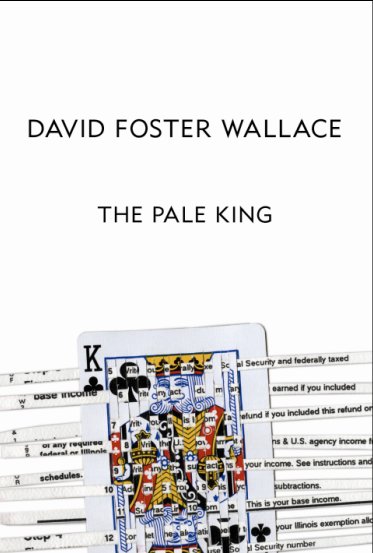
Karen Green, Wallace's widow, created the cover art for the US edition (above).

The King of Clubs may symbolize "foresight ... the ability to predict what is coming". Another website (cluttered with ads) says the card
represents a male who is older in age or spirit with brown hair and hazel eyes. ... Suit of Clubs Personality Traits: Inventive, creative, visionary, altruistic. ... Clubs are generally associated with agreements, business pursuits, governmental matters and events with dynamic impact in terms of our lives. Frequently, the Clubs will herald the beginning stages of a new course in life. They usually signify self-growth and accomplishment.
The UK cover has the title written on the height of a huge stack of papers, representing both the enormous amount of work the IRS workers have to do and the way DFW stacked the manuscript before his death.

It also notes the book is "an unfinished novel".

In other DFW news, his papers are now available for researchers at the Harry Ransom Center at the University of Texas at Austin.

The archive includes:
Infinite Jest (novel, 1996)

Container
15.4-7 Handwritten drafts, undated
16.1-6 'First two sections,' typescript drafts
and photocopy, undated
16.7 Typescript draft fragments, undated
17.1-3 Typescript draft fragment (continued)
17.4-8 Typescript draft, with corrections, undated
18.1-6 Typescript draft (continued)
18.7 Draft for copyedit, undated
19.1-6 Draft for copyedit (continued)
20.1-4 Draft for copyedit (continued)
20.5-6 Typescript, copyedited, May-June 1995, undated
21.1-5 Typescript, copyedited (continued)
22.1-3 Typescript, copyedited (continued)
22.4-6 Proof set, 5 September 1995
23.1-5 Proof set, 6-22 September 1995
23.6 Notepad with corrections list
Sigh. Why couldn't his papers be in Toronto or Buffalo? Or Detroit? Somewhere within driving distance...

April 26, 2010

Skydome in IJ

[Charles Tavis had] been on design teams for stadia and civic centers and grandstands and micological-looking superdomes. He'd admit up-front that he'd been a far better team-player engineer than out there up-front stage-center in the architectural limelight. He'd apologize profusely when you had no idea what that sentence meant and say maybe the obfuscation had been unconsciously deliberate, out of some kind of embarrassment over his first and last limelighted architectural supervision, up in Ontario, before the rise of O.N.A.N.ite Interdependence, when he'd designed the Toronto Blue Jays' novel and much-ballyhooed SkyDome ballpark-and-hotel complex. Because Tavis had been the one to take the lion's share of the heat when it turned out that Blue Jays' spectators in the stands, many of them innocent children wearing caps and pounding their little fists into the gloves they'd brought with hopes of nothing more exotic than a speared foul ball, that spectators at a distressing number of different points all along both foul-lines could see right into the windows of guests having various and sometimes exotic sex in the hotel bedrooms over the center-field wall. The bulk of the call for Tavis's rolling head had come, he'd tell you, when the cameraman in charge of the SkyDome's Instant-Replay-Video Scoreboard, disgruntled or professionally suicidal or both, started training his camera on the bedrooms windows and routing the resultant multi-limbed coital images up onto the 75-meter Scoreboard screen, etc. Sometimes in slow motion and with multiple replays, etc. Tavis will admit his reluctance to talk about it, still, after all this time.
Infinite Jest, 516-17

There have been several incidents, but "multi-limbed coital images" have not been shown on the big video screen.

April 3, 2010

Arm Out Like A Hack's Arm, Gately Blasts Through B.U. Country

One of the possible weak spots in Gately's AA recovery-program of rigorous personal honesty is that once he's jammed himself into a black-as-water Aventura and watched the spoiler throb as he turns over the carnivorous engine, etc., he often finds himself taking a little bit less of a direct route to a given Ennet-errand-site than he probably could. If he had to come right down to the heart of the issue he likes to cruise around town in Pat's car. He's able to minimize the suspicious time any particular bit of extra cruising adds to his errands by basically driving like a lunatic: ignoring lights, cutting people off, scoffing at One-Ways, veering wildly in and out, making pedestrians drop things and lunge curbward, leaning on a horn that sounds more like an air-raid siren. ...

He likes to make a stately left onto Commonwealth and wait to get out of view of the House's bay window and then produce what he imagines is a Rebel Yell and open her up down the serpentine tree-lined boulevard of the Ave. as it slithers through bleak parts of Brighton and Allston and past Boston U. and toward the big triangular CITGO neon sign and the Back Bay. ... The giant distant CITGO sign's like a triangular star to steer by. ...

Below the split on Comm. it's Boston U., Kenmore and Fenway, Berklee School of Music. The CITGO sign's still off in the distance ahead. You have to go a shocking long way to actually get to the big sign, which everybody says is hollow and you can get up inside there and stick your head out in a pulsing neon sea but nobody's ever personally been up in there.
Infinite Jest, 475-477

April 2, 2010

Book Review: Although Of Course You End Up Becoming Yourself By David Lipsky

In March 1996, David Lipsky was on assignment for Rolling Stone, accompanying David Foster Wallace for the end of his promotional tour for Infinite Jest. The assignment fell through -- Lipsky never submitted anything to the magazine -- and the interview tapes went into storage.

After Wallace committed suicide in September 2008, Lipsky was asked to write a eulogy of sorts for RS: "The Lost Years & Last Days of David Foster Wallace".

Shortly after it was reported that D.T. Max, who published an article in The New Yorker about Wallace and his unfinished novel The Pale King (due April 2011), had signed a contract to write a biography of DFW (also 2011?), Lipsky also signed a book deal. Last September, I posted: "I'm not sure what form his book will take, but I'd be thrilled with an introduction and a complete transcription of the interviews."

It turns out that I am pretty much getting my wish*! Although Of Course You End Up Becoming Yourself: A Road Trip with David Foster Wallace will be published on April 13. It is roughly 350 pages and is mostly Wallace's own words.

* When I noted this at The Howling Fantods, site owner Nick Maniatis replied "it's better than that. There's a neat introductory piece, and David Lipsky's thoughts and observations appear throughout the text without disrupting the conversations."

From the book copy at Amazon*:
They lose to each other at chess. They get iced-in at an airport. They dash to Chicago to catch a make-up flight. They endure a terrible reader's escort in Minneapolis. Wallace does a reading, a signing, an NPR appearance. Wallace gives in and imbibes titanic amounts of hotel television ... They fly back to Illinois, drive home, walk Wallace's dogs. Amid these everyday events, Wallace tells Lipsky remarkable things — everything he can about his life, how he feels, what he thinks, what terrifies and fascinates and confounds him — in the writing voice Lipsky had come to love. ... Then Lipsky heads to the airport, and Wallace goes to a dance at a Baptist church.
* Amazon has that "search inside" function for this book. Oh no. There goes the next five hours.

Some reviews: Maria Bustillos (The Awl) calls it "intoxicatingly intimate", Marie Mundaca (Hipster Book Club) says it's "ambling, fun, and a little intense ... [like being] in the back seat driving with [your] smartest friends", and Andrew Shaffer (Pop Matters) says it's "as close to an autobiography as we'll ever get". Zac Farber thinks it's "occasionally mesmerizing" and will likely appeal more to "academics, the literati, and hard-core Wallace disciples" than casual readers.

Lipsky has taken the time to do three lengthy interviews via email. Two of them are at Mark Athitakis's American Fiction and The Howling Fantods. But the whopper is with the wallace-l list serve group. List overseer Matt Bucher collected questions and sent them to Lipsky. He posted the Q&A at his site today: "Rarely do we get to see such an extended portrait of a writer during the moment their masterwork enters the public arena."

I'll snip my question and Lipsky's answer (he goes into this kind of depth (or more) for every question):
Allan Wood: Is there any indication that DFW knew or hoped or imagined that IJ would be the important novel it has become? We've read [Little, Brown editor Michael] Pietsch saying that after he read some of the manuscript, he wanted to publish IJ more than he wanted to breathe. Did Wallace give any indication that he felt he had really nailed it?

David Lipsky: That's funny, Allan. I really smiled when I read this, because I asked the exact same question, in two parts, in more or less the exact words that you did.
Lipsky: "Michael Pietsch's presentation. He went to his sales force, at their conference, and said, 'This is why we publish books.'"

David: "I wasn't there. I know he really liked it. And I know he really read it hard, because he helped me — I mean, that book is partly him. A lot of the cuts are where he convinced me of the cuts. But also, editors and agents jack up their level of effusiveness when they talk with you, to such an extent that it becomes very difficult to read the precise shade of their enthusiasm. What's being presented for you and what they really feel."
And then at little later I asked your second part — exactly the way you did.
Lipsky: "But when did someone come to you and say, 'David, you really nailed it'?"

David: "It's very odd, because Michael would say really nice stuff to me, and he'd say it in the context of having critical suggestions. So I could write it all off as you know, Well he, this is the sugar that's making the medicine go down.

"And Charis [Charis Conn, his first Harper's editor] liked it, but Charis likes everything I do. There was some stuff — because Mark Costello is really good friends with Nan Graham, who knows more about the publishing industry than anybody. She was DeLillo's editor, which as far as I'm concerned does it for me. So I can remember — when they did this postcard thing, and they wanted to do signed bound galleys and sent me boxes full of paper — my not knowing what to make of it. And calling Mark and having Mark find out, I presume from Nan, that this meant that they were going to support the book, and that they were into the book or whatever. Which given that the book is a thousand pages made me think that they thought it was a pretty good book."
I think David hoped it'd be a great book. Mark Costello told me David announced to him all at once in college, "I want to write books people will read 100 years from now." David said he worked harder on this book than any other. But he was immensely prickly with himself — he graded himself on a very steep curve — so he didn't take the early reviews seriously. He said, "The book takes at least two months to read well. If two years from now, I've got people who like have read the thing three times, who come up and say, 'This thing's really fucking good,' then I'll swell up ... like, if I have a bunch of conversations, like with this guy Silverblatt [Michael Silverblatt, host of NPR's Bookworm], or with Vince Passaro, or with like David Gates, somebody who clearly read the book closely. And a bunch of people are saying it's good, then I'm probably gonna start feeling wholeheartedly good about the book. As it is, there's a kind of creeping feeling of a kind of misunderstanding."

He also said a great thing about how you start to write a really good book. "I think I have a really low pain threshold. I think the 'I'll show people,' or 'People are really gonna like this' - thinking that way has hurt me so bad. That when I'm thinking that way, I'm not writing. That that's this thinking in me that's gotta reach this kind of fever pitch, and then break. In order for me to even start — not to get in the groove, but to get started ... And I would still hear the, 'This is the best thing ever written,' and 'This is the worst thing ever written.' But it's sort of like, you know how in movies there will be a conversation, and then that conversation gets quieter, and a different conversation fades in. I don't know, there's some technical word for it. Just, the volume gets turned down. ... I mean, this is absolutely the best I could do between like 1992 and 1995. And I think though that if everybody'd hated it, I wouldn't be thrilled, but I don't think I'd be devastated either. It's about that it got, it became alive for me."

March 10, 2010

DFW Papers Archived In Austin

David Foster Wallace's private papers will be archived at the Harry Ransom Center at the University of Texas, Austin.
The archive contains manuscript materials for Wallace's books, stories and essays; research materials; Wallace's college and graduate school writings; juvenilia, including poems, stories and letters; teaching materials and books.

Highlights include handwritten notes and drafts of his critically acclaimed "Infinite Jest" ... The Wallace materials are being processed and organized and will be available to researchers and the public in fall 2010.
The HRC has uploaded some pictures of the marked-up inside covers of books from Wallace's library, including two Don DeLillo novels; two pages from his dictionary (with the word witenagemot circled); a well-worn copy of Pam Cook's The Cinema Book (which seems to have been very important to the film aspects of IJ); and a bound copy of the corrections for the IJ paperback.

Wallace's agent, Bonnie Nadell, offered a few thoughts on the archive. On that page, there is a maddeningly small jpg of a hand-written IJ page. A slide show includes four additional hand-written pages. ... But wait! The first page is also uploaded at The New Yorker in amazing quality. It is the section that begins on page 157, the 1960 monologue of JOI's father.

Matt Bucher took some "crappy i-phone pics" of some of the stuff that is already exhibited. Very interesting stuff! The cover page of the IJ manuscript Wallace sent to Nadell, which has scribbling all over it, notations written in various coloured pens, features this typed instruction:
PRIVATE DOCUMENT
INTENDED ONLY FOR RETINAS OF PEOPLE TO WHOM IT'S EXPLICITLY SENT
Bucher also took a picture of a manuscript page of one of the book's best sections -- the interesting facts you can learn in Boston AA -- which has been heavily edited, words added and subtracted, even some entire lines not in the final book.Someone on wallace-l noted "the feeling of wonder is mixed for me with sadness at how a living human can so quickly become an archive".

It is odd, looking at the chicken-scratch writing on the inside of his paperbacks as though they were museum artifacts. But at the same time, I cannot begin to tell you how much I want to go to see this stuff.

One of my obsessions with Infinite Jest is the nuts and bolts of its creation: How was it constructed, both the individual sections and the overall order of the narrative? What was his timeline of writing the thing? What level of crazy work went into making the narrative sound so perfectly like the reader's own personal interior voice? In one of his letters to Michael Pietsch, his editor at Little, Brown, Wallace mentions having re-written a section "for about the 11th time" -- how did that evolve?

Wallace wrote his early drafts by hand. When, in the finished book, several pages are spent detailing the rapid thought-process in someone's mind, how in the hell can you get that down writing slowly by hand? I guess that's where the real work is, the re-writing, the building, all that stuff behind the curtain. Which leads me back to being in absolute awe that this glorious novel exists.

Nadell:
For each draft of a story or essay there are levels of edits marked in different colored ink, repeated word changes until he found the perfect word for each sentence, and notes to himself about how to sharpen a phrase until it met his exacting eye. Having represented David from the beginning of his writing career, I know there were people who felt David was too much of a "look ma no hands" kind of writer, fast and clever and undisciplined. Yet anyone reading through his notes to himself will see how scrupulous they are. ... [A]nyone looking through his drafts and even his books will see the levels of thinking that went into every sentence and every page.

November 7, 2009

Gaudeamus Igitur


It may be a mess, but it's a very careful mess. A lot of work went into making it look like that. ... I wanted to write something that would make somebody say, "Holy, shit, I've got to read this," and then seduce them into doing a certain amount of work.
The JoS IJ read begins today.

October 28, 2009

Infinite Winter Board

The Infinite Winter discussion board is here.

Anyone out there -- regular commenter or lurker -- who wants to participate, sign up and drop me an email.

Let me know what you think about the tentative reading schedule.

October 25, 2009

Infinite Winter

Back in June, I mentioned re-reading David Foster Wallace's 1996 novel Infinite Jest during the off-season. At that time, three commenters mentioned the possibility of reading it also.

Game 7 of the World Series is scheduled for November 5. We could start on Monday, November 8 -- which, re the chronology of the novel, would be a great day to start. If we follow the same 75 pages per week schedule as Infinite Summer, we'd finish a week or two after the arrival of pitchers and catchers.

It seems like a pretty quick pace. Maybe it'll be fun. Or maybe it'll fizzle out before Xmas. Anyone interested*?

* When it was released three years ago, the 10th anniversary paperback was only $10. Cheap!

September 12, 2009

DFW And The Pale King

David Foster Wallace committed suicide one year ago today.

Telegraph UK, August 13, 2009:
For at least 10 years before his death, Wallace was working on a long novel that he called The Pale King. Set in a branch of the US Internal Revenue Service, it aimed to articulate the hard-won thesis of mindfulness that Wallace had come to after years of depression and treatment: "Bliss -– a second-by-second joy and gratitude at the gift of being alive, conscious –- lies on the other side of crushing, crushing boredom."

Michael Pietsch, who is piecing together the many drafts of The Pale King in collaboration with [Wallace's agent Bonnie] Nadell and Wallace's widow, Karen Green, agrees. "The thrust of it," he says, "is an attempt to look at the dark matter of tedium and boredom and repetition and familiarity that life is made of, and through that to find a path to joy and art and everything that matters. Wallace has set himself the task of making a moving and joyful book out of the matter of life that most writers veer away from as hard as they can. And what he left of it is heartbreakingly full and beautiful and deep. He was looking at how one survives."
I am a huge fan of Wallace's work, especially his 1996 novel, Infinite Jest, and I am beyond excited to read The Pale King, which will be published in May 2010.

TPK continues to explore the same themes that Wallace tackled in both his fiction and non-fiction. According to The New Yorker, the novel is "about the transcendence that comes through boredom". It centers on
... a group of employees at an Internal Revenue Service center in Illinois, and how they deal with the tediousness of their work. The partial manuscript ... expands on the virtues of mindfulness and sustained concentration. Properly handled, boredom can be an antidote to our national dependence on entertainment ...
Wallace began his research for The Pale King shortly after the publication of Infinite Jest. Karen Green, his widow, said that Wallace took accounting classes and studied IRS publications. "You should have seen him with our accountant. It was like, "What about the ruling of 920S?"

That information helps us understand this 1998 exchange between Wallace and Gus Van Sant:
DFW: I'm on leave this year. I'm auditing a class but I'm not teaching. The class I'm auditing is a real bitch but somehow I'm holding on at a high C or low B.

GVS: What's the class?

DFW: It's ah, it's advanced tax accounting, which is a long story and you probably don't want to know about it, but it's wa-a-a-y over my little noggin. It's a Will Hunting class.

GVS: Oh my God.

DFW: 35 pages of incredibly dense, you know, CPA stuff at night and then you get tested on it the next day.
Simon Prosser, publishing director of Hamish Hamilton, a Penguin imprint which won the UK rights to TPK:
I think it's as good as Infinite Jest. I'm really, really blown away by what I've read. It's absolutely incredible. The level of writing is so high. It's just so tremendously sad that he didn't realise how close he was to what he wanted to achieve.
At "Consider David Foster Wallace: A Conference", held in late July 2009 at the University Of Liverpool, David Hering shared the comments he received from Mary Clemmey, Wallace's UK agent. Clemmey said (in part):
It is in a sense a book about everything that matters -- and everything falls within its scope. Nothing is taken for granted and at every level the book puts the greatest distance possible between itself and the cliched and mundane. It is has the highest of ambitions not just in terms of style and subject but also moral compass and indeed humanity. Without meaning to sound hyperbolic, it is unarguably the work of a writer of genius. And for once that word seems apt and indeed unavoidable.
Also re this conference, click here to read the keynote address given by Greg Carlisle, author of Elegant Complexity (a reader's guide to IJ).

TPK runs "several hundred thousand words and will include notes, outlines, and other material". What is totally cool is that Little, Brown will create a website that includes drafts, journals, and notes, so readers can see how the book came together and "have a detailed sense of Wallace as a working writer". As Pietsch said:
To see his mind at play, to see him begin to assemble these chapters out of scraps of narrative, throwing one word against another ... it is extraordinary, and heartbreaking.
There have been three published excerpts (between 2007 and 2009) that are confirmed to have come from TPK: Good People, The Compliance Branch, and Wiggle Room.

Two pages from the manuscript ("Irrelevant Bob") and artwork from Green can be found on The New Yorker's website here.

Other possible excerpts are linked here (this is pure speculation, however). There is also a report that in 2007, Wallace read something (about 30 minutes in length) at New Mexico State University about "a father/husband who was killed when part of him got caught in the closing doors of a subway train, and his family's attempts to deal with it". Nick Maniatis, who runs The Howling Fantods, has tried to get more information on this reading, but has come up empty.

After Wallace's death, two articles were published: "The Lost Years & Last Days of David Foster Wallace" by David Lipsky (Rolling Stone, October 30, 2008) and "The Unfinished" by D.T. Max (The New Yorker, March 9, 2009).

Max spoke to many people close to Wallace, including his widow, and offered the first information on The Pale King. A lot of Lipsky's article was drawn from hours of conversation he had with Wallace during the book tour for Infinite Jest. In June, it was announced that Max had been signed by Viking to write a biography of Wallace, to be published in 2011. A few weeks later, Lipsky also inked a deal. I'm not sure what form his book will take, but I'd be thrilled with an introduction and a complete transcription of the interviews.
On May 21, 2005, Wallace gave the commencement address at Kenyon College. Someone recorded it and a transcription gained some noterity on the internet. It was included in The Best American Nonrequired Reading 2006 and has been edited and published as This Is Water: Some Thoughts, Delivered on a Significant Occasion, about Living a Compassionate Life.

It's not a long speech, but by including only a sentence or short paragraph on each page, Little, Brown has padded it out to 144 pages. What Wallace talks about in the speech is certainly connected to the themes of IJ -- "banal platitudes can have a life or death importance" -- but I think it quite clearly has much more in common with his work on TPK.
The really important kind of freedom involves attention and awareness and discipline, and being able truly to care about other people and to sacrifice for them over and over in myriad petty, unsexy ways every day.
And you may never experience shopping at the grocery store the same way again. Scroll down here for an audio clip.

Infinite Summer, the mass group read of Infinite Jest, ends in 10 days. I'm thrilled that at least one reader of this blog decided to take the plunge after I wrote about it in June.

I hope he made it through! While I did not take part in the project, I have been enjoying discussions at the IS forums and several blogs, including Infinite Detox, A Supposedly Fun Blog, Infinite Zombies, Infinite Tasks, That Sounds Cool and I Just Read About That.

I am once again stunned and amazed by the writing talent that would otherwise have never been read -- and perhaps never been written -- without the existence of the internet.

August 10, 2009

One Day At A Time

When I look back at what I was writing about the Red Sox in 2003, I see a lot of venting and rehashing of numerous managerial decisions and non-decisions, backed up with plenty of stats and splits and quotes.

Now, and especially since 2007, I'm more apt to stew for a little bit, then go about my day and look forward to 7 PM. I watch every game, root like hell, keep the faith. I love having a game every evening. But the idea of spending a few hours examining the appropriateness of Terry Francona's bullpen decisions on Friday that led to Junichi Tazawa making his major league debut in the 14th inning seems somewhat pointless. And what can you really say about the team-wide batting slump? You can drive yourself nuts, but it won't do the team any good.

Some of that mindset is because of 2004. Prior to that, who knew when the Red Sox would win a World Series? Would it be another five years, 10, 40? When the team was a contender, every game was a crucial battle, because this loss right here could end up being the one game that kept us out of the playoffs. And so there was plenty of anxiety, frustration, rage, despair. It's exhausting to keep that up for six months. Waking up still fuming at the previous night's loss is not healthy. I know some fans still think that way, and if I asked them "Why?", they'd give the same answer I do when asked why I am less intense: I just am. (Unfortunately, my attitude also results in a duller blog.)

Now not only do I intuitively know that the previous night's loss is history, its result unchangeable, and tomorrow's game is far away, so all we can hope for -- and the only thing the team can do today -- is win today, but I can actually have it work in my brain.

It is the same attitude I was forced to take when things looked dark in 2004 and 2007 (and 2005 and 2008, for that matter). Take a deep breath and boil it down. No team can win three or four games (or make up 6.5 games in the standings) at once. It is a waste of time and energy to fret about winning on Tuesday when you play on Monday. So win Monday's game. That's all you can control.

Manny Ramirez had the right idea when, in October 2007, he famously said:
We're not going to give up. We're just going to go and play the game, like I've said, and move on. ... It's not like the end of the world or something. Why should we panic? ... It's going to happen. It's going to happen. We've got a lot of confidence in our teammates. They've been good all year round. ... We have to keep grinding it out and see what's going to happen. ... If we go play hard and the thing doesn't come like it's supposed to come, we'll move on. ... Why should we panic? We've got a great team.
I posted this back on August 25, 2003:
Kevin Millar: "It baffles me that all the media and all the fans want to bash the Red Sox in August. There's a lot of baseball left. There are going to be negatives, but why not jump on this team's back and have fun with it and pull for this team and write good things about this team, because when this team is in the wild card or [wins] the division title, this is going to be a fun team to root for. ... I love this team and I love this city, but some of the things you see and read ... It's 2003. ... [The past] makes zero sense to me."

Millar's comments in his MLB diary were perceived by the Boston sports media as a slam on the fans, but it was clearly an expression of befuddlement (and annoyance) at the media's harping on past Boston losses, some of them decades and decades old. Millar's right; it makes no sense.
On that day, the Red Sox trailed the Yankees by five games and were tied for the wild card.
This is too serious for a baseball post -- and I can't tell if it actually applies -- but there is a line in David Foster Wallace's Infinite Jest that pops into my head every so often: "... no single, individual moment is in and of itself unendurable."

Very late in the novel -- 650 pages after that line -- one of the main characters, a former addict and AA counselor, is in a hospital, drifting in and out of consciousness, unable to communicate and in pain but also terrified that he will be given possibly addictive pain medication against his will.
Any one second: he remembered: the thought of feeling like he'd be feeling this second for 60 more of these seconds -- he couldn't deal. He could not fucking deal. He had to build a wall around each second just to take it. No one single instant of it was unendurable. Here was a second right here: he endured it. What was undealable-with was the thought of all the instants all lined up and stretching ahead ...
A central theme in all of Wallace's work is that seemingly trite, unhip, "polyesterishly banal" cliches -- One Day At A Time and Give It Away To Keep It -- are actually incredibly meaningful and damned hard to truly follow.

So: Keep Coming Back. Hang In There. We're All Here Because We're Not All There.

But if you do want to wallow in gloom (or, some would argue, the cold facts), you can see -- from Cool Standings projections -- the decline of the Red Sox's chances of winning the East during the weekend in New York:
Morning of   0804  0806  0807  0808  0809  0810
Yankees       47%   52%   60%   67%   72%   78%
Red Sox       41%   35%   27%   23%   16%   13%
Boston's chance of simply making the playoffs has dropped from 70% to 47% in less than a week.

The Yankees are playing five games better than their Pythag while the Red Sox are dead on. The "expected" standings, based on runs scored and runs allowed, show the Yankees in first, with the Rays 1 GB and the Red Sox 1.5 GB.

The Red Sox have plenty of problems, no doubt about that, but that may be a truer indication of the closeness of these three teams.

June 21, 2009

Infinite Summer

Today, thousands of people all over the world began reading David Foster Wallace's Infinite Jest -- 75 pages per week.

Infinite Summer will last, appropriately enough, until September 22. (Check out that link for various testimonals, a central message board, a "How To Read IJ" guide, links to dozens of groups/blogs who are going to be reporting their progress, even special bookmarks.)

Matthew Baldwin is the man behind IS:
Tackling Infinite Jest has been on my to-do list for more than a decade. I'm challenging everyone -- myself included -- to finally make time for this celebrated novel, and do so in the company of readers around the world.
IS has got me in a mood to re-read IJ -- while I have returned to various sections of the book dozens of times, I've read it straight through only once -- but I'm going to wait until November, when baseball season is over. By chance, November 2009 is when a lot of the action in the novel, published in 1996, takes place.

(I posted about my love/obsession with IJ last September after Wallace committed suicide.)

A winter read will also lead me right into the Spring 2010 publication of Wallace's unfinished novel, The Pale King, about which I am tremendously excited.

***

Other Stuff:

Demolition of Yankee Stadium

The Break Of The Curveball

Cleveland Tourism

March 2, 2009

Buy Your Own Damn Fries

Note: David Foster Wallace content in comments.

***

Barack Obama recorded the audio book for his autobiography Dreams From My Father. The Boston Phoenix extracted mp3s of the cursing.

Examples: "There are white folks, and then there are ignorant motherfuckers like you" and "This shit's getting way too complicated for me". The comments at this WFMU blog post include two more.

Remember the isolated David Lee Roth vocal track for Van Halen's "Runnin' With The Devil"? Well, if you liked that, you'll love this. WHOOOOHOOOOOO!!!!

***

Red Sox Content: The Boston Pops will release The Red Sox Album, which includes arrangements of "Shipping up to Boston" and "Sweet Caroline", on Opening Day, April 6. A version of John Philip Sousa's "National Game March" includes the crack of David Ortiz's bat. A series of three concerts is scheduled for May 21-22-23.