April 4, 2022

2022 Predictions: Boston Globe, USA Today, Athlon, FanGraphs,
Yahoo, The Sporting News, Baseball America, Beyond The Box Score

Boston Globe

Random comments:

Peter Abraham: "AL East: Blue Jays. This division will be a rock fight, with four teams capable of winning."

Julian McWilliams: "AL East: Rays. Everyone seems to have hopped on the Blue Jays hype train, but the Rays remain one of the most consistent teams in baseball and thrive during the regular season."

Alex Speier: "AL East: Blue Jays. With Canada's vaccination requirements, they may have the biggest home-field advantage in the history of the sport. . . . October without the Red Sox or Yankees for the first time since 2014? They're certainly talented enough to reach the playoffs, but the AL East seems like the Group of Death."

USA TODAY

AL East

Four of these teams won 90+ games in 2021 but the Blue Jays were the most active in the offseason, acquiring third baseman Matt Chapman and starter Kevin Gausman – albeit to replace Marcus Semien and Robbie Ray. . . . The Rays have won the division two years in a row but didn't do much to upgrade, and have a lot riding on Wander Franco (and his new 11-year, $182 million contract) taking a significant step forward. . . . Yankees fans may have hated the offseason, but the team didn't get significantly worse over the winter. The pitching questions persist but they could get a jolt from new infielders Josh Donaldson and Isiah Kiner-Falefa. . . . Trevor Story will move to second base for the Red Sox, who swooped in to sign the two-time All-Star and boast one of the best lineups in baseball. . . . The Orioles hope to see top prospect Adley Rutschman soon (but not too soon) and are going to lose 100 games again but have players worth watching in Cedric Mullins and Ryan Mountcastle.

Athlon

AL East

Toronto Blue Jays
Tampa Bay Rays*
New York Yankees*
Boston Red Sox*
Baltimore Orioles

AL Central: White Sox
AL West: Astros
NL East: Atlanta
NL Central: Cardinals
NL West: Dodgers

Postseason Predictions

WC

White Sox over Red Sox; Yankees over Rays
Cardinals over Brewers; Mets over Padres

DS

Astros over Yankees; Blue Jays over White Sox
Dodgers over Brewers; Atlanta over Mets

CS

Astros over Blue Jays; Dodgers over Mets

WS

Dodgers over Astros in 6

AL MVP: Guerrero, Trout, Ohtani (Judge 4, Devers 7)
NL MVP: Harper, Soto, Turner (Mookie 4)

AL Cy Young: Cole, Bieber, Ray
NL Cy Young: Burnes, Buehler, Scherzer

FanGraphs


Yahoo

The Sporting News

The predicted standings are the average wins and losses from 20,000 season simulations.

AL East

Blue Jays   91-71
Rays        87-75
Red Sox     86-76
Yankees     86-76
Orioles     70-92

The AL East is the best division in baseball, and it doesn't take a model to know that. . . . The Sporting News' model sees the Blue Jays as a slim favorite to win the division over the Yankees, Rays and Red Sox, but it expects all four teams to reach the playoffs.

Toronto's lineup . . . is the best in the American League . . . The Rays are that team that is constantly underloved by metrics and subsequently overperforms. The model has them in third in the AL East, but it would surprise no one to see them win the division. . . . The Red Sox surprised some people with their run to the ALCS in 2021, and Boston expects to be back in the mix for the playoffs again . . . Fans of the Yankees are disappointed that New York wasn't able to land any major name in free agency, but that doesn't stop the model from being bullish on the Bronx Bombers' chances to make the playoffs. . . . 

          Division    WC    Miss playoffs

Blue Jays   42.9%   41.1%     16.0%
Rays        22.2%   47.6%     30.2%
Red Sox     18.2%   45.7%     36.1%
Yankees     16.5%   43.3%     40.2%
Orioles      0.1%    1.8%     98.1%

AL Playoff Predictions

First-round byes: White Sox, Astros
Remaining playoff teams: Blue Jays, Rays, Red Sox, Yankees

Team       Win Pennant (10+%)

Blue Jays     16.9%
White Sox     15.2%
Astros        13.9%
Rays          13.0%
Red Sox       12.3%
Yankees       10.8%

NL Playoff Predictions

First-round byes: Dodgers, Braves
Remaining playoff teams: Cardinals, Giants, Mets, Phillies

Team Win Pennant (10+%)

Dodgers       17.4%
Giants        14.2%
Atlanta       14.1%
Mets          12.9%
Cardinals     11.9%
Phillies      10.7%

World Series Prediction

Team Win World Series (5+%)

Dodgers        9.3%
Blue Jays      8.7%
Giants         8.4%
White Sox      7.7%
Rays           7.1%
Astros         7.0%
Atlanta        6.8%
Mets           6.4%
Cardinals      6.0%
Red Sox        5.7%
Yankees        5.2%

Baseball America

National League 

Wild Cards: Cardinals, Giants, Mets
Pennant: Dodgers

MVP: Soto, Acuna, Betts/Freeman/Machado/O'Neill
Cy Young: Scherzer, Buehler, Woodruff

American League 

Wild Cards: Mariners, Rays, Yankees
Pennant: Blue Jays

MVP: Guerrero, Ohtani, Correa/Judge/Ramirez
Cy Young: Cole, Ohtani, Bieber/Berrios/Giolito/Ray

World Series (9 picks)

Dodgers: 5 (over Blue Jays, Blue Jays, Blue Jays, Rays, Rays)
Blue Jays: 2 (over Dodgers, Dodgers)
Rays: 1 (over Mets)
Cardinals: 1 (over Rays)

Which Team Had The Most Disappointing Offseason? 

Yankees. By the end of 2021, it was clear the Yankees were old and injury-prone. With talents like Carlos Correa, Freddie Freeman and Trevor Story on the market, the team instead chose to bring back Anthony Rizzo and trade for Josh Donaldson while also getting weaker offensively at shortstop (Isiah Kiner-Falefa) and catcher (a tandem of Kyle Higashioka and Ben Rortvedt). To add some salt, the Twins used some of the cost savings from shedding Donaldson's contract to sign Correa, while the rival Red Sox spent big for Story. (Josh Norris)

AL East Picks (posted March 7, 2022)

Andrés Chávez: Tampa Bay Rays
Tampa won't have Tyler Glasnow, who will be recovering from Tommy John surgery, but they have two future aces in Shane McClanahan and Shane Baz, plus the experienced Corey Kluber and an army of talented, versatile arms to round out the staff. Perhaps more importantly, they will have a full season of young phenom Wander Franco (who hit .288/.347/.463 with a 127 wRC+ as a 20-year-old in 2021) to headline the lineup. . . . The Blue Jays may be one big piece away (either an infielder or another impact pitcher) from really challenging the Rays, but the Yankees and Red Sox (two teams that could also bring in some big pieces after the lockout) do seem to be half a step behind.
Kenny Kelly: Toronto Blue Jays
As a longtime Rays disrespecter, they can't keep getting away with it. Eventually, the Rays' miserly approach is going to come back to bite them in the regular season. . . . Someone is going to overtake the Rays, and it might as well be the Blue Jays, the lone 90-win team who missed the playoffs last year. Losing Marcus Semien and Robbie Ray stings, but Toronto has enough there to succeed without them.  . . . Even without Semien, the Jays still have a lineup that should be one of the most productive in the majors. Without Ray, Toronto still has a formidable one-two punch in Gausman and José Berríos.
Matt O’Halloran: Boston Red Sox
This may be a homer pick, but homer picks aren't necessarily bad picks. The Red Sox are bringing back the majority of a roster that just won a Wild Card spot en route to the ALCS, farther than any other AL East team. The losses of Hunter Renfroe and Kyle Schwarber do leave a hole in the lineup, but I would expect an addition to supplement these losses once the lockout ends . . . If Bobby Dalbec's late-season surge (1.047 OPS from 7/29 on) wasn't real, a reinforcement in Triston Casas figures to be in the big leagues this summer. The top of the rotation will be anchored by the formidable 1-2 punch of Nathan Eovaldi and Chris Sale . . . In the end, this division is anybody's (well, except the Orioles). While I doubt they will be widely considered the favorites, the Red Sox will be very competitive in 2022 . . .
Steven Martano:  Toronto Blue Jays
Last year the Jays won 91 games (shockingly only good for fourth place in an uber-competitive division), but based on their run differential of 183, their Pythagorean record was a robust 100-62. Their young core is a year older, and they've upgraded their rotation. No one will argue that Toronto's young players are an unmitigated offensive juggernaut . . . Toronto's pitching was adequate last season, but they've put together a solid rotation going into 2022. . . . The Jays are more balanced and more mature than last season and are poised to take a step forward, winning the AL East for the first time since 1993.
Estevão Maximo: Toronto Blue Jays
[U]nless something extraordinary happens I would give the slight favoritism for the Toronto Blue Jays to win the highly contested AL East. . . . [T]his offense remains one of the five best in baseball with ease. The team that finished with a Pythagorean W-L record of 99-63 last year now has a full season of deadline acquisition José Berrios. One figures that's almost a given that the Rays will outperform their projections in what has become almost a seasonal tradition so they can't ever be ruled out. The Yankees should figure to be in the race as well and I see Boston somewhat behind with too much uncertainty surrounding the staff, but nothing is truly off the table.

Have The Red Sox Caught Up With The Yankees Yet?

[Draft Post: October 18, 2021 (Why did I not post this last fall? Did I tack it onto the end of another post?)]

After the Yankees decisively lost the AL Wild Card Game, manager Aaron Boone said some bizarre things . . . like how the rest of the American League had finally caught up to the Yankees.

I'm not sure how a team can have been outplaying the entire league during the exact same 11-year time period in which it has not played a single World Series game.
The league has closed the gap on us. . . . [I]t's not just the Red Sox and the Astros now in our league. Look at our division, the Rays are a beast, Toronto, there's some teams in the Central that are better and better, teams in the West that are better and better, teams that have closed the gap on us.

In the last 11 years, the Red Sox have won three pennants and are currently trying to win their third World Series title. The Yankees have won zero pennants and zero World Series anythings. 

April 1, 2022

Cashman Rejects Reality Of Yankees' 12-Year World Series Drought
("I Don't Think That's As True A Statement As It Could Be")

Yankees general manager Brian Cashman believes his team's 12-year World Series drought should have an asterisk. When asked about that championship drought, he rejected "the notion that the franchise is in the midst of an arid stretch". 

While Cashman is free to reject reality (many Americans have chosen to do so in recent years), it doesn't change the facts: the MFY have not won (or even played in) a World Series since 2009. (That was so long ago, Daniel Bard would still pitch in four more seasons with the Red Sox.) Oh, just as a reminder, the Red Sox have won two titles since then and they personally ended the Yankees' 2018 and 2021 seasons.

Cashman is still bitter about losing the 2017 ALCS in seven games to the Astros.

The only thing that stopped [us] was something that was so illegal and horrific. So I get offended when I start hearing we haven't been to the World Series since '09. . . .  The only thing that derailed us was a cheating circumstance that threw us off. . . . People are like, "Oh, we haven't been to a World Series" . . . and I'm like, "Yeah, I don't think that's as true a statement as it could be." We had a World Series team. . . . People don't want to hear that. I get it. But that's real to me.

The Yankees have made the postseason in each of the four subsequent seasons, winning only five of 16 games.

In 2018, they lost to the Red Sox in the ALDS (1-3).

In 2019, they lost to the Astros in the ALCS (2-4).

In 2020, they lost to the Rays in the ALDS (2-3).

In 2021, they lost to the Red Sox in the Wild Card Game.

Cashman should probably "smoke the objective pipe".

The Athletic:

Cashman . . . hears the proverbial roar outside the gates in The Bronx from a populace accustomed to something more glorious than one-night Octobers. He has worked to temper this desperation by implementing a more dispassionate, level-headed approach . . .

The team's luxury-tax payroll resides at nearly $246 million, according to FanGraphs. That figure is above the first threshold of the competitive balance tax. . . . [That has] limited the Yankees this past winter. . . .

The relative passivity was met with groans from segments of the fanbase. These are not simply the grumblings of spoiled supporters. Rival evaluators wonder about the wisdom of an offense built around injury-prone players like Judge, Stanton and Donaldson. . . .

[Cashman again] bristled at discussion of a drought.

"I'm past it now," Cashman said. "But it does bother me when it comes up. . . . I can't tell you we would have won. I can't tell you we would have beat the Dodgers. But I do feel pretty confident that that team [the Astros] wasn't stopping us . . . That's all."

Without Apple TV+, you are not watching these Friday night Red Sox games:

May 6: White Sox at Red Sox
May 27: Orioles at Red Sox

Thanks, Manfred.


Trevor Bauer has filed a defamation lawsuit against The Athletic and writer Molly Knight, claiming they published knowingly false information about him "with hatred, ill will, and spite, with the intent to harm". (Which actually sounds more like how Bauer behaved toward the women he sexually assaulted.) Bauer also filed a lawsuit against Deadspin about one month ago.

Bauer's intent with this latest lawsuit is clearly, as Craig Calcaterra writes, "an effort to intimidate and silence his critics by virtue of an expensive legal defense or the threat of one". Assuming Bauer actually goes through with it, he would have to sit for a lengthy deposition, during which he would be forced to, as Calcaterra describes,

make sworn statements about all manner of facts related to his alleged sexual assault. Which — in addition to putting him in the news, often, over the course of months and even years as an allegedly violent sexual assaulter — will, in turn, put him in legal jeopardy, both for perjury and for the underlying claims of assault. "I choked a woman unconscious and punched her and anally penetrated her while she was unconscious but I DID NOT break her skull!" may seem like a safe harbor to someone like Bauer, but it's not a super duper safe harbor in the grand scheme of things nor does it put him in anything approaching a flattering or sympathetic light.

Meanwhile, Commissioner Rob Manfred has done nothing about suspending Bauer (as per enforcing MLB's clearly-written policy on sexual assault).

March 31, 2022

Lindy's 2022 Preview: Red Sox Predicted To Finish 4th & Make Postseason

[Note: If anyone is able to send me scans or even cell phone pics of the AL/NL predictions and Red Sox/Yankees previews from the Athlon and/or Street & Smith magazines, that would be great. The store in my small town doesn't carry them.]

AL East

Blue Jays
Yankees
Rays
Red Sox
Orioles

Red Sox

Few teams have had as impressive or dramatic a turn-around as the Red Sox did last year, going from a last-place finish in 2020 to not only making the playoffs but also coming within two wins of capturing the AL pennant. . . .

That type of up-and-down trajectory has been all too common for the franchise. In the last 10 years, the team has won two World Series titles and four AL East crowns, and also finished fifth in the division four separate times. . . .

The floor for this roster is higher than most probably expected after the 2020 disaster. Bloom deserves plaudits for addressing Boston's major problem: pitching. But will the Red Sox owners, now that the team is back on a winning track, re-open their pocketbook to raise the ceiling? With how tough the rest of the East is, it's hard to imagine lightning striking twice without some help on the ground.

Rotation: Last season reminded everyone just how good a healthy Nathan Eovaldi can be. His success in 2020 was built on limiting walks; last year he cut down on home runs, once a persistent issue for him. Eovaldi also benefited from throwing his too-hittable cutter less in favor of more curveballs — his best pitch — and sliders. Chris Sale looked rusty . . . in his return from Tommy John surgery . . . His fastball velocity fluctuated and was down from his pre-injury years. Sale's slider was his only reliable secondary, with his changeup losing some bite. . . . Nick Pivetta took a big step forward . . . doing a better job placing his fastball at the top of the strike zone to set up his elite curveball at the bottom. Pivetta is frustratingly inconsistent and inefficient, but he can be a solid middle-of-the-rotation starter. If Rich Hill can stay healthy, he should be able to help with his ability to throw quality strikes consistently. At age 42, though, he's a five-and-fly guy, and last year's sticky-stuff crackdown took spin off his curveball. Michael Wacha will be the default fifth starter, although he doesn't miss enough bats  . . . Hill or Wacha could give way to Tanner Houck, whose vicious slider and excellent velocity helped him forge a 11.3 K/9 IP rate last year.

Bullpen: Garrett Whitlock [went] from Rule 5 draft pick to postseason relief ace . . . His 96-mph sinker consistently avoids the barrel of bats, and his secondaries missed bats entirely. [He might also be used as a starter this year.] Matt Barnes went from All-Star closer in the first half last year to nonentity in the second, due to a too-heavy workload and a positive COVID diagnosis. Barnes' occasional command issues are frightening . . . Ryan Brasier reemerged as one of Alex Cora's preferred right-handed setup men late last year. However, his high strikeout totals did not make the trip with him. . . . COVID wrecked Josh Taylor's 2020 season, but he didn't miss a beat in his return, racking up whiffs as Boston's top lefty. . . . Hirokazu Sawamura . . . faded late. His virtually unhittable splitter helps make up for shaky command. The rest of his arsenal is so-so.

Catcher: Don't be surprised if this is Christian Vazquez's final season in Boston. After a poor showing at the plate last year and set to turn 32 in August, he appears to be in fast fade. The excessively high BABIP that helped him to a career year in 2020 vanished last year, and in its place was a lot of weak contact. . . . Kevin Plawecki is an able backup, and prospect Connor Wong is about a year away.

Infield: First baseman Bobby Dalbec is a king of two true outcomes: home runs and strikeouts. A second-half surge last year (.269/.344/.611) saved his roster spot, but persistent contact issues keep Dalbec in and out of the lineup. . . . Triston Casas [should get] a look. Kike Hernandez . . . as a hitter is best suited to be a part-time player, but his defense [at second base] makes him a viable starter. . . . Xander Bogaerts is as reliable a hitter as there is in the league. He does it with a blend of patience, contact and power. . . . However, his glove is a problem. Per Statcast, his minus-9 Outs Above Average last year ranked in the low-end percentile among shortstops. Like Bogaerts, Rafael Devers is a foundational franchise piece. No one else on the team boasts the raw power he has, and last year he simultaneously cut down on strikeouts and upped his walk rate. Like Bogaerts, Devers isn't cut out for his position . . .

Outfield: On one hand, [Alex Verdugo is] a patient hitter who avoids excessive whiffs, makes quality contact and can handle fastballs. On the other hand, he struggles to get the barrel on the ball, frequently driving it into the ground. . . . [I]t doesn't add up to as much production as you would expect. . . . Jackie Bradley is a superb center fielder, but he was the worst hitter in MLB last year . . . [T]here's not much reason to expect better from Bradley. . . . The left fielder will be determined during spring training. At the top of the depth chart is Jarren Duran . . . Rob Refsnyder also is available. [With the signing of Trevor Story to play second base, Hernandez will spend most of his time in the outfield.]

Designated Hitter: J.D. Martinez . . . was at the forefront of the team's resurgence [in 2021]. Locking in on fastballs was crucial for Martinez. He went from hitting .184 with a .377 slugging percentage against heaters in 2020 to .270 and .479, respectively, last year. There's no question that Martinez has slipped from his 2015-2019 salad days, but there is no reason to believe he has emptied his MLB tank.

Organization/Management: . . . Alex Cora was back in the manager's chair last year, and it probably was no coincidence that the team flourished again. Cora fosters clubhouse chemistry, and he is a superb motivator and leader. His tactical decision-making is open to debate. Cora sometimes lets his emotions and the moment dictate his strategy. . . . Chaim Bloom [is] a shrewd judge of player talent, has done well revitalizing Boston's farm system, and has turned the team's fortunes around much faster than most would have imagined  . . . It would help Bloom should principal owner John Henry relent on his newfound stinginess.

Yankees

The Yankees were less than the sum of their parts last year. . . . [The MFY] stumbled its way to 92 wins — the Yankees spent less time in first place in the AL East than the Orioles did — and barely made the playoffs. Their postseason stay was short, too, with their hated rival, the Red Sox, easily dispatching them in the Wild-Card game. It's now 12 years and counting without a World Series title or pennant for the Yankees . . .

Along the way, there have been some odd and hard-to-explain stumbles: wrong turns for Gary Sanchez and Gleyber Torres; a refusal to spend beyond the occasional splurge for an upper-echelon player . . . a roster so shallow and inflexible that Rougned Odor and Brett Gardner were counted on for regular playing time last year. . . . [T]he 2021 squad . . . couldn't hit, couldn't field, couldn't stay healthy and couldn't find consistency . . . [T]he Yankees can't act like they don't need help . . .

Rotation: Aside from some panic concerning his spin-rate dip during MLB's sticky stuff crackdown, Gerrit Cole's 2021 season was ace-level. There are some cracks in the foundation — fewer whiffs and less bite on his curveball than in his Houston years — but Cole still pumps fastballs at 98 mph with a strikeout rate better than 30 percent. Jordan Montgomery gave the Yankees unexpected volume and durability . . . grinding out five- and six-inning starts . . . [He] throws strikes (albeit hittable ones) . . . What Luis Severino can contribute after missing essentially three seasons because of elbow and shoulder injuries is anyone's guess. . . . Nestor Cortes was a big surprise last year, racking up quality starts and strikeouts as a fill-in starter. . . .  Domingo German remains a back-end starter with some upside . . . although he needs to locate [his fastball] better . . . Jamison Taillon, recovering from ankle surgery, is due back in April. . . .

Bullpen: Closer Aroldis Chapman . . . struggles to throw strikes regularly, and batters are making plenty of loud contact. . . . Jonathan Loaisiga is a multi-inning weapon in high-leverage situations . . . Chad Green contributes quality late-inning work . . . Clay Holmes was swiped from the Pirates . . . and morphed into a valuable asset. . . .

Catcher: Gary Sanchez crawled his way back toward respectability last season, returning to league-average production offensively. . . . [H]e still ranks as one of the Yankees' big disappointments. . . . [H]e now hits a lot of harmless fly balls and pop-ups . . . [H]e hasn't improved his pitch recognition and continues to flail at off-speed pitches and breaking balls. . . . He remains a poor blocker whose . . . strong arm . . . doesn't make up for his shortcomings. [The MFY finally wised up and traded Mr. Maniloaf, aka the Crouch Potato, to the Twins.] . . . Backup Kyle Higashioka is . . . a weak hitter.

Infield: A balky left knee kept first baseman Luke Voit out of the lineup at times . . . [P]itchers . . . are challenging him with off-speed and breaking stuff, which confounds him. After two miserable years at shortstop, Gleyber Torres is back at second base. . . . [H]e struggles to reach balls hit to his right. Offensively, Torres remains a mystery. . . . Gio Urshela . . . was too aggressive at the plate last season, getting himself out with whiffs and weak ground balls. He no longer looks like a viable regular. DJ LeMahieu . . . didn't make enough quality contact in 2021, and his days as an above-average defender are probably over. . . . [H]is skillset might be in terminal decline.

Outfield: Left fielder Joey Gallo didn't make an impact . . . striking out too much, even by his standards. . . . Just like in 2019, Aaron Hicks spent more of the 2021 season off the field than on it . . . [I]t came with a big downturn in his offense — an increase in whiffs and dip in walks. Advanced metrics indicate Hicks has lost a significant step in center field. . . . Strikeouts will always be part of [Aaron] Judge's game . . . while his defense grades out as average.

Designated Hitter: Giancarlo Stanton . . . comes with routine injury concerns, no defensive or base-running value, and $179 million owed to him over the next six years.

Organization/Management: It's not exactly clear how or why Aaron Boone kept his job after last season . . . He was hammering square pegs into round holes and trying to convince fans and reporters that they fit perfectly. . . . This will be Brian Cashman's 25th year in charge of the Yankees [and] the roster-building of late has not been good enough. . . . [T]he Steinbrenners have reduced the cash flow to a trickle . . . in-house moves - Gleyber Torres' disastrous stint at shortstop, Gary Sanchez's lack of progress, the stop-and-start development of young pitching - haven't panned out.

Scout's Take: . . . If George was still alive, Boone would be gone for sure. George wouldn't like it that they've won the World Series once in the last 21 years. . . They have so much swing-and-miss and all-or-nothing in their lineup. They kind of remind me of a beer-league slow-pitch softball team.

AL Central: White Sox
AL West: Astros
AL WC: Red Sox, Rays, Mariners, Yankees
AL: Champions: White Sox

AL MVP: Vladimir Guerrero Jr., Blue Jays
AL Cy Young: Shane Bieber, Guardians
AL Rookie: Spencer Torkelson, Tigers
AL Manager: Scott Servais, Mariners

NL East: Atlanta
NL Central: Brewers
NL West: Dodgers
NL WC: Cardinals Mets, Padres, Phillies
NL Champions: Dodgers

NL MVP: Fernando Tatis Jr., Padres
NL Cy Young: Zack Wheeler, Phillies
NL Rookie: Alek Thomas, Diamondbacks
NL Manager: Buck Showalter, Mets

HEY, YOU! WHO THE FUCK STILL READS A BLOG? . . . ANYWAY, SOME
REAL NEWS! I'M RUNNING THE METS, BABY, ME AND MY MIGHTY BINDERS
OF AWESOME! TOO BAD WE WON'T GET TO POUND THE PISS OUT OF YOU
LOSERS THIS YEAR! JUST WATCH HOW A REAL TEAM GETS IT DONE!

March 30, 2022

Cardinals Score 15 Runs In Eighth Inning, Pound Nationals 29-5

The Cardinals came to bat in the top of the eighth on Wednesday afternoon with a 13-4 lead over the Nationals. Three outs later, the score had ballooned to 28-4 because St. Louis sent 19 batters to the plate and scored 15 runs:

double, double, single, infield error, single, single, single, double, foul out, hit by pitch, pitching change, single, hit by pitch, single, walk, single, infield error, wild pitch, sacrifice fly, passed ball, walk, pitching change, fielder's choice groundout

Cardinals - 440 302 0(15)1 - 29 26  0
Nationals - 000 004 0  4 0 -  8 12  2

Two Washington pitchers were each charged with 10 earned runs: starter Aníbal Sánchez and reliever Cade Cavalli (who has yet to pitch in the majors).

The major league record for most runs in a single inning of a regular-season game is 17, accomplished by the Red Sox on June 18, 1953 against the Tigers at Fenway Park (23-3).

Tigers  - 000 201   0 00 -  3  7  3
Red Sox - 030 002 (17)1x - 23 27  0

There have been two spring training games in the last two weeks featuring 37 runs scored. On March 21, Texas beat the Guardians 25-12.

Texas     - 059 231 122 - 25 27  0
Guardians - 005 001 222 - 12 15  0

Everyone Loves A Contest #27: 2022 Red Sox W-L Record

With the 2022 Red Sox season set to begin Thursday, April 7, against the MFY in New York, it's time for the annual Red Sox W-L Contest!

The person who correctly guesses the Red Sox's 2022 regular season W-L record will win a hard cover copy of Mitchell Nathanson's Bouton: The Life of a Baseball Original, an excellent biography of the iconoclastic and outspoken pitcher and author of Ball Four.

Contest entries must be emailed to me and include the following two predictions:
1. 2022 W-L Record
2. Tiebreaker: Jackie Bradley's batting average
(2020: Bradley bats a career-high .283 for the Red Sox.
2021: Bradley bats a career-worst .163 for the Brewers.
2022: Bradley bats . . .)

As always, the winning W-L prediction must be exact. The tiebreaker, if needed, will be the closest guess, either over or under.

Deadline: Wednesday, April 6, 11:59 PM ET.

Good luck . . . and don't forget: Yankees suck!

March 28, 2022

MLB.com Ranks Lineups: 4 AL East Teams In Top 10 (Red Sox #6)

MLB.com's Anthony Castrovince ranks the Top 10 lineups -- and four of the teams are from the AL East.

The Red Sox are ranked sixth, behind the Dodgers, Blue Jays, White Sox, Atlanta, and Yankees. The Rays are ninth. Except for the Dodgers, there are caveats about all of the teams above Boston, so the Red Sox could perhaps be projected a little higher.

Regardless of where the Red Sox fall in a pre-season ranking of only lineup strength, the AL East is going to be a crazy fight. The division had four teams with 91+ wins last year and with the slightly expanded postseason, it's possible that the Red Sox, Yankees, Blue Jays, and Rays could all make the postseason. 

Will Leitch (MLB.com) points out that last season, the Blue Jays

were trying to catch the Sox and Yanks, but this year, because of all three games of the three-game Wild Card Series being at the home stadium, home field means even more than it did in a one-game playoff, making the Sox-Yankees battle that much more important. It ends up making places one through four in that division matter. The difference between finishing first and getting a bye, and finishing third or fourth and having to play three games on the road, just for the opportunity to advance, is vast.

ESPN gave the Red Sox an offseason grade of C+. That might sound bad, but it's the best grade of the division. The others: Rays (C), Blue Jays (C), Yankees (D+), Orioles (D).

Jeff Passan (ESPN) has an in-depth look at the negotiations and signing of Trevor Story. The Red Sox were concerned at one point that the signing might not happen because Story was reluctant to get the COVID-19 vaccine. And he refused to say anything more about it: "It's a very personal matter. Decisions like that are kept between me and my family." 

Why is it that people who understand and accept that vaccines have been a component of modern medicine for at least a century and are not a covert way for the populace to be monitored by "them" never describe the act of getting a vaccine or a booster shot as an extremely "personal" matter? Craig Calcaterra says they act like admitting to receiving a vaccine shot is "a diagnosis of, like, some rare STD that can only be acquired by having intercourse with livestock or something".

New York City Mayor Eric Adams caved to pressure from the Yankees and Mets last week and removed the city's COVID-19 vaccine mandate -- but only for athletes and entertainers. Hurray for science!

March 24, 2022

MLB's Refusal To Play WS Games In November Means Six-Game Series & Idiotic Travel Plans

MLB does not want to see World Series games played in November, so even though the 2022 season will start a week late (thanks in large part to the owners' refusal to bargain for the first six weeks of their unnecessary lockout), it will still end on October 5. Cramming in that missing week of games has resulted in some strange and idiotic scheduling.

The Rockies will end the season with six games against the Dodgers in Los Angeles (September 30-October 5).

The Royals close out the season with six games against the Guardians in Cleveland (September 30-October 5).

The Cubs and Reds also finish the season with a six-game series, but the games will be split between Chicago (September 30-October 2) and Cincinnati (October 3-5).

The Brewers play three games in Philadelphia (April 22-24), go home for a single game (April 25), then fly back to Pittsburgh for three games (April 26-28).

The Tigers come back a day early from the All-Star Break to play a doubleheader in Oakland (July 21). Then they have a day off before starting a homestand (July 23).

Texas also returns early from the break to play one game in Miami (July 21) before going to Oakland (July 22-24).

The Yankees come back one day early with a doubleheader in Houston (July 21) followed by a series in Baltimore (July 22-24). New York finishes the season with four games in three days in Texas (October 3-5): a night game, a day-night doubleheader, and a night game.

The Giants play a three-game series in Los Angeles (September 5-7), go to Milwaukee for a doubleheader  (September 8), and then head to Chicago (September 9-11).

The Red Sox play three teams on three consecutive days: Atlanta (August 10), Orioles (August 11), and Yankees (August 12). However, those games are all at Fenway, so no travel involved.

March 22, 2022

Red Sox Will Wear "Remy 2" Patch This Season

The Red Sox will wear uniform patches this season in remembrance of Boston infielder and broadcaster Jerry Remy, who died last October at the age of of 68.

On Tuesday, the Red Sox avoided arbitration with five players, signing them to one-year deals.

Rafael Devers, still only 25 years old, agreed to a $11.2 million contract for 2022. He has one year of arbitration-eligibility remaining. The others: Alex Verdugo ($3.55 million), Nick Pivetta ($2.65 million), Christian Arroyo ($1.2 million) and Josh Taylor ($1.025 million).

Fun Fact: Rich Hill has signed with the Red Sox, as a free agent, seven times!

June 30, 2010
December 16, 2010
December 13, 2011
February 1, 2014
March 26, 2014
August 14, 2015
December 1, 2021

The Red Sox raised their record to 6-0 on Tuesday afternoon, beating the winless Rays 4-2. Hill and Garrett Whitlock each pitched two shutout innings.

March 20, 2022

Red Sox Sign Trevor Story (6/140), Who Will Switch To 2B

The Red Sox have signed free agent shortstop Trevor Story to a six-year, $140 million contract ($23.3 million per year). The team has not confirmed the deal.

It would appear that the mediots and sports radio devotees who moaned that an incurable case of Raysitis would prevent Chaim Bloom from spending real money for a star player were dead fucking wrong. Huh. Imagine that.

Story, who turned 29 last November and has played shortstop for his entire six-year major league career (745 games), will move to second base with Boston. He'll have to learn the position very quickly, as the season begins in less than three weeks. With Xander Bogaerts at short and Rafael Devers at third, the Red Sox boast an extremely potent infield.

Story's contract reportedly includes "an opt-out after the fourth year that can be negated if a seventh-year club option is exercised, which would make the contract worth a total of $160 million".

Bogaerts has an opt-out clause at the end of this season, so Story could possibly move back to shortstop in 2023 if X decides to mark his spot in another city. If Bogaerts does not opt out, his contract runs through 2025, with a club option for 2026. X said a few days ago he would be thrilled to play alongside Story:

He's a big bat. We know what he does defensively already. I think that bat would play really well at Fenway just with that short porch over there. He has a nice swing that's kind of built for that. . . . That's a big boy. . . . That's an impact player.

As news of the signing spread, his teammates agreed.

Kiké Hernández:

Hell of a player. . . . Not a lot of home run hitters go out there and steal 30 bags [Story stole a career-high 27 bases in 2018; he was 20-for-26 last year], and I know he has that ability. We don't have that many guys in our lineup that can do that. Not just his bat, but his baserunning can help us a lot.

Nathan Eovaldi:

It sparks the team. . . . Our lineup is already extremely talented and then to add another piece like that is only going to make us better.

Michael Wacha:

From my experience and pitching against him, he's always a tough out. . . . I was able to actually work out with him a couple of offseasons ago in Fort Worth and got to witness firsthand how explosive and how athletic he is in the gym.

Rich Hill

When you look at a spray chart, it's pretty difficult to prepare sometimes when you can have that kind of ability to go from foul pole to foul pole with the bat control that he has. Also, just his glove in the field, what he's been able to do over the last multiple years has been impressive.

As with most Rockies players, there is a sharp difference between Story's home and road stats:

Coors: .303/.369/.603  .972 OPS
Road:  .241/.310/.442  .752 OPS

Josh Rojas finished the 2021 season with a .752 OPS, 92nd among MLB hitters.

Nick Groke (The Athletic) covers the Rockies:

But his road splits! . . . Here is the basic truth: A Rockies hitter is not as good as his home numbers say and he's not nearly as bad as his road numbers might suggest. This is called the Coors Field Hangover. Seeing flat pitches that don't move in Denver one day, then bend around an arc the next day in San Francisco, for instance, can really mess with a hitter's head. Even then, ignoring his home numbers, Story's basic career road numbers put him among the best shortstops in the game. By park-adjusted OPS, he ranks right around Francisco Lindor and Javier Baéz over the past three years.

Story's home-road splits will even out, like they did with LeMahieu and Arenado. And if the past is any indication, it's fair to expect the newest Red Sox second baseman will become an even better hitter in Boston.

Chad Jennings, one of The Athletic's Red Sox writers:

Why, after a week of stunning inactivity and two years of fiscal restraint, was Story such a perfect fit for the Red Sox? The team has prioritized longevity and flexibility, and in his own way, Story gives them both.

In the short term, the plan is to play him at second base. The club has been in pursuit of a right-handed bat since it traded away Renfroe before the lockout, and Story can provide that thump. He's hit at least 24 homers in each full season since his big league debut, and assuming he can make the transition from shortstop, he can immediately slot into a position where the Red Sox were relatively weak (while allowing Kiké Hernández to remain in center field, where he thrived last season).

But the Red Sox committed to six years because Story's fit should last beyond this season, and perhaps beyond second base. With Xander Bogaerts facing an opt-out decision this winter, Story provides shortstop insurance going forward. He's coming off a down year but had been remarkably steady before that, and the Red Sox are betting on a return to form that solves two problems at once (second base glove, right-handed bat) and another potential problem down the road.

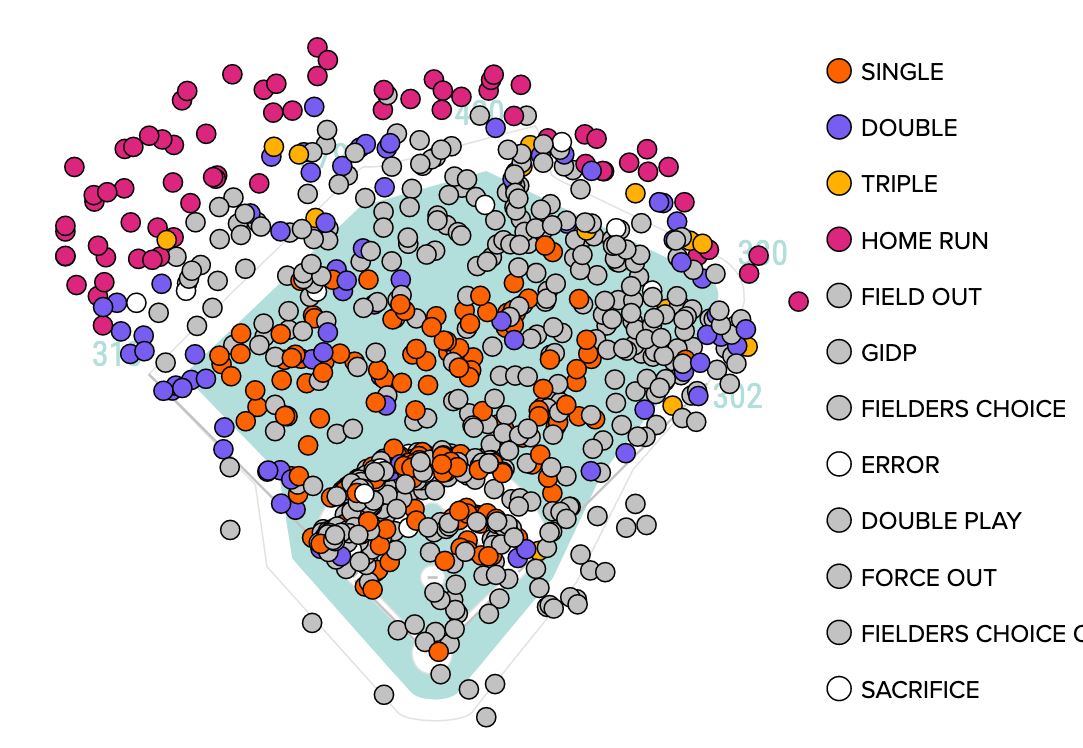
There are numerous caveats with the following, but still . . . Story hit 24 home runs last year. However, if he had played all of his games at Coors, his batted balls (all things being the same) would have resulted in 19 homers. With all his games at Fenway, he would have finished with 39 dongs -- and that number is similar in each AL East park: New York 48, Baltimore 42, Toronto 36, Tampa Bay 33.

This is Story's spray chart for the last three season, overlaid onto Fenway Park. A lot of left field fly outs would be doubles and home runs and hardly any of his right-field homers would be caught.


I can't improve on Matthew Kory's summary:

This will almost certainly put the Red Sox over the Luxury Tax threshold for the 2022 season. . . . 

This is not a permanent trip to Cap Hell though. A tremendous amount of money comes off the Red Sox' books after this season and that will drop them well below the tax threshold, at least as things stand now. By my math, $97 million will drop off after this season . . .

It's impossible to predict the future, but before the 2021 season Story would been listed among the safer bets. In fact, had Story hit the market a season earlier, he likely would've been in line for a contract of roughly twice the size he just signed. The 2021 season and his elbow injury throw that into some question. . . . Overall though, he's a well-rounded player with power, batting average, speed, and good fielding. . . .

Story does a number of things for the Red Sox. He gives them another above average bat and lengthens the lineup. He gives them a long term answer at second base and a fall back option at shortstop should Xander Bogaerts get hurt during the 2022 season or leave following it. For 2022, he makes the Red Sox better both in the field and at the plate. For 2023 and beyond he gives the Red Sox a strong floor at an important position. . . .

Story pushes Enrique Hernandez to center field full time, which makes the best use of Hernandez's skills. Story also pushes Christian Arroyo to the bench as a backup infielder, a role he's probably more suited for than starter.

As for the front office, this is the biggest splash the Red Sox have made since signing David Price before the 2016 season. . . . Most importantly, the Red Sox are a better team today than they were yesterday. Considering what has happened in the AL East since the end of the 2021 season, that wasn't just extraneous, it was necessary.

Globe: International Drug Lord César Peralta Ordered Hit On David Ortiz
(Why? "A Buildup Of Perceived Slights And Jealousies" Is (For Now) Investigators' Best Guess)

An explosive report from the Globe's Bob Hohler details a "brazen alleged murder conspiracy" by international drug lord César "The Abuser" Peralta to assassinate Red Sox icon and Hall of Famer David Ortiz.

Former Boston police commissioner Ed Davis was hired by Ortiz to investigate the 2019 shooting. Davis's six-month investigation, in which he was aided by Ric Prado, a former high-ranking CIA official, states that Perlata believed Ortiz had disrespected him so he put a bounty on Ortiz's head and sanctioned the 2019 assassination attempt.

Peralta's lawyer says Peralta "had nothing to do with" the attempt on Ortiz's life and described the two men as "close friends". Ortiz denies having anything other than a casual relationship with Peralta; they lived in the same apartment building for a period of time and Ortiz frequented some clubs that were owned by Peralta. Davis's investigation found "no evidence that Ortiz engaged in any type of business with Peralta or knew him more than incidentally", according to the Globe.

Ortiz was "sad, confused, angry, all kinds of emotions" when Davis told him what he had found.
I accept what Ed and Ric are telling me, but how come no one in the Dominican justice system has told me this is how it went down? Instead, it's the opposite.
From Hohler's article:
Davis's findings contradict narratives presented by Dominican law enforcement officials. They first alleged that an unspecified person with an unknown motive placed a bounty on Ortiz. They quickly abandoned the theory, however, and chalked up the shooting to a case of mistaken identity, without ever implicating Peralta. . . .

Thirteen suspects are awaiting trial in the case . . . [which] Dominican authorities allege [was a hit on] Ortiz's friend, Sixto David Fernández, because he was considered an informant. The gunman, however, mistook Ortiz for Fernández, Dominican prosecutors allege — a theory widely ridiculed because the two bear little resemblance. . . .

Ortiz hired Davis in 2019 partly because he was concerned about the integrity of the Dominican investigation under Jean Alain Rodríguez, the attorney general at the time. Rodríguez has since been jailed on public corruption charges unrelated to Peralta. . . .

Peralta, 47, is currently being held without bail in Puerto Rico, facing charges of conspiracy to import cocaine and heroin. . . .

Peralta was a fugitive from the US charges when Ortiz was shot. Yet he was thriving in plain sight in Santo Domingo, the Dominican capital, where he owned many high-end nightclubs and restaurants and a money exchange. US authorities allege he used the businesses to launder drug money and employ women he trafficked from South America.

The FBI stated in a 2018 affidavit that Peralta's international trafficking network generated millions of dollars, some of which he used to bribe Dominican national police and government officials to avoid arrest, prosecution, and narcotics seizures.

The US Treasury, in designating Peralta a drug kingpin in 2019, said he and "his criminal organization have used violence and corruption in the Dominican Republic to traffic tons of cocaine and opioids into the United States and Europe." . . .

Davis, Boston's police commissioner from 2006-13, said his investigation developed troubling information from a Trinitarios [a violent Dominican street gang] cell in Lawrence soon after Ortiz was shot.

"It was well known in the gang that they wanted to kill Ortiz," Davis said. . . .

[P]recisely why Peralta may have felt so disrespected that he would order Ortiz slain remains murky. Davis said Dominican law enforcement refused to cooperate with his investigation [as did Jean Alain Rodríguez] . . .

Davis said his findings are based mainly on intelligence from US law enforcement sources and Prado's investigation in the Dominican Republic. . . . [They] learned that Peralta's hold on powerful Dominican officials was pervasive. . . .

Davis and Prado allege that Peralta's motive for the Ortiz shooting likely was a buildup of perceived slights and jealousies. . . .

In 2015, Ortiz staged a birthday party at the Aqua Club in Santo Domingo, which Peralta owned and which US authorities later identified as one of Peralta's alleged money-laundering enterprises. Ortiz said he did not know at the time that Peralta owned the club.

After Ortiz retired in 2016, he increasingly frequented the Santo Domingo night scene. Some of the more upscale popular clubs were owned by Peralta, who often exchanged greetings with Ortiz and on occasion posed for a photo with him, Ortiz said.

But the more Peralta watched Ortiz become the center of attention at his clubs, Prado said, the more jealous he became of Ortiz's celebrity.

Ortiz and Peralta also lived for a time in the same luxury condominium building in Santo Domingo, the Naco Blue Tower, Ortiz one floor below Peralta. Ortiz moved into the tower before Peralta and said he moved out "because it was too obvious there were a lot of weird-looking people going into the building, and I wasn't feeling comfortable." . . .

What's more, Prado said, the building came to be known on the streets as "the Big Papi Tower," which may have further rankled Peralta. At 5 feet 5 inches, Peralta stands nearly a foot shorter than Ortiz.

"Like other big-time hoods, Peralta's ego is so big that he could not afford to have his power usurped," said Prado, who recently authored a memoir, Black Ops: The Life of a CIA Shadow Warrior. . . .

There was speculation, too, that Ortiz was romantically involved with Peralta's wife or girlfriend, which Ortiz adamantly denied in the interview. . . .

"Even if there was no affair, just the fact that one of Peralta's women was attracted to David or was flirting with him, that could be seen by Peralta as an affront," Prado said. . . .

Davis and Prado agree with Dominican prosecutors that the hit squad initially was assembled to eliminate Fernández. . . .

Fernández was among more than a half-dozen men seated with Ortiz around front-row tables on the outdoor patio at the Dial Bar in Santo Domingo . . .

As Ortiz sat before a glass of Scotch, the gunman walked up from behind and fired a single round into his back, sending him sprawling. The bullet also pierced Lopez's leg. Fernández escaped unscathed, by the grace of a firearm malfunction, Davis said.

[A frame-by-frame analysis of surveillance footage] revealed that after the gunman shot Ortiz, he pointed the Browning Hi-Power 9mm semiautomatic pistol at Fernández's face and pulled the trigger. But the weapon misfired, a round still lodged in the chamber.

Davis and Prado said the analysis showed the assailant tried a second time to clear the chamber, and when that failed, he fled.

"His intent was obvious," Prado said: The gunman was trying to shoot both Ortiz and Fernández; there was no mistaken identity. . . .

[Ortiz says he is] an innocent victim who has been wrongly suspected of engaging in behavior that invited an attack that caused him immeasurable physical and emotional trauma.

Ortiz travels with security now. He has fully recovered from a fourth surgery last year related to the shooting . . . [and he] yearns to know why anyone might want him dead . . .

March 19, 2022

Red Sox Start Spring 2-0; Eovaldi Will Pitch Opening Day In New York

The Red Sox have begun their spring training schedule with two wins, a 14-2 pounding of the Twins on Thursday and a 7-6 walkoff win over the Rays on Friday. 

The hero of the second game was Christian Koss, who went 3-for-3, clubbing solo home runs in both the eighth and ninth innings, the latter being the game-winner. Bobby Dalbec went deep on both days.

Nathan Eovaldi, who will face the MFY on April 7 in his third consecutive Opening Day start, pitched three innings against the Rays. He faced 12 batters and gave up three hits (including two doubles). After throwing a total of 22 pitches in the first two innings, Eovaldi needed 20 in the third, when he allowed two runs.

Free agent shortstop Trevor Story, who turned 29 last November, has reportedly included the Red Sox on a list of four possible teams.

The Red Sox have signed lefty reliever Derek Holland, 35, to a minor league contract. Holland made 39 appearances for the Tigers last year, with a 5.07 ERA. (For some reason, Ian Browne's story included this irrelevant line: "At his best, Holland was a force, winning 16 games for the pennant-winning Rangers of 2011." That sentence sounds more suited to an obituary. 2011 was a long time ago.)

The Red Sox inked lefty Jake Diekman (3.86 ERA in 67 games for the Athletics last season) to a two-year deal and lefty Matt Strahm for one year. Strahm had a 2.61 ERA in 19 games for the 2020 Padres, but was limited to only 6.2 innings last year because of right knee surgery.

Chris Sale suffered a stress fracture in his right ribcage about a month ago while throwing live batting practice. He won't pick up a baseball for a few weeks.

March 18, 2022

MLB: Ruining Baseball To Attract People Who Don't Care About Baseball
To Wit: "Extra-Inning Runner" Might Be Returning In 2022 (Goddamn It!)


"What can I say? I hate baseball."

Baseball And The Oscars Aren't Broken. Our 'Fixes' Are Making Them Worse.
These Are Two Of The Great Achievements Of American Culture
Julia Fisher, Washington Post, March 18, 2022

. . . Major League Baseball [is] doing seemingly everything in [its] power to make [baseball] worse, tinkering in an attempt to appeal to more viewers. It's as if they're ashamed [about one] of the great achievements of American culture.

MLB has long wrestled with concerns about pace of play. Commissioner Rob Manfred is on a crusade to make games shorter, sexier, more appealing to the lay fan who knows next to nothing about the sport. As a result, the new collective bargaining agreement, signed March 12, seems likely to usher in a pitch clock as soon as 2023. . . .

For the last two years, Americans had to watch an absurd charade in which extra innings began with a runner on second base. All of a sudden, extra-inning baseball . . . became, well, not baseball. Runs were scored by runners who had never reached base, wreaking havoc with statistics, threatening aneurysms for anyone trying to keep a scorebook, damaging the integrity of a sport in which, traditionally, every inch on the base paths is earned. It seemed that that abomination would end this season, but as of last Tuesday, talks to keep the ghost runner have resumed. So there will be fewer glorious 18-inning games keeping fans glued to their televisions, in awe of the drama of baseball.

Already gone are the perfunctory balls thrown in an intentional walk, which means that one of baseball's great, rare delights — seeing a batter lean over and hit a lazy pitchout — has disappeared forever. MLB officials have threatened to ban position players from pitching. And they've instituted a rule by which pitchers must face three batters or complete an inning before being removed from a game.

Worst of all, the National League recently adopted the designated hitter. (Never mind that this change is likely to make games longer, not shorter.) . . . 

All these rules changes rob baseball of its idiosyncratic joys. Fans who live and breathe the sport, who luxuriate in its weirdness, are seeing an ever more streamlined game — a more boring game. Most of the best things about baseball are unpredictable; its special character lies in its ability to yield, a few times a season, a play or an inning where there's no possible response but to marvel, "Baseball!" But Manfred and his cronies are convinced that a less weird game will appeal more to the non­-fans whom they want to fill ballparks (and will protect increasingly fragile players), so we're stuck with the changes. Lovers of the sport will just have history to remember. . . .

Last year's Oscars ceremony — damaged by coronavirus protocols, yes, but mostly by the academy's own obliviousness, its seeming desperation to make the show about anything but movies —was more or less unwatchable. . . . 

The far more exciting event on television that night — and playing out live just a few miles away — was a matchup between the Los Angeles Dodgers and the San Diego Padres. That game, which the Padres won, 8­-7, featured a pinch-hitting appearance by the Dodgers pitcher Clayton Kershaw. There were charges of sign-stealing. The game went 11 innings. It was weird baseball, unexpected baseball — beautiful, exciting baseball. It lasted four hours and 59 minutes, and no one glued to the game would have wanted a minute less.

Here's the thing the folks running baseball and the Oscars seem not to understand: Short and bad doesn't help anyone. No one tunes into the Oscars or a baseball game thinking, "Oh, well, at least this will be over soon." If they see the show as something to get over with quickly, they aren't going to watch. . . .

MLB and the Oscars shouldn't be ashamed to produce baseball and movies, in all their fullness, instead of dumbing good things down to attract people who never cared anyway.

That's right. The extra-inning runner, which was set to tossed into the dustbin of history after last season along with seven-inning doubleheader games, may be returning, like a zombie once thought to be dead.

Jayson Stark and Matt Gelb report:

As part of their negotiations on health and safety protocols, Major League Baseball and the MLB Players Association are discussing restoring the rule that placed a runner on second to begin extra innings, sources on both sides told The Athletic on Monday [March 14]. No agreement has been reached. But several players said they expect the rule to be enacted once the protocols are announced in the next 24 to 48 hours. [Although it's now four days later, I have not seen any decision on this issue.] . . .

The rule was supposed to have expired after last season, but commissioner Rob Manfred has endorsed it multiple times, and players generally like it.

Fan reaction, on the other hand, has ranged from lukewarm to indifferent. . . .

Sources said the union surveyed player reps for all 30 teams Sunday to gauge player interest. Early indications are that players heavily support it. But negotiators continued to discuss it Monday, on several levels. . . .

It is possible that, rather than using it in all extra innings, the ghost runner wouldn’t be used until the 11th inning or even the 12th.

Another concern players have voiced is how stats are handled. In 2020 and 2021, pitchers who allowed the ghost runner to score were charged with only an unearned run. But not surprisingly, pitchers aren’t happy about being held responsible for runs scored by players they never put on base . . .

Are they really considering altering the rule to have it take effect in the 11th or 12th? Jesus, it's like we're back in the 1880s when, over a span of only ten years, the number of balls it took for a walk was changed from 9 to 8 to 6 to 7 to 5 to 4.

March 15, 2022

Unvaccinated Players Will Not Be Allowed Into Canada For Games Against Blue Jays

The Canadian border remains closed to unvaccinated visitors –, and that includes unvaccinated baseball players. This will likely cause some issues when the baseball season begins.

The Red Sox do not play in Toronto until April 25, when they have a four-game series. At that time, assuming Canada's policy does not change, any unvaccinated players will be placed on the restricted list and will not accompany the team. They will not be paid and will not accrue service time for those games, according to the new CBA.

Jennings describes the Red Sox (one of seven teams who did not reach MLB's 85% vaccination threshold last season) as "among the least-vaccinated teams in the majors last year". Xander Bogaerts*, J.D. Martinez and Chris Sale were among the Red Sox players who refused to be vaccinated against the coronavirus.

Matthew Kory (Sox Outsider) notes that Canada's decision "makes sense. Why import Covid if you don't have to?" He cites Joshua Howsam's tweet:

Well, they have a nice, simple choice: get a free shot that helps prevent the spread of a rampant virus or hurt their team while they lose service time and money.

If the Red Sox have to leave two of their best hitters at home when they visit the Blue Jays because they stubbornly refuse to take common sense guidelines against a virus that had killed more than one million Americans, how will that sit among the players who did the right thing, both for themselves, their families, and their teammates? And if Red Sox end up not making the postseason, perhaps in part to going 3-7 (for example) in Toronto how will that look and be accepted?

*: According to this New York Times article, Bogaerts is now vaccinated.

The article also reports that unvaccinated members of the Yankees and Mets will not be able to play in any home games this season.

Under a New York City regulation enacted on Dec. 27, people who perform in-person work or interact with the public in the course of business must show proof that "they have received a COVID-19 vaccine." The proof of vaccination must show that a worker is fully vaccinated, has received a single-dose vaccine or, if only the first shot of a two-dose vaccine has been administered, then there must be evidence of a plan to receive the second dose within 45 days of the first.

The mandate "grants an exception for visiting professional athletes and anyone who accompanies them, along with performing artists and college athletes".

The Red Sox begin the season in New York on April 7, three weeks from this Thursday.

It was reported last year that Aaron Judge was not vaccinated. When he was asked about his status yesterday, Judge refused to answer -- which most likely means he's still unvaccinated:

I'm so focused on just getting these first games of spring training so I think we'll cross that bridge when the times comes. But right now, so many things could change. So I'm not really too worried about that right now.

Yeah, he's so focused, he can't take a one-half of a second to say "Yes" to whether he is vaccinated. Such dedication to his craft (i.e., hanging out on the injured list).

Like the Red Sox, the Mets were among the six teams (a link above states it was seven teams; amazingly, later in this same Times article, the number is also given as 10 teams!) that did not reach MLB's vaccination threshold of 85% which allowed teams to loosen pandemic protocols.

I don't follow basketball at all, so I'm amazed to learn that Kyrie Irving (unvaccinated) of the Brooklyn Nets has played in only 19 of his team's 69 games this season, being allowed to play only in cities with no vaccine mandate.

I am having difficulty imaging the utter shitstorm if Judge refused to get vaccinated and was unable to play in any of his team's home games. I'd love to see it, though.

Boo: Gary Maniloaf got traded to the Twins.

March 11, 2022

Paywall Baseball: MLB Gives Fans Yet Another Middle Finger

MLB has been negotiating exclusive broadcast deals with streaming services, arrangements that will leave fans who do not spend additional money for the particular services (in addition to the annual MLBTV charge or month cable costs) with no option to watch.

It's impossible to argue that these decisions are anything but a money-by MLB grab with zero benefit to fans.

AppleTV+ ($4.99 per month) will broadcast two games each week as part of a "Friday Night Baseball" double-header. The five-year deal will reportedly pay MLB $425 million ($85 million per year).

If the proposed deal with NBCUniversal goes through, Peacock would show 18 games, on Monday and Wednesday nights. Another report states Peacock is finalizing a deal for exclusive rights to stream Sunday games.

While Peacock Premium is free for Comcast subscribers everyone else will pay $4.99 per month or $9.99 per month for Peacock Premium Plus "without most ads". Cool. Paying $10 per month won't get rid of commercials and Peacock's definition of "most" is likely extremely elastic.

March 10, 2022

Tentative Agreement On New CBA Reached; Camps To Open Sunday
(New Deal Includes Advertising On Uniforms & Helmets)

ESPN is reporting that MLB and the Players Association have reached a tentative agreement on a new collective-bargaining agreement (2022-26). The agreement came on the 99th day of the owners' lockout.

The Players Association's final vote was 26-12 in favour of the agreement. The eight-man executive subcommittee unanimously rejected the deal; they wanted higher luxury-tax thresholds. The team representatives voted 26-4 in favour, with reps from the Yankees, Mets, Astros, and Cardinals voting no. (At least 20 votes were required for approval.)

Spring training camps will open on Sunday, exhibition games will begin March 17 or 18, and Opening Day will be (tentatively) April 7. If so, the Red Sox will begin the 2022 season on the road against the Yankees.

According to ESPN's Jeff Passan:

The deal materialized after talks ratcheted up this week, when the league made a proposal that bridged the significant gap in the competitive-balance tax, a key issue in the end stages of talks. A dispute over an international draft threatened negotiations and caused the league to "remove from the schedule" another two series Wednesday, but those issues were resolved Thursday morning and the league delivered a full proposal to the union, which it voted to accept. . . .

MLB had pushed for expanding the postseason to 12 teams -- a plan to which the MLBPA agreed. Additionally, player uniforms will feature advertising for the first time, with patches on jerseys and decals on batting helmets.

Other elements of the deal include:

• A 45-day window [i.e., the 2022-23 off-season] for MLB to implement rules changes -- among them a pitch clock, ban on shifts and larger bases in the 2023 season

• The National League adopting the designated hitter

• A draft lottery implemented with the intent of discouraging tanking

• Draft-pick inducements to discourage service-time manipulation

• Limiting the number of times a player can be optioned to the minor leagues in one season


Hala-fucking-loo-yah!

March 9, 2022

Manfred Cancels More Games (No Laugh-Filled Press Conference This Time)

Commissioner Rob #FireManfred has "removed from the [2022] schedule" an additional week of games.

Because of the logistical realities of the calendar, another two series are being removed from the schedule, meaning that Opening Day is postponed until April 14th.

On March 1, #FireManfred said the first week of games had been cancelled. But it appeared that as of March 7, MLB was still planning on a 162-game schedule, leading one to assume #FireManfred's laff-riot cancellation was not really a cancellation. But now it looks like #FireManfred has flip-flopped on his flip-flop. 


(Found here.)

Dan Szymborski muses: "My guess is that MLB's abrupt cancellation instead of another counterproposal suggests that Manfred no longer had 23 owners for another step further."

I hear the Players Association is also working on an album:

"Manfred's Farm"
"I Don't Believe You (MLB Acts Like They Never Have Colluded)"
"It's Alright, Ma (I'm Only Tanking)"
"Stuck Inside of Bargaining with the Manfred Blues Again"
"Idiot Wind"

March 7, 2022

Players Union Agrees To Pitch Clock, Larger Bases, Restrictions On Shifts (As Early As 2023)

The Players Association submitted a new proposal to MLB during Sunday's bargaining session. The biggest news from that proposal, according to Evan Drellich of The Athletic, was "outside of core economics".

The players agreed, contingent on other things, to an element the league was seeking regarding on-field rule changes: the ability for the commissioner to put in a pitch clock, larger bases or restrictions on the shift, as early as the 2023 season. . . .

The commissioners office had recently asked the players for the ability to implement some major rule changes sooner than is currently allowed, dropping the time required from one year to 45 days. The players agreed to it in three areas that MLB wanted — the pitch clock, larger bases, and restrictions on the defensive shift — but not for the implementation of an automated strike zone, which MLB also sought. 

To say I am disappointed by the Players Association's agreement to a pitch clock, bigger bases, and banning shifts to some degree would be a gross understatement. When the players start colluding with the owners to wreck the game . . . 

I am not against a pitch clock in principle, but look at what MLB is doing here: it wants to make a new rule and have an actual countdown clock rather than simply enforce a rule that has been in the rule book for more than 120 years. Why is MLB doing all of this bullshit rather than telling umpires to enforce Rule 8.04?

8.04 When the bases are unoccupied, the pitcher shall deliver the ball to the batter within 12 seconds after he receives the ball. Each time the pitcher delays the game by violating this rule, the umpire shall call "Ball."

The 12-second timing starts when the pitcher is in possession of the ball and the batter is in the box, alert to the pitcher. The timing stops when the pitcher releases the ball. The intent of this rule is to avoid unnecessary delays. The umpire shall insist that the catcher return the ball promptly to the pitcher, and that the pitcher take his position on the rubber promptly. Obvious delay by the pitcher should instantly be penalized by the umpire.

There is nothing wrong with that rule. It's been around forever and it covers everything: the catcher promptly throwing the ball back to the pitcher, the pitcher getting back on the rubber quickly, an alert batter in the box, and the next pitch on its way. 

I suppose I can understand why MLB would not want to revise Rule 8.04 to 20 seconds (which is the time MLB has mentioned in recent years regarding pitch clocks). Because the first words out of any even semi-conscious reporter should be:

Wouldn't it be easier if the Commissioner simply insisted that the 12-second rule be enforced? In fact, why hasn't he never mentioned that rule publicly? And if he's so determined to speed up games, why is he agreeing to nearly double the time the pitcher can wait before delivering his next pitch?

Why do we need bigger bases? Is it so MLB can eventually slap larger advertisements on them?

Talk of banning shifts makes my goddamn blood boil. In fact, it's better if I don't think about this very much and just copy what I wrote last July, when the Commissioner Rob "Ruining Baseball Every Day" Manfred spoke about probably ending some of his dumb-ass rule changes for the 2022 season, but mentioned the possibility in the future of dictating where teams can put their fielders on the field:

Manfred said he remains serious about fucking the game up by other means, such as banning shifts:

Let's just say you've regulated the shift by requiring two infielders each side and second base. What does that do? It makes the game look like what it looked like when I was 12 years old. It's not change; it's kind of restoration, right?

I think front offices in general believe it would have a positive effect on the play of the game. I'm hopeful, without going into the specifics of rule by rule, that we will have productive conversations with the MLBPA about, let me use my words, non-radical changes to the game that will restore it to being played in a way that is closer to what many of us enjoyed historically.

How in the hell can requiring that two infielders remain on each side of second base be a restoration when that set-up has never been a rule, ever, in the entire history of the game?

And played in a way that we enjoyed historically? If I recall, there has never been a rule stipulating where a fielder can or cannot stand in fair territory. If Alex Cora feels like having all four infielders and three outfielders bunched together in a group-hug in the right field corner, then that should be his goddamn prerogative. It's horrible strategy, certainly, but it should be allowed.

Re-reading that really pisses me off. "It's kind of a restoration"? My fucking ass!!! 

Did you know that Manfred had not been Commissioner for even one week before he started talking about "eliminating shifts"? (Well, clearly, I kept thinking about it.)

I have always said I would stop this blog when I got tired of writing it. At a couple of points along the way, I thought I might have reached that point, but it turns out I was wrong. . . . Now I'm pretty much convinced it will end because I stop following baseball.

In the immortal words of Mr. Elia: "It's a disheartening fucking situation we're in right now".

March 5, 2022

"Millionaires vs Billionaires" (Part 2: What Percentage Of MLB Players Reach Free Agency?)

I asked the SABR-L community: "What Percentage Of MLB Players Reach Free Agency?" I wondered how many major league players last long enough to put themselves on the "open market".

Two responses came in today:

Pete Ridges wrote:
Or, Do most players have short careers?

1) Let's start by looking at all the position players whose last game was in 2012, say. I count 98 players.
86 of 98 played at least 10 games in their career.
60 of 98 played at least 100 games.
21 of 98 played at least 1000 games.
7 of 98 played at least 2000 games.
1 of 98 (Omar Vizquel) played 2968 games.
The median was 170 games, but the mean is 492 games. Players around the median include Mike McCoy, Jason Donald, Jeff Clement, Scott Moore...if you can recognise half of the names on the list, you must have been paying very close attention.

2) But if, instead, you pick a random box score from 10 or 20 years ago, you may well recognise most of the names. You may well find that all (not just 60%) of the position players in that game played at least 100 career games, and that about half played over 1000 games.

On the list of 98 players, Omar Vizquel and Eddy Rodriguez [Padres catcher, 2 games] count the same: each is one of the 98. But if you pick a box score, you are far more likely to come across Vizquel than Rodriguez. The top 12 players on that list had a total of 24,454 games: the other 86 players totalled only 23,717 games. In fact, the 49 players below the median totalled 2611 games, which is fewer than Vizquel alone. So, picking a random game, you are slightly more likely to pick a box score containing Omar Vizquel than a game with even one player who was below the median.

So, which question are we interested in? The percentage of all the players in the encyclopedia, or the percentage of players in a typical game?

Finally, note that the number of players with single-digit career games depends partly on transaction rules, such as September roster sizes and how many options a player has. These rules may not be relevant to other discussions.
Sean Lahman wrote:
Talent is not normally distributed at the MLB level, as Bill James pointed out in his abstracts, because big league players represent the far right end of the bell curve. It's important to remember this when looking at salaries or career lengths.

There aren't any public data sets (afaik) that track service time, but we can approximate that by looking at games played, at least for batters. I looked at the 763 players who made their debut from 2005-2012, and here's how their careers panned out. I used 125 games as a proxy to measure a full season in the big leagues.

Sixty percent of players played less than three seasons, which means they didn't play long enough to become eligible for arbitration. 25% of players made it to six seasons, which is the threshold for free agency. Roughly 10% of players made it to 10 seasons. Raw data is below. I think any methodology would produce a similar shape.
Career Games Played
 Pct       Games    Cum. %
39.3%      1-125
12.1%    126-250   (51.4%)
 8.6%    251-375   (60.0%)
--------------------------
 7.1%    376-500   (67.1%)
 4.6%    501-625   (71.7%)
 3.3%    626-750   (75.0%)
--------------------------
 4.6%    751-875   (79.6%)
 3.6%    876-1000  (83.2%)
 3.6%   1001-1125  (86.8%)
 3.1%   1126-1250  (89.9%)
--------------------------

March 4, 2022

"Millionaires vs Billionaires"

Categorizing the negotiations between Major League Baseball team owners and players as a case of "billionaires versus millionaires" is both a tired trope, incorrect, and a clear signal the speaker has no real understanding of the issue.

While the 750 players lucky enough to secure a spot on the 25-man roster of one of the 30 major league teams make far more than minimum wage, there are other factors worth considering.

Those players are the absolute best (or among the absolute best) in the entire world. Their jobs are almost literally impossible to get. There are 2.3 billion people on the planet between the ages of 20 and 39 (29.9%). If half that number (1.15 billion or 15%) are male, then only 1 out of every 1,533,333 men will find a spot on a major league roster.

While in the minor leagues, players are paid sub-poverty wages. Not using its tremendous power to help players in the minors is one of the Players Association's greatest mistakes.

In 2019, the last full season before the pandemic, MLB recorded an unprecedented $11 billion in revenue.

According to a 2007 study published in Population Research and Policy Review, 5,989 position players played 33,272 years of major league baseball from between 1902 and 1993. That puts the average career length at 5.6 years.

Most players spent their entire career under team control, never reaching free agency* (which comes after six years of service time). Fewer than half of all rookies stay in the majors long enough to play a fifth season and one in five position players end up lasting only one season.

Breaking the data down by eras:

Early Era (1902-1945: 4.3 seasons
Golden Age (1946-1968): 6.47 seasons
Modern Era (1969-1993): 6.85 seasons

I looked for information on what percentage of major league players reach free agency, but I came up empty.

Millionaires & Billionaires

Player X has $3 million (each * indicates $1 million):

***

Owner Y has $3 billion (each * indicates $1 million):

************************************************************************************************************************************************************************************************************************************************************************************************************************************************************************************************************************************************************************************************************************************************************************************************************************************************************************************************************************************************************************************************************************************************************************************************************************************************************************************************************************************************************************************************************************************************************************************************************************************************************************************************************************************************************************************************************************************************************************************************************************************************************************************************************************************************************************************************************************************************************************************************************************************************************************************************************************************************************************************************************************************************************************************************************************************************************************************************************************************************************************************************************************************************************************************************************************************************************************************************************************************************************************************************************************************************************************************************************************************************************************************************************************************************************************************************************************************************************************************************************************************************************************************************************************

Fun Facts:

The height of a stack of 1,000,000 one dollar bills is 358 feet (about 1/15 of a mile).
The height of a stack of 1,000,000,000 one dollar bills is 67.9 miles.

The length of 1,000,000 one dollar bills laid end-to-end is 96.9 miles.
The length of 1,000,000,000 one dollar bills laid end-to-end is 96,900 miles (around the earth almost four times)

Spending $1,000,000 at a rate of $20/second would take 13 hours, 48 minutes.
Spending $1,000,000,000 at a rate of $20/second would take 578 days (1 year, 214 days).