March 1, 2022

Manfred Laughs And Smirks, Cracks Jokes Before Canceling First Week Of 2022 Season

MLB Commissioner Rob Manfred laughed and smirked during Tuesday afternoon's press conference . He cracked jokes and generally looked like he was enjoying himself. He also cancelled the first two series of the 2022 season — and more games will certainly be trashed in the weeks ahead.

"You could not invent a more disastrous public face for the game of baseball if you tried."

This asshole, whose every word and action telegraphs his intense desire to kill baseball, whose annual salary is $11 fucking million, cried poverty, claiming revenue has been "difficult" for MLB over the last five years. In 2019 (the last full season before the pandemic), MLB raked in a record-setting $11 billion in revenue. That's one example of the bullshit being shoveled this afternoon.

Manfred: We Have To Destroy Baseball In Order To Save It


On February 10, MLB Commissioner and Hater-of-Baseball Rob Manfred lamented the cancellation of any regular-season games because of his decision to lockout the players during negotiations for a new collective bargaining agreement as "a disastrous outcome".

A mere eighteen days later, Manfred indicated his "willingness to miss up to a month of games".

MLB had set a firm, but completely artificial, deadline (March 1) for agreement with the Players Association on a new CBA without the 2022 being affected. It turns out MLB's hard deadline was, in reality, a bit flaccid. The fictional deadline was revised to Tuesday at 5:00 PM ET. That deadline, also, will come and go without an agreement because the Players Association agreed unanimously this morning not to accept MLB's final proposal. 

Manfred has announced a press conference this afternoon at 5:00 PM ET. As Ken Rosenthal of The Athletic has written: "Every time Manfred opens his mouth publicly, he only makes matters worse." Today will be no different.

It has taken a while, but the growing consensus among many baseball writers is that MLB is . . . I believe the legal term is . . . full of shit.
(Note: All bolding in quoted articles quotes is my emphasis.)

Ken Rosenthal (The Athletic) wrote last week:
If commissioner Rob Manfred truly believes missing games will be a "disastrous outcome for the industry," he sure does not appear to have convinced his bosses, the 30 major-league owners.

The players' union made moves on Saturday [February 26], moves it considered significant toward reaching a new collective-bargaining agreement. Major League Baseball responded by raising a collective middle finger.
Rosenthal wondered when MLB would finally "make the union an offer that at least appears reasonable". Manfred's actions and words in recent years have galvanized the players, "uniting them in a way the sport has not seen since the strike of 1994-95".
The owners are so intent on a zero-sum victory, so cavalier about the possibility of missing games, they do not even care how fans might interpret their actions. . . .

The league from the start has said it will not consider shortening time to free agency, expanding salary arbitration eligibility or reducing revenue sharing, equating its rigid stance in those three core areas to the players' refusal to negotiate a salary cap. The difference is that those three areas were part of past CBAs and a salary cap was not. But the players, recognizing the owners will not give, have essentially given up the fight. Their only remaining ask is in arbitration, where their requested increase in the percentage of Super Two players from 22 to 35 percent hardly is a game-changer.

Many of the league's "concessions" — a draft lottery, provisions to limit service-time manipulation, the amount of money it is willing to devote to a pre-arbitration bonus pool — are just slightly above the inclusion of floor mats by a car dealer in the purchase of a new vehicle. Heaven forbid the owners negotiate the actual price of the car. . . .

For additional fun, the league also tried to link the expanded playoffs, the union's most valuable bargaining chip, to the draft lottery, an anti-tanking measure that, without additional provisions attached, might have minimal impact. The "deal" [was] the equivalent of Mike Trout for a Triple-A reliever . . .
Rosenthal believes fans are "fairly unanimous — and aligned with the players — in their contempt for Manfred". I honestly don't know if that is true or not.

Manfred has lied continuously since inaccurately calling the owners' actions against the players a "defensive lockout" move and then laughingly saying it was done to "jumpstart" negotiations before doing fuck-all for 43 days before agreeing to do any negotiating. 

I've said before that there are disturbing similarities between Manfred and Donald Trump. The one that presently comes to mind is having convinced yourself that everyone else is dumber than you are and lying with the expectation that no one will remember anything from the past.

Craig Calcaterra, in February 28's edition of "Cup of Coffee", says MLB's latest offer is so insulting, "stonewalling would be less hostile. . . . No response to the players' offer would be preferable and more constructive than the offer they actually made." He cites Rosenthal's article (linked above) as evidence  of how obviousness MLB's bad-faith bargaining and transparent public lying has been, noting that Rosenthal "has no history whatsoever of being a union firebrand".
There is only one conclusion that can be drawn from this: that the owners are seeking to break the union and that they are willing to sacrifice a big chunk of the 2022 season in order to do it. There is no other rational interpretation. The owners, through their behavior, are essentially mocking the very notion of the players even having demands in the first place. . . . On Saturday the players made a comprehensive proposal. It was the kind of package MLB officials have insisted the players must propose if there was going to be any kind of a deal. And it was a package that made considerable movement towards the owners' position. Specifically:
The players dramatically reduced their demands regarding the number of players with two-plus years of service time who would qualify for arbitration, dropping from 75 percent of those players to 35 percent.

That's only 13 percent more than the number of players who qualify under the current Super Two setup;

The players decreased their demands regarding competitive balance tax thresholds by $2 million each in the second, third and fourth years of an agreement; and

The players dropped their request for a revised revenue-sharing policy that would penalize small-market teams for losing, instead focusing only on their request to reward small-market teams that increase local revenue on their own with more shared revenue.
Anyone who has followed these negotiations even remotely closely knows that this represents a significant ratcheting-back of demands on the part of the players. Indeed, given how revenues have grown and given the inflation rate, these demands, such as they are, would arguably result in a deal that is better for the owners than the 2017-2021 CBA that just expired. It promises to give the owners more in revenue than they even had before.

And the owners rejected it almost completely out-of-hand.
As Neil Weinberg tweeted: "MLBPA isn't even asking for a fair deal at this point. They're asking to be taken advantage of slightly less than during the last CBA."

So what should the union do? Calcaterra offers a suggestion:
[T]ake the owners up on their invitation. Tell them that they have made their last best offer. Tell the owners to call when they are ready to lift the lockout because they'll happily play without a CBA rather than continue to bash their heads against a brick wall. When they do that, they should tell the owners that wherever this ends up, expanded playoffs are now off the table and that the owners should not come crying to them when their debt holders and gambling partners get upset that the money isn't flowing and the action isn't happening.

In response I presume the owners would attempt to declare a formal impasse which would allow for them to legally impose their last offer, but such a move only works if they are found to have been negotiating in good faith. This is essentially what happened in 1995, remember, when the owners tried to use scab players to break the strike, at which point the matter went to court, the court found that the owners were not acting in good faith, and the players agreed to go back to work under the old deal while a new one was negotiated over the course of nearly two years.

In this case I'd love to see the owners argue that, in a time of massively-expanding revenues, that their proposal of an all-but-hard salary cap — in the form of a below-inflation tracking threshold and more draconian penalties than which previously existed — shrinking minimum salaries due to the operation of inflation, and the players giving them a half-billion dollar gift in the form of expanded playoffs is "good faith."
Or: Calcaterra explained how this shitshow developed in the first place:
I'd argue that we got here because there exists a baseline sense of entitlement on the part of the current generation of owners. They are a group of men — led by their toady, Rob Manfred — who truly and vehemently believe they should get to dictate terms in all things, be it labor, stadiums, regulation, taxes, you name it. They are the product of two to three generations of rich men who grew into adulthood and/or came into power in an environment in which labor rights are assumed to be illegitimate and no one ever -- ever -- says no to capital. They are the standard-bearers of our new Gilded Age and they are genuinely offended at the notion that they are not entitled to the maximal percentage of riches generated by the labor of the people they employ.

The owners' position here, by the way, has been telegraphed for many years. Back in 2019 Major League Baseball and the MLBPA took the unprecedented step of opening Collective Bargaining Agreement negotiations over two years before the current CBA expired. Most took that as a sign that the parties were cognizant of how difficult the negotiation of the next agreement would be and considered it to be evidence that the owners took the matter seriously. Except they didn't.

As I reported at the time, Rob Manfred took an aggressive posture, telling the union that there was "not going to be a deal where we pay you in economics to get labor peace" — which is the very definition of a labor negotiation — and that "maybe Marvin Miller's financial system doesn't work anymore." Sources close to those negotiations told me at the time that the impression left by Manfred's comments were that the league planned to take a hard line with the union and was unwilling to make any concessions on the numerous pocketbook issues about which the players were concerned.

What was clear then, and is even more clear now, is that Major League Baseball and its owners do not believe that the players have the will to fight. Sources close to the players told me back in 2019 that the league was underestimating player anger, resolve and solidarity, and that, even then, the union was telling players and their agents that they needed to gear up for battle. We had a preview of that battle in 2020 when the owners misread player resolve with respect to the nature and shape of the truncated pandemic season and got more of a fight than they were expecting. We're now seeing it again. The owners believe they can run roughshod over the players and do not seem to believe that the players will do what they need to do in order to not let that happen.

As the kids say, the owners are fucking around. If I'm reading player sentiment correctly, they're about to find out.
Jeff Passan (ESPN) pulled no punches, stating MLB's feints towards good-faith negotiating have been a "monthslong charade". MLB is "willing to immolate the game to achieve its goals":
Major League Baseball is in a crisis of its own making, a self-inflicted wound borne of equal parts hubris, short-sightedness and stubbornness from a class of owners who run the teams and seemingly have designs on running the game into the ground. . . . It is a study in the consequences of bad behavior -- of indignities big and small, of abiding by the letter of the law while ignoring its spirit and, worst of all, of alienating those who make the sport great.

The players are angry at the trajectory of the negotiations, which have inched along for almost a year with little demonstrable progress. More than that, they're tired of the game they love saying, in ways both active and passive, it does not love them back.

Player pay has decreased for four consecutive years, even as industry revenues grew and franchise values soared and the would-be stewards of the game pleaded to anyone who would listen that owning a baseball team isn't a particularly profitable venture. Players' service time has been manipulated to keep them from free agency and salary arbitration. The luxury tax, instituted to discourage runaway spending, has morphed into a de facto salary cap, and too many teams are nowhere near it anyway, instead gutting their rosters and slashing their payrolls because the game's rules incentivize losing. The commissioner has called the World Series trophy a "piece of metal," and the league has awarded the team that did the best job curtailing arbitration salaries a replica championship belt. Any of these is a problem. In aggregate, they served as a call to action for the players . . .

Since the [Competitive Balance Tax]'s arrival in 2003, 13 MLB franchises have won the World Series and 19 have played in it. That is the exact same number of teams as in the salary-capped NFL, far better than the nine champions and 14 competitors in the salary-capped NBA and right there with the 11 Stanley Cup winners and 21 finalists in the salary-capped NHL. In the championship seasons prior to the CBT era, 14 organizations won the World Series and 20 made it. The CBT was about competitive balance like "Citizen Kane" was about a sled. . . .

MLB sold the CBT as a way to rein in so-called runaway spending by the New York Yankees. Over time, though, the real intent -- a salary cap in sheep's clothing -- revealed itself. The tax rates grew. Draft-pick penalties joined the fray. Of all the brilliant negotiating Manfred did during his time as the league's lead labor lawyer, his work on turning the CBT from carrot to stick stands out. In September 2017, he said the quiet part out loud in an interview with a San Diego TV station.

"We have tried to deal with payroll disparity by limiting, through the use of taxes, the very highest-payroll clubs," Manfred said, adding: "For the first time in the 25 years since I've been in baseball, everybody in the top quartile of clubs had payrolls that actually went down this year due to the increased penalties that were negotiated as part of this collective-bargaining agreement."

Nothing illustrates the evolution of the CBT quite as well as the 2021 season. Only the Los Angeles Dodgers and San Diego Padres exceeded the $210 million threshold. Five other teams, however, came within $3.4 million of it. MLB had orchestrated the coup of financial coups in collective bargaining: getting what amounts to a salary cap without a floor or a guaranteed revenue split.

The players noticed. They saw how over the previous two collective-bargaining agreements, the CBT threshold rose about 18% while industry revenues grew by at least 40%. They saw that in 2018, long before COVID existed, their average salaries went down -- as they did again in 2019 and 2020 and 2021, even as the biggest deals in the sport were growing and $300 million-plus guaranteed contracts were no longer outliers. They saw franchise values exploding to the point that in 2021, Forbes estimated, the 30 MLB teams were worth a combined $55.28 billion. Ten years ago, only two collective-bargaining agreements earlier, their combined valuations were $15.68 billion. . . .
Passan, again:
Arbitration has always been a contentious process, and players were livid when they learned MLB celebrated tamping down salaries by awarding a championship belt to the team that did it best. During spring training in 2020, when MLB was reeling from widespread criticism by players that Manfred had been too soft on the Houston Astros for cheating during their championship run, he referred to the World Series trophy as a "piece of metal" in an interview with ESPN's Karl Ravech.

"'Piece of metal' was the Gulf of Tonkin," one longtime baseball man said. "It was the aha moment for everyone. And then he did it again recently with everything about how owning a team isn't that profitable. Treating players like they're stupid has never worked. It's never been a great approach."

Baseball, it seems, can't help from doing it, and it's a symptom of those in ownership who regard players with disdain and struggle to stomach the notion that they warrant the salaries they receive. There are good owners, ones who prioritize winning above profits and understand baseball is wildly different from the businesses in which they made their billions.

Sports is a unique industry. Typically, workers make a product. In baseball, they are the product. The game of baseball is the framework, and in it exists two classes: players and owners. Players spend their entire lives chasing the major leagues. Just making it there is improbable. Staying long enough to make life-changing money is a miracle. Owners, on the other hand -- at least those who don't inherit their teams -- join the baseball world just as they would a country club: by buying membership.

If you went and got the next 1,200 best players in the world, the product would suffer greatly. If you handed MLB teams over to any 30 competent businesspeople, the sport would not suffer. Actually, it might improve. It doesn't take a billionaire to leverage a spot in a legalized monopoly with profound built-in revenues. . . .

The coming days will show how real the league's threat of a hard deadline actually is. . . .

In the meantime, players will do what they've been doing for months: sending one another messages about the current state of affairs and, more often than the commissioner may realize, screenshots of Manfred's golf scores at Winged Foot, as found on Reddit. Gallows humor is the only kind that plays these days, when players' lives and livelihoods are interrupted for no good reason other than that the owners can. . . .

Already this is the second-longest period of labor strife in baseball history, and though it has stopped transactions and doused the hot stove and generally cast the sport in an awful light, until today, the most tangible thing lost was spring training. Soon, that won't be the case. This is Rob Manfred's disaster, the league's disaster, the owners' disaster, and it's been a long time coming.
[Manfred's penchant for golfing during crisis is yet another Trumpism.]

On February 10, Manfred said: "I'm the same person today as I was in 1998."

Beware the man who admits he has not learned anything in 24 years.

Joe Posnanski (Joe Blogs) thinks the recent sessions have been more productive because of the issue of expanded playoffs. MLB wants nearly 50% of teams (14 of 30) to make the postseason.
I think the owners realized in a very real way that the players actually don't want the playoffs expanded. My guess is that, all along, the owners kind of thought expanded playoffs would be something they could just throw in to the deal, good for everybody, kind of like the universal DH.

But the players don't see expanded playoffs as a good thing. I also don't see expanded playoffs as a good thing, but we have different reasons. The players seem to believe that the easier it is to get in the playoffs, the less urgency there is for good teams to spend money.

They are undoubtedly right. The one thing we have seen in baseball is that there does not seem any way to incentivize small-market (and tanking) teams to spend money on players. The CBT was SUPPOSED to give those teams more money to spend on improving, but that turned out to be a joke. The added wild-card team was supposed to give those teams more reasons to try, but that turned out to be a joke too.

So, my guess, owners realized that they probably needed to be just a little more generous in their terms to secure the extra playoffs they want. They offered a somewhat better deal to the players if they would agree to a 12-team playoff (it was 10 teams last year) and a better deal still if they would agree to a 14-team playoff. The players were willing to explore a 12-team option if . . .

And that's where we are.

Now, personally, I utterly loathe the idea of expanded playoffs because I see it as yet another short-sighted, short-term money grab that makes the baseball season even less special. To play 162 games to eliminate just 60% of the teams is nonsensical, and continues that long but persistent march to eradicate what made baseball special and different in the first place. But the people who run baseball have long given fans lesser evil choices, and if forced to choose between expanded playoffs or months without baseball because of a labor war, I suppose I'll take expanded playoffs and the slower decline into the abyss.
I have been walking slowly down into the abyss for several years. I'm about ready to turn around and walk away. I do not need to see the abyss.


* * *

Of course, not all media are seeing clearly:

* * *

Crying Poverty All The Way To The Swiss Banks

Yeah, Jeets

February 26, 2022

Red Sox Release Minor Leaguer After He Posts Racist, Homophobic, Anti-Semitic Tweets

The Red Sox released minor leaguer Brett Netzer after he confirmed he had posted a series of racist, homophobic, and anti-Semitic tweets on Friday night and Saturday morning.

Netzer last played (though not very well) in 2019 for Portland (AA). The 2020 minor league season was canceled and Netzer spent the 2021 entire season on the restricted list.

Netzer started off last night claiming it's unnatural for human beings to have dogs and cats as pets ("more time should be spent on pursuing truth"). I suppose that's an interesting take, though it's in stark contrast to about 30,000 years of history.

After that, triggered by ???, Netzer (who identifies as a racist) shifted to a few pointed comments about Red Sox chief baseball officer Chaim Bloom – and Jews in general . . . and transgender people . . . and blacks.

Someone noted that Netzer posted "posting screenshots of his tweets [on Instagram] saying 'release me'". The Red Sox obliged him . . . but he didn't seem very thankful.

An epigraph on his Twitter page reads: "Difference of opinion is where education is found." The irony is presumably unintentional.

February 11, 2022

The Universal DH Is Here

MLB and the Players Union have apparently agreed on the use of a Designated Hitter for both leagues, beginning in 2022.

And with that, I am pushed another step further away from a sport I have loved watching, reading about, researching and writing about for more than 45 years.

(But now that a real hitter will bat instead of pitchers who simply take three strikes and sit down, won't games drag on for even longer now?)

Not that anyone is asking, but my choice would be for no DH anywhere. I assume I'm in the minority on that point. Yes, yes, pitchers are more or less automatic outs (they batted .110/.150/.142 in 2021) and the idea of having another hitter bat for the pitcher (or having lineups of only eight men) is not new; it was bandied about as far back as 1891. I don't fucking care.

The necessity of having a pitcher throw four intentional balls should be part of the game for many reasons, one of which is the rare occurrence of when one of those soft tosses pitches sails to the backstop or gets smacked for a hit to the opposite field. Pitchers not named Shohei Ohtani collected 92 extra-base hits last season. Besides, the rules (both old and current versions) state that a game features two teams of nine players. A DH makes that 10 players per side.

Craig Calcaterra notes (in addition to logging Rob Manfred's numerous bald-faced lies in the past day or so) that the "Both sides wanted a DH" explanation being touted by writers like Buster Olney

is misleading to the point of abject disingenuousness. It was a case of the owners wanting to take the single most valuable bargaining chip away from the players [a multi-billion dollar concession of expanded playoffs] — one that they were clearly planning to use as a means of getting substantive concessions from the owners on other, far more important matters — in exchange for something that, while possibly desirable, was relatively worthless.

That's a statement of fact many people are making in reply to Olney's tweet. And Olney must know this, of course, because he is not a moron. So you have to ask yourself (as you have to do when seasoned journalists who have covered national politics for decades make disingenuous statements about either political party), why is he choosing to misinterpret the facts in that particular way? What is the reason? Because if the writer knows better, there must be a reason.

Manfred said the possibility of missing regular-season games (because of his decision to lock out the players) would be "a disastrous outcome". How many writers will point out that it was MLB's choice to lockout the players. It did not have to. MLB could have held the exact same bargaining sessions with the Players Union without instituting a lockout — and without putting the scheduled start of spring training and the regular season in jeopardy. All of the blame for any postponed games will rest on Manfred's weak shoulders.

In yet another Manfred-Trump comparison, one would think someone who lies constantly would eventually get good at it. But it turns out, when it comes to those two asshats, that is not the case.

February 9, 2022

Trevor Bauer Will Not Face Criminal Charges For Sexual Assault (Despite His Lawyers Admitting He Committed Sexual Assault)

Prosecutors in Los Angeles have decided not to bring criminal charges for sexual assault against Dodgers pitcher Trevor Bauer. (I posted about this case back in July and August 2021.)

In a statement provided to The Athletic, the Los Angeles County district attorney stated:

After a thorough review of the available evidence, including the civil restraining order proceedings, witness statements and the physical evidence, the People are unable to prove the relevant charges beyond a reasonable doubt.

Craig Calcaterra calls that decision "stupid and wrong", but he is not surprised. It's not that evidence against Bauer does not exist – Bauer's own lawyers admitted their client committed sexual assault while his victim was unconscious – but comments from the judge [California Superior Court Judge Dianna Gould-Saltman] overseeing the case make getting a conviction more difficult than it would normally be.

As Calcaterra wrote in today's Cup of Coffee (my emphasis):

As you'll recall, at the restraining order hearing, Bauer's accuser testified under oath that Bauer struck her and sodomized her while she was unconscious. She testified that she did not consent to that. Indeed, being punched and sodomized while unconscious was never even discussed. Bauer presented no evidence to contradict that. What's more, in arguments, his lawyers admitted that that's what happened. They claimed however, with no evidentiary backing and in the face of her testimony to the contrary, that she asked for it. Like, they actually said that. That she wanted to be punched and sodomized while she unconscious. Again, these were arguments. There was no evidence presented to support such claims.

As I noted at the time, I know of no legal theory whatsoever that allows for someone to punch and sodomize an unconscious person. The judge, however, said that one can do anything one wants to an unconscious person as long as the unconscious person didn't explicitly say one could not do so beforehand. That sort of "opt-out" instead of "opt-in" consent is not the law and cannot be the law, especially when it involves an unconscious person because how can an unconscious person change their mind or say anything? When there was zero discussion about that head of time, the baseline HAS to be "you cannot punch or sodomize an unconscious person." It's preposterous to say otherwise. Unless, of course, you were the judge in the restraining order hearing.

Between that pronouncement from the bench — an unnecessary one given that the restraining order petition could've been denied without even talking about that stuff given that Bauer had had attempted no contact with the petitioner since the assault — and between several days of proceedings during which Bauer's attorneys slut-shamed the petitioner and portrayed her as a money-grubbing opportunist, it is not at all surprising that prosecutors were loathe to bring charges. Sexual assault cases are extraordinarily difficult to bring in the best of circumstances. Bringing them against the backdrop of what has already occurred in this case would be exponentially harder. Given that high-profile cases invoke political considerations for prosecutors — losing them is bad for them — not bringing a case against Bauer was always the more likely outcome, even though it seems pretty damn clear to me he committed sexual assault. . . .

Bauer's accuser swore under oath in documents and then testified under oath in open court to the following:

Bauer choked her until she was unconscious;

She did not consent to being beaten or sodomized before she was rendered unconscious (note: as a matter of law, and contrary to the non-germane comments of the judge from the bench last August, an unconscious person cannot legally consent to anything and a conscious person cannot consent to having serious bodily harm inflicted upon them); and

Bauer beat and sodomized her while she was unconscious.

Bauer presented no evidence to contradict those assertions. Indeed, Bauer took the Fifth and Bauer's attorney conceded in argument during the hearing that Bauer choked his accuser until she was unconscious and was violent towards her while she was unconscious. To the extent Bauer's attorneys impeached the accuser's credibility, it pertained to matters surrounding her petition for a restraining order, primarily in connection with calls and texts between the two of them after the incidents at issue. There was no apparent impeachment of her credibility as it related to what occurred between the two of them at Bauer's home.

Major League Baseball's investigation into Bauer's actions is ongoing. For MLB to issue a suspension under its Joint Domestic Violence, Sexual Assault and Child Abuse Policy, an arrest, criminal charges, or a criminal conviction is not necessary.

February 6, 2022

Happy 127th Birthday, Babe Ruth!


On this date in 1895, George Herman Ruth was born.

The dates of Babe Ruth's first and final major league home runs are May 6, 1915 and May 25, 1935.

Over that span of 20 years and 19 days, Ruth hit 714 official home runs.

Ruth out-homered two teams over that time period: the Red Sox (653) and Reds (672). Ruth nearly out-homered two additional teams: the White Sox (720) and Senators (724).

He also led both leagues in showing off his big bat to the ladies.

February 4, 2022

MLB Would Rather Concoct Lame PR Tricks Than Negotiate With Players

MLB quickly reneged on its promise (from only two days ago) to present a counteroffer to the Players Association. Instead, it requested federal mediation, which is nothing but a lame public relations stunt.

Giants pitcher Alex Wood asked: "How can MLB request for there to be a mediator from the Federal Government to help with negotiations when they literally haven't even done any negotiating up to this point?"

That seems like a reasonable question. After MLB imposed the lockout on December 2, 2021, it spent six weeks refusing to negotiate. Over the past three months, an unimpressive total of five hours has been spent discussing the issues. And now, rather than honor its promise to continue to negotiate, MLB is pretending it has done everything it can and — what other choice do we have? — must now call in a mediator.

Twins catcher Mitch Garver sees through the bullshit, calling it "a ploy . . . to show they are bargaining in good faith. . . . The league wants the public to think they are doing everything they can."

As Craig Calcaterra put it, MLB is acting "like a kid pouring a whole box of soap into the washing machine, watching bubbles go all over the house, and then yelling for his mom to help".

Ian Happ summed it up:

MLB Steps to Negotiating:
1. Commit to making a counter
2. Refuse to make that counter
3. Say they need a mediator

The Players Association rejected MLB's mediation stunt. Several players pointed out to MLB that in order to agree on a new Collective Bargaining Agreement, both sides must . . . umm . . . bargain.

February 1, 2022

Latest Bargaining Session Turns Into A "Yelling Match"; Start Of Spring Training Likely Delayed

Chris Halicke (Sports Illustrated) quotes a source with knowledge of Tuesday's collective bargaining session between Major League Baseball and the Players Association saying the 90-minute meeting devolved into a "yelling match".

Ken Rosenthal and Evan Drellich (The Athletic) reported on Monday:

Anyone sensing momentum in baseball's collective bargaining negotiations needs to take a deep breath. League and player representatives continue to hold much different views of the game's economics. The scheduled start of spring training in mid-February is clearly in jeopardy. In another few weeks, Opening Day on March 31 would be a longshot, too.

As the owners' lockout drags into its third month, the essence of the problem is this: Major League Baseball contends it is proposing a better deal for players than the one they had under the most recent collective bargaining agreement. And the Players Association contends that the deal is worse. . . .

A breakdown of the most contentious issues in the negotiations reveals just how far apart the two sides are . . .

Minimum salary . . . Arbitration and pre-arb bonus pools . . . Luxury tax . . . Draft lottery . . . Service-time manipulation . . .

The players want significant change, and the owners largely want to maintain the status quo. . . .

A new CBA is not close.

Drellich characterizes Tuesday's meeting as "heated" and writes "the sides remain very far apart with the normal report time for pitchers and catchers about two weeks away". 

Since the next bargaining session has not been scheduled, it is highly unlikely that spring training will begin on time later this month.

The MLBPA made a pair of proposals: one that modifies its pre-arbitration bonus pool, the other on service-time manipulation.

The union, which is trying to get more money to younger players not yet eligible for arbitration, changed its pre-arbitration bonus pool proposal to $100 million. That is a $5 million decrease from its original proposal. The league's most recent offer was $10 million.

Regarding service-time manipulation, the union has proposed a system where a player who might not normally get a year of service time would be credited with one year if they reach certain thresholds and levels of performance. . . .

The union also incorporated and modified an element of MLB's proposal on service-time manipulation, dangling a draft pick to teams as an incentive for not holding a player in the minor leaguers.

January 29, 2022

Fat Billy Goes To Trump's Texas Whine-A-Thon/Public Therapy Session

More here.

January 27, 2022

Event Promotion Implies Dodgers And Angels Are Hosting A Fundraiser For January 6 Insurrection Organizer Who Courts Neo-Nazis (Both Teams Have Been Silent For 2 Days)

The flyer makes it look as though the Dodgers and Angels are hosting a fundraiser for a seditious neo-Nazi. However, it appears that Paul Gosar (six of his siblings called him a "traitor" and endorsed his opponent) has simply purchased a bunch of tickets that he hopes to give out to donors.

My question is: How quickly are the teams speaking out against their logos being used to promote this  racist garbage and forcing Gosar to remove the logos from his announcement?

Answer? Not fast enough.

As I publish this post, it has been close to 48 hours since AZ Right Wing Watch first tweeted the news. Numerous fans sent the tweet to both teams, but neither team has made a public announcement.

Sam Blum, The Athletic (Jan. 26 8:22 PM tweet):
This advertisement for an event w/ Rep. Paul Gosar (extremely controversial/conspiratorial politician) is posted on WinRed. It's a real ad.
IMPORTANTLY: The Angels tell me they have "no affiliation with this event & are working to have our marks removed from the advertisement."
There is also some confusion over the announced date of the event, since the teams do not play each other on February 27.

The slow pace at which MLB and the Players Union are working to end MLB's lockout likely means that nothing will be happening on either February 27 or March 27. The Dodgers and Angels should still made a very public announcement against Gosar using their trademarked logos to make his event look more legitimate.

January 25, 2022

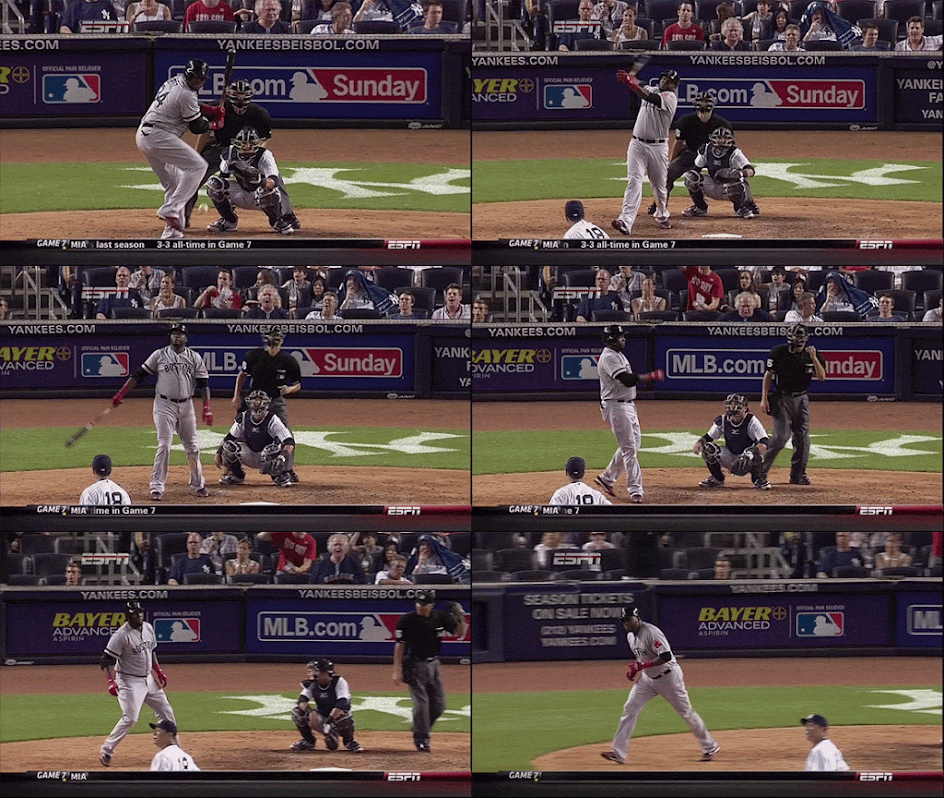
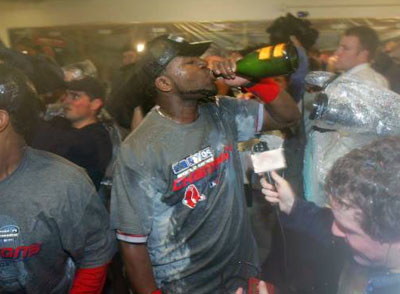
David Ortiz Is A First-Ballot Hall Of Famer (And Now It's Official)


David Ortiz was elected to baseball's Hall of Fame on the first ballot. Big Papi was the only player elected by the Baseball Writers' Association of America to be named on 75% of the ballots. 

Ortiz was named on 307 of 394 ballots (77.9%) and will be inducted with six others on July 24, 2022. The Golden Days and Early Baseball Era committees selected Jim Kaat, Tony Oliva, Bud Fowler, Gil Hodges, Minnie Miñoso and Buck O'Neil.

Barry Bonds finished second (66%), Roger Clemens was third (65.2%), and Curt Schilling was fifth (58.6%). All three players failed to receive the necessary 75% in their tenth and final years on the ballot.

Ortiz spent his first six major league seasons in the Twins organization before being released on December 16, 2002. About one month later, on January 22, 2003, the Red Sox (at the urging of pitcher Pedro Martinez) signed Ortiz as a free agent to a one-year, $1.25 million contract.

Ortiz did not become a fixture in Boston's lineup until May, but once he was given a chance, he provided powerful evidence he belonged. From May 14 to June 14, Ortiz batted .433 in 19 games, with an OPS of 1.174. Only two of his 29 hits were home runs, he also smacked 12 doubles and drew five walks while striking out only nine times. The taters came later: eight in July, 11 in August, and eight in September.
"I was the type of player that I know I've got the talent, but all I was looking for was the opportunity to be an everyday player. Thank God at some point it came true, once I got to the Red Sox, and the rest is history. I feel so thankful and grateful for being able to accomplish what I was able to accomplish and, thank God, have the career I have.
The Large Father's heroics in his first five seasons in Boston were many. From his legendary clutch performances in the magical and still-hard-to-believe-it-happened 2004 postseason to setting a Red Sox single-season record with 54 home runs in 2006 (which led the American League, as did his 137 RBI, 119 walks, and 355 total bases) to leading the led Red Sox to another championship in 2007.

His performance in the 2013 World Series was transcendent: 11-for-16, with eight walks.  a .688 batting average (the best average in WS history of anyone with 16+ PA) with and a 1.948 OPS. In 25 plate appearances, he struck out only once as Boston won its third World Series championship in a decade. 

In his final season – 2016, at age 40 – Flo led both leagues with 48 doubles, a .620 slugging, and a 1.021 OPS. He also topped the AL with 127 RBI.

To the very end, pitchers were wary of facing him in clutch situations. Ortiz led the AL in intentional walks in three of his final four seasons.

In three World Series, Ortiz hit .455 (#5 all-time), with 14 RBI and 14 runs scored in 14 games. He also had 14 walks - and only five strikeouts. with a 1.372 OPS (#4 all-time).

Ortiz's Ranking (World Series, Season)
#2 Batting average: .688 (#1 of anyone with 16+ PA)
#2 On-base percentage: .760  (#1 of anyone with 16+ PA)
#8 Slugging percentage: 1.188 (#2 of anyone with 25+ PA)
#7 OPS: 1.948 (#2 of anyone with 25+ PA)
#7 Walks: 8 (Of the 16 players with 8+ walks, Ortiz had the fewest plate appearances (25))
(All stats from 2013 World Series)

Ortiz's Ranking (World Series, Career)
#5 Batting average: .455
#6 Slugging percentage: .795
#2 OBP: .576 (#1 of anyone with 31+ PA)
#4 OPS: 1.372 (#1 of anyone with 31+ PA)

Ortiz also holds the all-time Division Series (26 seasons, since 1995) records for best average (.714), on-base (.846), slugging (1.571, tied), and OPS (2.418), all accomplished in 2007.

Ortiz really made his mark among Red Sox fans in walkoff situations. From 2003-16, Ortiz came to the plate 106 times (in 85 games) with a chance to win the game. He went 27-for-79 (.342), with 12 home runs. Ortiz had 20 career walkoff hits (23.5% of games), including the postseason, with thirteen of those coming in a three-season stretch (2004-06).

Here's a mind-boggler: Ortiz delivered a game-winning hit in six consecutive games in which he had a chance for a walkoff hit: his final opportunity in 2005 and his first five chances in 2006 (I cite #6 below). I'm not completely sure, but I feel confident that's unprecedented in baseball history.

In June 2017, I wrote:
Back in 2005 and 2006, when Ortiz came to the plate at Fenway Park with a chance to win the game, he never made an out. That is barely an exaggeration. When I compiled the data for the first version of this post (August 1, 2006), I noted that from the end of the 2004 regular season through July 2006, Ortiz came to the plate 19 times in a walkoff situation – and made only three outs. He had a .786 batting average (11-for-14) with seven home runs and 20 RBI!
His July 31, 2006 home run off Cleveland rookie Fausto Carmona (later known as Roberto Hernandez) may be my favourite non-playoff Ortiz walkoff hit. Big Papi was on an amazing streak of winning games and had hit an extra-inning game-winner only two days earlier. With Boston down by two runs and two men on in the ninth, I probably would have bet my year's salary on Ortiz winning the game if someone had asked. It felt like everyone in Fenway Park knew it would happen, including Carmona. Maybe especially Carmona. The Cleveland pitcher threw two balls to build a little tension and then – BAM! – Ortiz crushed a three-run homer to center. All I could do is stare at the TV and laugh.
Ortiz – being human – couldn't keep batting almost .800 in walkoff situations. And at times, he was (admittedly) no longer that guy, the slugger who made pitchers quake in their cleats, but his past heroics remained in the back of everyone's mind when he spat in his batting gloves, clapped those big mitts together, and dug in. For years, a game-winning hit always seemed (to me, anyway) extremely likely.
Of course, the walkoff opportunities listed below tell only a small part of Ortiz's story. But it is a huge part of Big Papi's legend . . .

I also noted that those walkoff stats do not count the numerous home games in which Ortiz tied the score or gave the Red Sox the lead in the 7th or 8th innings and they also do not include any clutch hits on the road. Additionally, home games Ortiz could only tie in the bottom of the 9th (or extra innings) are not included.

A personal Ortiz memory: On May 1, 2013, I was on the field at Skydome, waiting to have a quick chat with Ortiz, to explain that I was (along with Bill Nowlin) writing a book about the 2004 postseason and we would love to have him sit down with Bill at Fenway Park at some point. (Two weeks earlier, on April 19, I had met Kevin Youkilis in the Yankees locker room before finding a quiet place to talk about his memories of his rookie season.) About a dozen Red Sox players milled about nearby; some were running sprints off the first base foul line. At some point I looked up towards the infield and Ortiz was walking in my direction. No one was close enough to me to hear my audible intake of breath. Seeing Jacoby Ellsbury or Koji Uehara was cool, but they didn't come close to jolting my senses or get my heart racing. Ortiz was something else entirely; he seemed larger, more majestic than anyone else (because he was), like a mythic creature emerging from dense fog. The Red Sox PR person went up to Ortiz and then motioned us towards the dugout. I took a seat. Ortiz sat on my right and listened to my spiel about the book project and our wish for a bit of his time in the near future. He listened politely, nodded and said a few words of agreement, and shook my hand. That was it. I did not have a ticket to the game, but I hopped into the stands and selected a seat from which to watch the Red Sox cruise to a 10-1 win. (Bill talked to Ortiz on May 24.)

The 2004 season changed Red Sox fans (and Red Sox fandom) forever. Because of that, there will never be another player who can match David Ortiz for Red Sox heroics at the plate. My interest in the Hall of Fame has shrunk to pretty much zero, but I'm still thrilled to see Ortiz get elected – and on the first ballot.


January 13, 2022

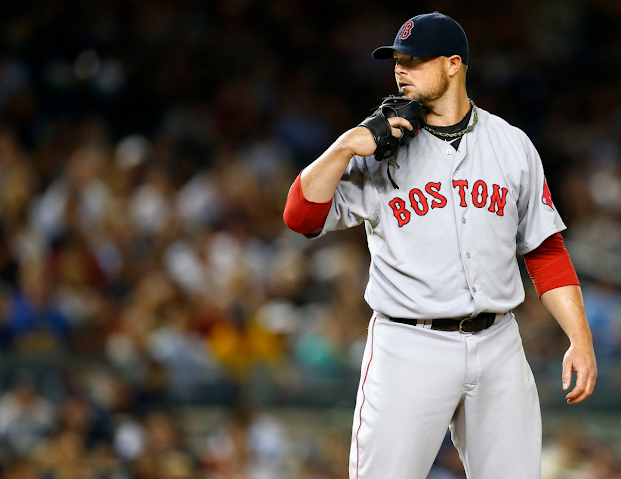
Jon Lester Has Retired After 16 Seasons

Jon Lester has retired after a 16-year career with the Red Sox (2006-14), Athletics (2014), Cubs (2015-20), Nationals (2021), and Cardinals (2021). 

Lester, who turned 38 last Friday, was a member of three World Series champions: the 2007 Red Sox, 2013 Red Sox, and 2016 Cubs.
It's kind of run its course. It's getting harder for me physically. The little things that come up throughout the year turned into bigger things that hinder your performance.
I'd like to think I'm a halfway decent self-evaluator. I don't want someone else telling me I can't do this anymore. I want to be able to hand my jersey over and say, "Thank you, it's been fun."
Throughout his career, Lester was extremely durable, making 31+ starts for 12 consecutive seasons (2008-19). Lester is one of only nine lefthanders in MLB history to have 12 seasons (not necessarily consecutive) with 31+ starts.

Lester was also remarkable consistent. His ERA was 3.64 both for his nine seasons in Boston and his six years in Chicago and his won-loss percentage for both teams was .636. Since the win stat has yet to be outlawed (a boy can dream), I'll also report that Lester (200-117) has the fourth-best winning percentage (.631) of any lefthander with 200+ wins, behind Whitey Ford, Lefty Grove, and Randy Johnson.

In 26 postseason games, Lester posted a 2.51 ERA over 154 innings. His ERA was 2.66 in seven postseason-clinching games.

Lester pitched in six World Series games, with a 1.77 ERA and 0.925 WHIP. For the Red Sox, he won the clinching Game 4 of the 2007 sweep of the Rockies and he won both of his starts (Games 1 and 5) in 2013 against the Cardinals. In 2016 with the Cubs, he lost Game 1, won Game 5 (when Chicago was down 1-3, on the brink of elimination) and pitched three innings of relief in Game 7 (and would have got the W if Aroldis Chapman had not blown the save and vultured the victory for himself).

Four mlb.com writers discuss Lester's chances of being inducted into the Hall of Fame.

Lester had 42 hits in his major league career, but none of them came in a Red Sox uniform. In 41 plate appearances with Boston, he was 0-for-34. He did walk once and drive in a run, though; both came in the same game, on June 27, 2010.

Lester was first mentioned at Joy of Sox on December 20, 2003 (when the blog was roughly four months old!), as a prospect being named as part of the (thankfully) aborted Slappy-for-Manny trade.

Lester made his debut (after waiting out a near five-hour rain delay) on June 10, 2006 and he pitched a no-hitter against the Royals on May 19, 2008. (That is also the Red Sox's most recent no-hitter.)

January 10, 2022

The One In Which I Praise The New York Yankees

The New York Yankees have hired Rachel Balkovec as the manager for the 2022 Tampa Tarpons (Low-A Southeast). Balkovec will be the first female manager in affiliated professional baseball.

Balkovec said (in 2019) she had "aspirations of being in a more leadership role from a broader standpoint . . . [possibly as] director of baseball operations or farm director or GM." Lindsey Adler of The Athletic added that Balkovec is comfortable with advanced analytics and fluent in Spanish.

Mark Polishuk (MLB Trade Rumors) recaps Balkovec's work history:

Beginning as a strength and conditioning coordinator in the Cardinals' farm system from 2011-15, she then moved to a similar role with the Astros from 2016-18, working with both Houston's Latin American prospects and then the Astros' Double-A affiliate.  She has spent the last two seasons working within the Yankees' minor league system as a hitting coach, following some time spent working with Driveline and in the Netherlands working with the Dutch national teams.

Never let it be said that I'm unreasonable when it comes to discussing those neo-Nazi Brownshirts.

Craig Calcaterra's latest Cup of Coffee includes news of Genevieve Beacom, a 17-year-old left-hander, who become the first woman to pitch for a professional team in Australia when she tossed a scoreless inning for the Melbourne Aces, managed by Peter Moylan (a 12-year MLB veteran).

Calcaterra notes: "As a bunch of people who watched video of Beacom said over the weekend, her mechanics are very much like Jon Lester's. Very economical and efficient as she mixed in fastballs and curves."