November 11, 2011

Papelbon Signs With Phillies

Jonathan Papelbon has shipped "up" to Philadelphia, having agreed (pending a physical) with the Phillies on a four-year deal worth roughly $50 million.

It's a drag to see the Snuffer go, but even with his stupendous performance in 2011, it was all but certain the Red Sox would not commit the kind of dough Papelbon wanted. Bot resisted signing a long-term deal with the Red Sox earlier in his career and he made it clear on several occasions that he wanted to test the free agent market.

Papelbon, who turns 31 this month, collected 219 saves in seven seasons with the Red Sox. In 27 post-season innings, he allowed only three runs (1.00 ERA), all of them coming against the Angels in Game 3 of the 2009 ALDS.

In 14.2 ALCS and WS innings, he allowed 0.48 baserunners per inning (excluding intentional walks). He recorded seven post-season saves, including Games 2, 3, and 4 of Boston's 2007 World Series sweep of the Rockies.
Earlier in the day, the Phillies denied they had a 4/44 deal in place with Ryan Madson.

Daniel Bard is the likely man to step into Boston's closer shoes, and he will cost approximately 4% of Papelbon's 2012 salary. Bard's WHIP has dropped every year (1.277, 1.004, 0.959), although he seems to have a mental block (or extremely shitty luck) when it comes to saving games. In his three-year career, he has blown 15 of 20 save attempts.

November 9, 2011

Francona Interviews For Cardinals Manager Job

Terry Francona has interviewed for the job of Cardinals manager. Tito said he met with chairman Bill DeWitt Jr. in Cincinnati.

Francona: "We just had a dialogue. I enjoy talking about baseball - a lot. Without going into details, we discussed pretty basic philosophy. I'd call it an enjoyable, casual conversation. ... I was just excited to go back in there and talk to them. Whatever happens, happens."

Tony La Russa was St. Louis' manager for the last 16 years (since 1996). He retired after winning the 2011 World Series.
Example
The Red Sox will interview Cleveland bench coach Sandy Alomar Jr. today. Two other managerial candidates have been announced: Blue Jays first base coach Torey Lovullo will be interviewed on Friday and Tigers third base coach Gene Lamont will meet with the team on Saturday.

Lovullo managed the Pawtucket Red Sox in 2010. He also played with Cleveland in 1998 when Ben Cherington worked in the Spiders' front office.
Example
The Red Sox have been scouting Yoenis Cespedes, a Cuban outfielder who defected to the Dominican Republic last summer. Cespedes, 26, is expected to be declared a free agent this winter. He hit 33 dongs in 99 games last season in Cuba. Two days ago, Baseball Prospectus' Kevin Goldstein wrote:
He's a tremendous talent—arguably the best all-around player to come out of Cuba in a generation. He's a legitimate centerfielder with plus power and speed and is in his prime.
Goldstein's highly-entertaining article walks us through "The Showcase", a 20-minute (!) promotional video of Cespedes.
Example
You'd think that because former Red Sox GM Dan Duquette was out of major league baseball for nearly a decade, that the Boston media would be able to resist insulting him after he accepted the position as Orioles GM. I did not make anything close to an exhaustive search, but the Herald's John Tomase could not resist, kicking off his column with "middle-aged paunch" and adding:
The starched white collar. The oval glasses. The smirk bordering on smug. The prep school part in his hair on the left. Judge the 53-year-old Duquette on looks alone and nothing has changed.
More like "I am judging the 53-year-old Duquette on looks alone. Nothing has changed." It takes Tomase 540 words before mentioning anything about Duquette's accomplishments in Boston.

Gordon Edes also wrote a fairly negative column for ESPNBoston, though he stuck to more substantial matters than Duquette's waistline. At the Globe, Tony Massarotti avoids the rancor, saying this new job is a chance for redemption.
Shame on us. Shame on all of baseball. We put more stock in the wrapping paper than what was in the box. If Duquette had a personable assistant GM like say, JP Ricciardi, many of his problems might have been avoided. Instead, the resentment built, and the Duquette era was remembered and chronicled as a colossal failure when it was not. ...

During his time in Boston, Duquette emphasized many of the same things Epstein did, albeit in far less polished language. He spoke of rebuilding the Red Sox through the draft and player development. He talked of expanding the team’s interests in international free agency. Duquette even used sabermetric analysis, something not nearly as accepted then as it is now ...

The Orioles are a laughingstock. They are easily the weakest sisters of the challenging AL East. They have been beaten, rejected and all but spit on in recent years.

Dan Duquette can certainly relate to that.
Naturally, I'm quite curious as to what Mazz has written about the Duke in the past. Could he have always been this level-headed and rational?

November 7, 2011

Manager Watch: Maddux Cancels Interview With Red Sox

Rangers pitching coach Mike Maddux told the Red Sox today that he was withdrawing his name from consideration for the manager's job.

Maddux, who pitched for Boston in 1995 and 1996, was scheduled to be interviewed tomorrow.
I could give more reasons why an opportunity like this should be taken rather than not, but the reason for withdrawing my name from consideration comes down to a family decision. My wife and two daughters are together in the same state for the first time in three years, and words cannot describe my happiness. The game of baseball has many sacrifices, but being apart from family is the toughest. I feel there is too much distance between the Dallas-Fort Worth Metroplex and Boston to see my family as much as I'd enjoy.
Sandy Alomar Jr. will be interviewed on Wednesday. Pete Mackanin and Dale Sveum were interviewed last week, and GM Ben Cherington says he would like to have filled the position by Thanksgiving - two weeks from this Thursday.
Example
Former Boston general manager Dan Duquette - out of MLB since 2002 - has agreed to be the Orioles' Executive Vice President of Baseball Operations. A formal announcement will be made tomorrow at 11 AM.

Brittany Ghiroli, MLB.com:
Duquette was farm director for the Expos from 1987-91 and their general manager from 1991-94, when he was hired to be GM by the Red Sox [1994-2002]. He traded for pitcher Pedro Martinez twice, first when he was with Montreal and again when he was with Boston, and also acquired Derek Lowe and Jason Varitek for the Red Sox in a trade with the Mariners. As Boston's GM, Duquette also signed Manny Ramirez and Johnny Damon, and despite being dismissed under the Red Sox new ownership in 2002, helped lay the groundwork for the club that won the World Series in 2004.

November 5, 2011

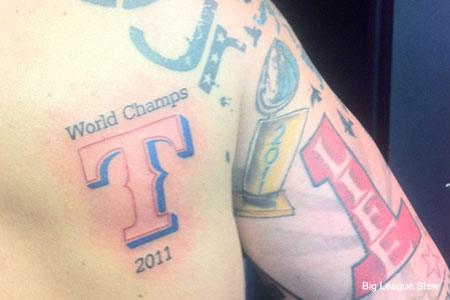
Rangers Champs Tattoo

Via Big League Stew:
'Duk:
Needless to say, we have a few questions about this gentleman, so we've asked to be put in touch with him. We will report back with any and all responses.
Example
Here are two Yankees tattoos:

Buckley Botches Honeymooners Reference

Steve Buckley, Herald, November 3, 2011:
Mike Quade's days as manager of the Chicago Cubs were numbered as soon as Theo Epstein said, "I do," and stepped in as the team's Grand Exulted Poobah of Baseball Operations, or whatever it is they're calling him out there in the Midway.
1. It's exalted ("elevated in rank, character, or status"), not exulted ("show or feel elation or jubilation") - although Epstein does seem very happy with his new job.

2. Buckley does not use the word "honeymoon" in his column, but I believe his "I do" makes his Poobah title a reference to Ralph Kramden and the Raccoon Lodge. Unfortunately, that Honeymooners reference is Grand High Exhalted Mystic Ruler. The Grand Poobah comes from The Flintstones, a cartoon stone-age Honeymooners.

3. Hellooooooooo, ball!

Former Conditioning Coach Dave Page Speaks Out

Former Red Sox strength and conditioning coach Dave Page feels he has been scapegoated and spoke yesterday on the Mut & Merloni show about four players who failed to follow the team's conditioning program as the 2011 season wore on.
[F]rom a physical, fundamental and mental preparation, we just didn't have it every night. ...

We got to the end of the year where we had four guys - without naming names --we had four guys that we thought didn't make it to that part of the season where we hoped they would be: one position player - an everyday guy - one pitcher - a starting pitcher -- and two bullpen guys. For the most part, everybody else had stayed within where we wanted them to be. They were what we expected. Most of them were working. ...

I did have a good conversation with one player at the end of the year in Baltimore that really kind of opened my eyes. I said, "Hey, what's going on here? It seemed like you pulled the plug a little bit. Why?" He kind of looked down at the ground, looked back and me and said, "I don't know why. I can't answer that question." Which was kind of a shock. ...

I got a text message from one player the other night that said ... "I feel this is all my fault."
The Herald's John Tomase's article on Page implies (to me, at least) that the texter was Josh Beckett. Page did tell WEEI that the Baltimore player was not Beckett, and a SoSH process of elimination suggests Lester was the pitcher.

Bob Hohler's article in the Globe mentioned that Beckett, Jon Lester, John Lackey, Clay Buchholz, and other players cut back on their exercise regimens despite Page's appeals. One source (who could well have been Page, considering this radio interview), said, "It's hard for a guy making $80,000 to tell a $15 million pitcher he needs to get off his butt and do some work." (Beckett earned $17 million in 2011 and Lackey was paid $15.9. Lester earned $5.8, with Buchholz at $0.5.) Since the club knew Lackey was hurt and would likely need surgery at the end of the year, the butt-sitting pitcher here is probably Beckett.

Page also mentioned a game against the Yankees in late August that he watched from the bullpen as an excellent example of the team's lack of effort.
In the first six innings ... we hit 18 balls in play. [Of the] 18 outs that we made, seven times the guy who hit the ball never made it to first base - peeled off before he got to the bag. I said something to the other coaches. I said, "We're just not playing hard."
Running all the way to first base seems like the least a batter can do after he has hit the ball. The peeling off annoys the hell out of me, as does the media's highly selective reporting on who does the peeling. Many Sox also do not bother running from first to second while the opposing team is trying to turn a double play. So a base runner (who is often lauded for "playing the game the right way") is busy making a wide half-circle in shallow right field while the other team turns two.

November 4, 2011

Sox Make No Offer To Ortiz During Exclusive Negotiating Period

The Red Sox did not make a contract offer to free agent DH David Ortiz while the team had exclusive negotiating rights. Flo can now speak with any of the other 13 American League teams (assuming no NL team will sign him to play first base).
I was expecting something would happen before [the exclusive negotiating period ran out], but so many things are going on. I know everybody has priorities, and to be honest with you, I thought I was one of them. ... I'm so used to knowing where I'm going to be the following year, but now seeing things go this way . . . To be honest with you, it doesn't matter where I go, I'm just going to try to be the same and do what I normally do. Workout the way a lot of people expect. I'll just have to listen to somebody else.
Any whining about how important Ortiz believes he is to the team - whether or not it's true - is not a smart move. (And it doesn't matter where he plays next year?!?)

In 2011, Ortiz slapped down the people (like me) who thought he was at the end of his career. Tiz had his best season at the plate in four years: his highest batting, slugging, and on-base averages, as well as the most hits, doubles, and total bases since 2007. But he will celebrate his 36th birthday on November 18 - and some decline would not be unexpected.

The Red Sox probably have a very good idea what the AL DH market is and are content to have Ortiz see for himself what the landscape looks like before presenting an offer.

Ortiz earned $12.5 million last year, and is hoping for a three-year contract. Ideally, Ortiz and Cherington agree on a 2/25 deal. I'm not ready to say good-bye to the Big Cat.

November 3, 2011

Mackanin, Sveum Interviewed For Manager's Spot

The Red Sox have interviewed third base coach Dale Svuem and Phillies bench coach Pete Mackanin for the vacant manager's spot. The team has also been given permission to interview Rangers pitching coach Mike Maddux and Cleveland bench coach Sandy Alomar Jr.

Cubs GM Theo Epstein fired manager Mike Quade yesterday and is considering Sveum and Mackanin - and the Cubs have permission to speak with Maddux.

Mackanin, 60, was interviewed on Monday.
My qualities are my versatility, the fact I have a rounded-out career. I've been a scout, I've been an advanced scout, I've done major league coverage, I've been a major league player, a minor league player, a third-base coach, a bench coach, an outfield instructor, infield instructor, minor league coordinator ...
Mackanin was an interim manager twice, for the Pirates (2005) and the Reds (2007). He said the Sox interview was "an interesting little scenario ... basically going over strategy in games and things like that. A lot of good questions, a lot of different questions, a lot of outside-the-box questions and inside-the-box questions."

Sveum - the third base coach for 2004 and 2005 - was interviewed Wednesday. GM Ben Cherington:
We're looking at sort of the entire body of work, and in some ways, I think his experience as third-base coach is a benefit to him. He's been through some adversity in Boston, and a lot of our candidates won't have been through that. ... There's a lot of substance to his baseball thought process and how he goes about teaching the game, making decisions during the game. He's familiar with the city, familiar with some people in the organization. He's had a little bit of managerial experience in the big leagues, albeit brief ... He's got a lot of the qualities that we're looking for.
John Lackey underwent Tommy John surgery on November 1.

The Red Sox picked up Marco Scutaro's $6 million option for 2012 - Scutaro had the second best OBP among AL shortstops with 400+ PA (and 5th-best in MLB) - and declined the options for relief pitchers Dan Wheeler and Scott Atchison.

There was talk about the Blue Jays possibly making a play for free agent David Ortiz, but Toronto has picked up Edwin Encarnacion's option and will likely use him as their DH.

Dustin Pedroia was named MLB's best fielding second baseman by The Fielding Bible. At first base, Adrian Gonzalez finished #2, close behind Albert Pujols. ... Ellsbury, Gonzalez, and Pedroia won Gold Gloves. It was Ellsbury's first GG, Pedroia's 2nd, and Gonzalez's 3rd. The last time Boston had multiple winners was in 1990. The Red Sox had three winners in 1968 and 1979.

Jacoby Ellsbury (CF), Gonzalez (1B) and Ortiz (DH) won Silver Sluggers as the best hitters at their respective positions. (Miguel Cabrera would have been a better choice at 1B than Bert.)

The Yankees committed a minimum of another $30 million to CC Sabathia to keep the hefty lefty off the free agent market this winter. Sabathia, who turns 32 next July, will paid $122 million over the next five years ($23 per for 2012-15 and $25 for 2016). The Yankees have a $25 option or $5 buyout for 2017.

October 30, 2011

Review: The Art Of Fielding by Chad Harbach

Chad Harbach's debut novel, The Art of Fielding, has received an amazing amount of buzz and praise, both for the quality of the writing and for the ten-year path the manuscript took to publication*. Baseball America called Harbach the literary equivalent of Stephen Strasburg.

* If you are interested, Keith Gessen explores the world of book publishing in the October issue of Vanity Fair. Gessen's article uses Harbach's experience as a springboard (the two men are co-founders and co-editors of n+1). An expanded version of the article (19,000 words or so) is available as a $2 e-book: "How a Book Is Born: The Making of The Art of Fielding".

From Gregory Cowles's glowing review in the New York Times (which includes plenty of plot details (aka information that does not belong in a book review because it can ruin your reading experience):
The novel centers on the Westish College Harpooners, a Division III team from the Wisconsin side of Lake Michigan that sees its fortunes rise and then rise some more with the arrival of a nearly magical young shortstop named Henry Skrimshander. Henry is an infield savant, scrawny but supremely gifted, and by his junior year he's chasing records and being scouted by the majors as a top draft prospect. Then, in the baseball equivalent of a werewolf movie, it all goes terribly wrong ...

[I]t feels exactly right that Henry's crisis is precipitated by over­analysis - he's paralyzed by thought, by an inability to simply act (or react). This is credible from a sports point of view, and fraught with significance from a literary one. Thinking, after all, is a writer's primary weapon, but every writer knows it's double-­edged; live too much in your head and you don't live enough in the world. This is Hamlet's quandary, and, as one character unsurprisingly notes, also Prufrock's: "Do I dare, and do I dare?" Harbach's achievement is to transfer the thinking man's paralysis to the field of play, where every hesitation is amplified and every error judged by an exacting, bloodthirsty audience.
I thoroughly enjoyed The Art of Fielding (I received a copy from the publisher, Hachette Book Group). Harbach, a Brewers fan, treats baseball as a form of art, and he is as deft at writing about the game as Skrimshander is at playing shortstop. And while there is plenty of baseball in the novel, Harbach is more concerned with his characters*' struggles with figuring out who they are (or who they want to be) and the attendant hard work, and the setbacks and dead ends along the way. Or, as The Atlantic's Reeves Wiedeman puts it:
What do you do when the thing you're best at, the one thing you truly love, suddenly causes you the most pain?
* Besides Skrimshander, the other main characters are: Mike Schwartz, Westin's catcher and the guy who discovers/recruits Henry; Owen Dunne, Henry's dorm mate (and teammate); Guert Affenlight, the college's president; and his daughter, Pella Affenlight.
While wondering why great sports novels are so rare, Wiedeman quotes from David Foster Wallace's essay (from Consider the Lobster) about his (DFW's) disappointment at Tracy Austin's memoir, and the realization that athletes often are unable to give us any real insight into what they do.

Wallace:
The real, many-veiled answer to the question of just what goes through a great player's mind as he stands at the center of hostile crowd noise and lines up the free-throw that will decide the game might well be: nothing at all.
Wiedeman:
Being a top athlete is such a physical, instinctual act, that it is one that its actors struggle to consider, and, indeed, deliberate on only at their own peril.
Wallace:
It may well be that we spectators, who are not divinely gifted as athletes, are the only ones able truly to see, articulate, and animate the experience of the gift we are denied. And that those who receive and act out the gift of athletic genius must, perforce, be blind and dumb about it - and not because blindness and dumbness are the price of the gift, but because they are its essence.
Wiedeman:
The value of the sports novel, then, is to explain not only to fans, but also to athletes themselves, just what the heck is going on inside their heads. Athleticism is a level of human performance so misunderstood by those who partake in it, that it begs for our best fictionalists to explore.
Salon's Mike Doherty writes that
Harbach exposes an issue that's integral both to the sport and to American democracy: the tension between the individual and the collective, where the pursuit of personal happiness is pitted against the good of the whole. ...

Baseball heroes uphold the standards set out for great men by Ralph Waldo Emerson in his essay "Self-Reliance" - they think for themselves and value "the independence of solitude" but accept "the society of [their] contemporaries" and "the connection of events," and come into their own as "guides, redeemers and benefactors." Such prose may seem grandiose in context, but Harbach's collegiate characters are given to quoting Emerson and other American Renaissance authors, who wrote at a time when baseball was becoming "the national pastime." Westish's baseball players are forced to examine how their roles on the team affect their trajectories in life.
Henry Skrimshander uses the same baseball glove he received on his ninth birthday: "The glove seemed huge back then; now it fit him snugly, barely bigger than his left hand. He liked it that way; it helped him feel the ball."

He is also rarely without his well-worn copy of Aparicio Rodriguez's The Art of Fielding, a collection of 233 aphorisms - bits of wisdom about baseball and life tinged with eastern philosophy. From the novel:
By this point in his life, reading Aparicio no longer really qualified as reading, because he had the book more or less memorized. He could flip to a chapter, any chapter, and the shapes of the short, numbered paragraphs were enough to trigger his memory.

26. The shortstop is a source of stillness at the center of the defense. He projects this stillness and his teammates respond.

59. To field a groundball must be considered a generous act and an act of comprehension. One moves not against the ball but with it. Bad fielders stab at the ball like an enemy. This is antagonism. The true fielder lets the path of the ball become his own path, thereby comprehending the ball and dissipating the self, which is the source of all suffering and poor defense.
...

Aparicio played shortstop for the St. Louis Cardinals for eighteen seasons. He retired the year Henry turned ten. He was a first-ballot Hall of Famer and the greatest defensive shortstop who ever lived. ...

There were, admittedly, many sentences and statements in The Art that Henry did not yet understand. The opaque parts of The Art, though, had always been his favorites, even more than the detailed and extremely helpful descriptions of, say, how to keep a runner close to second base (flirtation, Aparicio called it) or what sort of cleats to wear on wet grass. The opaque parts, frustrating as they could be, gave Henry something to aspire to. Someday, he dreamed, he would be enough of a ballplayer to crack them open and suck out their hidden wisdom.
Here are a few quotes from interviews Harbach has done in the few months since the book's publication:
I think the book is about a kind of crisis moment where what the characters have always done and have always relied on turns out not to be enough at these critical moments. ... [I]f you're not constantly transforming yourself for real, at a certain point you get stuck and reliant on a way of thinking about things you do that's not working anymore.

For Henry the diamond is safety and refuge - he knows what will be demanded of him out there, and he knows that he can provide it. The game is complex, of course, but it holds out the hope of being perfectly knowable. Life is much scarier, its demands much more shifty and unknowable. I guess what happens to Henry is that he's spent his entire career striving to make life as simple as baseball. It works for a while, but it's a doomed project, and suddenly baseball becomes as complex as life.

The Art of Fielding is in large part a book about the varieties of male friendship, from the antagonistic and the competitive to the deeply affectionate and the frankly sexual, and so Moby-Dick, taking place as it does in a very intense world of very intense men, seemed like the ideal analogue. A baseball team is a lot like a whaling ship: in each case, a group of men who might otherwise have little in common spend an inordinate amount of time in close and not-so-comfortable quarters, excluding the world, in pursuit of a common goal.

For Henry, I think the question is more: is there life outside of baseball? Until now, he's been so "regular and orderly" in his life, as Flaubert recommended, and that dull regularity has made him a great athlete but has stunted him in other ways. There's a tension between the demands of life and the demands of art; that's what he's trying to resolve. Can he do the strange, surprising, scary things required to become a real human being with a real inner life, and still devote himself to his craft?
That all sounds very exciting to me as a reader, but Harbach doesn't go into it as deeply as I would have liked.
There are apparently scores of literary references (to Melville and others) throughout the book, but I am not savvy enough to catch them. However, Melville does use the noun "skrimshander" in Chapter 57 of Moby-Dick:
Throughout the Pacific, and also in Nantucket, and New Bedford, and Sag Harbor, you will come across lively sketches of whales and whaling-scenes, graven by the fishermen themselves on Sperm Whale-teeth, or ladies' busks wrought out of the Right Whale-bone, and other like skrimshander articles, as the whalemen call the numerous little ingenious contrivances they elaborately carve out of the rough material, in their hours of ocean leisure. Some of them have little boxes of dentistical-looking implements, specially intended for the skrimshandering business. But, in general, they toil with their jack-knives alone; and, with that almost omnipotent tool of the sailor, they will turn you out anything you please, in the way of a mariner's fancy.
The last name of Westish's Adam Starblind seems similar to the Pequod's Starbuck. And Owen Dunne recalls Owen Chase, the first mate on the Essex that set sail on a sperm whale-hunting expedition in August 1819. In November 1820, a whale rammed the ship and it sank. Chase alone survived to tell the tale, which fascinated Melville. (Dunne is also possibly linked to John Irving's Owen Meany.)
Praise for The Art of Fielding has not been universal. Robert Sternberg (Globe and Mail) states that
the cultured and literary baseball fan eager to be taken deep into the unknown world of Division III college baseball will be disappointed ... The book is too unfocused, heavily plotted and weighted down by the author's many contrivances, idiosyncrasies, indulgences and wearisome, not to mention unnecessarily topical, preoccupations. ...

In Moby-Dick, Melville often digresses from his simple plot to expound eloquently on various facets of the commercial whaling industry. Harbach becomes so wrapped up in the twists and turns of his elaborate plot, and the frequently inane repartee of his slippery characters, that he rarely allows himself such digressions, so by the book's end his subject, baseball, seems incidental.
I disagree with Sternberg's complaints, generally. He's not entirely wrong, but I do not pick up a book expecting to love every paragraph; I know I will likely encounter sections that I might describe as unnecessary or contrived or boring. That was rarely the case with The Art of Fielding, thankfully. However, I do agree that baseball ultimately ends up playing second fiddle to the various off-field dramas of the main characters. (Which doesn't necessarily sink the book. I simply wanted more baseball!)

Andrew Ivers labelled it a "professional failure" and Biblioklept (which quit reading after 100 pages) said it was
run-of-the-mill literary fiction ... The book is not entirely terrible. It just isn't very good, certainly not good enough to warrant the excessive praise that's been heaped upon it. Cardboard characters, cliché after cliché (plot, character, prose), and plenty of bad writing.
(Many reader reviews, good and bad and effusive, can be found at Good Reads.)
Vanity Fair published a lengthy excerpt entitled "Phumber 405" (Chapter 2 of the novel). The book begins between games at a "no-name tournament" in the heat of August with Mike Schwartz watching as Henry takes infield practice after his South Dakota team has been eliminated.
Schwartz didn't notice the kid during the game. Or rather, he noticed only what everyone else did - that he was the smallest player on the field, a scrawny novelty of a shortstop, quick of foot but weak with the bat. Only after the game ended, when the kid returned to the sun-scorched diamond to take extra grounders, did Schwartz see the grace that shaped Henry's every move. ...

Now when the kid reached the worked-over dust that marked the shortstop's spot, he stopped, bouncing on his toes and jangling his limbs as if he needed to get loose. He bobbed and shimmied, windmilled his arms, burning off energy he shouldn't have had. He'd played as many games in this brutal heat as Schwartz.

Moments later the South Dakota coach strolled onto the field with a bat in one hand and a five-gallon paint bucket in the other. He set the bucket beside home plate and idly chopped at the air with the bat. Another of the South Dakota players trudged out to first base, carrying an identical bucket and yawning sullenly. The coach reached into his bucket, plucked out a ball, and showed it to the shortstop, who nodded and dropped into a shallow crouch, his hands poised just above the dirt.

The kid glided in front of the first grounder, accepted the ball into his glove with a lazy grace, pivoted, and threw to first. Though his motion was languid, the ball seemed to explode off his fingertips, to gather speed as it crossed the diamond. It smacked the pocket of the first baseman's glove with the sound of a gun going off. The coach hit another, a bit harder: same easy grace, same gunshot report. Schwartz, intrigued, sat up a little. The first baseman caught each throw at sternum height, never needing to move his glove, and dropped the balls into the plastic bucket at his feet.

The coach hit balls harder and farther afield - up the middle, deep in the hole. The kid tracked them down. Several times Schwartz felt sure he would need to slide or dive, or that the ball was flat-out unreachable, but he got to each one with a beat to spare. He didn't seem to move faster than any other decent shortstop would, and yet he arrived instantly, impeccably, as if he had some foreknowledge of where the ball was headed. Or as if time slowed down for him alone.

After each ball, he dropped back into his feline crouch, the fingertips of his small glove scraping the cooked earth. He barehanded a slow roller and fired to first on a dead run. He leaped high to snag a tailing line drive. Sweat poured down his cheeks as he sliced through the soup-thick air. Even at full speed his face looked bland, almost bored, like that of a virtuoso practicing scales. He weighed a buck and a quarter, maximum. Where the kid's thoughts were - whether he was having any thoughts at all, behind that blank look - Schwartz couldn't say. He remembered a line from Professor Eglantine's poetry class: Expressionless, expresses God.

Then the coach's bucket was empty and the first baseman's bucket full, and all three men left the field without a word. Schwartz felt bereft. He wanted the performance to continue. He wanted to rewind it and see it again in slow motion. He looked around to see who else had been watching - wanted at least the pleasure of exchanging a glance with another enraptured witness - but nobody was paying any attention. The few fans who hadn't gone in search of beer or shade gazed idly at their cell-phone screens. The kid's loser teammates were already in the parking lot, slamming their trunks. Fifteen minutes to game time. Schwartz, still dizzy, hauled himself to his feet. He would need two quarts of Gatorade to get through the final game, then a coffee and a can of dip for the long midnight drive. But first he headed for the far dugout, where the kid was packing up his gear. He'd figure out what to say on the way over. All his life Schwartz had yearned to possess some single transcendent talent, some unique brilliance that the world would consent to call genius. Now that he'd seen that kind of talent up close, he couldn't let it walk away.

October 27, 2011

Cardinals Win A Historic Game 6

Rangers   - 110 110 300 20 -  9 15  2
Cardinals - 200 101 012 21 - 10 13  3


Matthew Leach, MLB.com:
The Cardinals trailed five times in the game, including by two runs in the ninth and again in the 10th, but an irrepressible club kept coming back. ... The win means that the World Series will go to a seventh game for the first time since 2002. ...

The Cardinals overcame one of their sloppiest games of the year for one of their most improbable wins. They committed three errors plus a costly wild pitch, lost a runner on a critical pickoff and had trouble for much of the night turning baserunners into runs. But after repeatedly getting down to their final turn at bat, they simply would not die.
The Rangers did not trail in the game after the top of the second inning - until David Freese hit his game-winning home run in the bottom of the 11th!

This was only the third time that a team came back to win a World Series game after being one out from elimination:
1911 Game 5 - New York Giants beat Philadelphia A's (but lost Game 6)
1986 Game 6 - New York Mets beat Boston Red Sox (and won Game 7)
2011 Game 6 - St. Louis Cardinals beat Texas Rangers (??)
The home team has won the last eight Game 7s:
1982 - Cardinals 6, Brewers 3
1985 - Royals 11, Cardinals 0
1986 - Mets 8, Red Sox 5
1987 - Twins 4, Cardinals 2
1991 - Twins 1, Atlanta 0 (10)
1997 - Marlins 3, Cleveland 2 (11)
2001 - Diamondbacks 3, Yankees 2
2002 - Angels 4, Giants 1
The last visiting team to win a Game 7 was the 1979 Pirates, who beat the Orioles 4-1. Pittsburgh trailed in that series 1-3 and won the last three games.

Seven Years Ago


October 26, 2011

Would Red Sox Seriously Consider Sabathia?

Anthony Mccarron, Daily News:
While they would never admit it, you have to think the Yankees got a shiver when they heard Tuesday that Boston's John Lackey will miss all of 2012 due to Tommy John surgery, news that could make the winter as sticky as a humid summer for the Yankees. ...

[W]hat if their rich rival makes a play for the Yankees' own ace, CC Sabathia, if - when? - Sabathia triggers the opt-out clause in his contract?

Losing Sabathia to any team would be damaging to a Yankee rotation that has only Phil Hughes, A.J. Burnett and Ivan Nova signed for next season. Losing Sabathia to the Red Sox? Potential baseball disaster. ...

The Red Sox may already have too many big contracts to pursue Sabathia ... If Sabathia opts out, he would be spurning the last four years of his contract, which is slated to pay him $92 million, so he would want more years and more cash.
The rest of Sabathia's MFY deal is 4/92, which is $23 million a year. He had the second highest ERA+ of his career in 2011. In the last two seasons, Sabathia has pitched 237.2 and 237.1 innings.

The last Red Sox pitcher to have 237 IP was Roger Clemens (1996). The last Boston pitcher to do it in consecutive seasons was also Fat Billy (1991-92). That's 20 years ago! However, several Sox pitchers have topped 215 innings recently: John Lackey (215 in 2010), Tim Wakefield (225.1 in 2005), Pedro Martinez (217 in 2004) and Curt Schilling (226.2 in 2004).

Would the Red Sox want to pay the hefty hurler, who turns 32 next July, something like $25 per (5/125? 6/150?!?) through 2016 (or 2017)? Even with slim pickings among free agent starters this winter, I don't think so. (The 2013 FA list is here.)
George A. King III, Post:
By the time two days of meetings in Tampa end tomorrow, the Yankees will develop a plan they hope will keep CC Sabathia from opting out of a contract following the World Series. ...

"Their hope is to present Sabathia with an offer he is agreeable with before he opts out," said a person with knowledge of the Yankees' thinking.
Sabathia has three days following the end of the World Series (a possible Game 7 is scheduled for Thursday) to make his decision. We'll have an opt-out answer no later than November 1.

October 25, 2011

Lackey Will Miss 2012 Season After TJ Surgery

John Lackey will have Tommy John surgery on his right elbow, according to Red Sox GM Ben Cherington, and will miss the entire 2012 season.

Cherington said that Lackey had "some intermittent elbow soreness throughout the season". Back in late June, Peter Gammons mentioned the possibility of Lackey needing TJ surgery, but at the time both Lackey and the Red Sox denied it.

Dr. Lewis Yocum, who operated on Daisuke Matsuzaka earlier this year, will do the surgery.

Theo Epstein Explains It All

As Theo Epstein begins his new job with the Chicago Cubs, he further explained his decision to leave the Red Sox in an editorial published in today's Globe:
I grew up in Brookline just down the road from Fenway Park, living and dying with every pitch, every win or loss, and every Red Sox season that fell painfully short. My whole outlook on life changed at age 12 as my twin brother and I writhed on the living room floor, devastated by Game Six of the '86 Series.

Had you told me then that the Red Sox would go on to raise not one but two World Series flags, I wouldn't have believed you. And had you told the 12-year-old me that I would someday walk away from my dream job as general manager of the Red Sox completely of my own volition, I would have thought you were crazy.

I think that kid would appreciate an explanation - and so might some of you. ...
In Chicago, Epstein has been nicknamed the "Savior" (even before he officially took the job). With quotes like this one from Curt Schilling - "If he spends the same amount of time he spent in Boston in Chicago, you'll have a World Series" - I guess that hype and hope is inevitable.

Epstein, at Wrigley Field:
I was so lucky to spend a decade in the Red Sox organization, and I consider myself very, very lucky to be a Cub today. ... To me, baseball is better with tradition. Baseball is better is with history. Baseball is better with fans who care. Baseball is better in ballparks like this. Baseball is better during the day. And baseball, best of all, is better when you win. ... Over time, I believe we can build a consistent winner, a team that is playing baseball in October regularly.
See Extra Bases for lots of press conference stuff.

1908 was 103 years ago. Good luck, Theo!

October 24, 2011

MLB Will Investigate Clubhouse Drinking

Joe Torre, MLB's executive vice president of baseball operations, says he will investigate the reports of drinking in the Red Sox clubhouse and may institute a ban on clubhouse beer.
If we do happen to bar alcohol from the clubhouses, you have to understand the intent of this thing ... [W]e should be role models for the youngsters and how they behave.
There are 12 or 13 teams (depending on which of the above links you read) that allow adults to consume alcohol in their clubhouses.

Torre was the manager of the Yankees when Roger Clemens and Jason Giambi (reportedly) routinely drank beer in the dugout during games.

Of course, MLB is not so concerned that it would reduce (or even consider reducing) the number of beer commercials shown during broadcasts. No, resurrecting Prohibition is the way to go.

October 23, 2011

Infinite Thanks

In Theo We Trusted.

... and the wonderful (and unprecedented and, at times, surreal) results forever changed our lives.
This full-page "thank you" from Epstein ran in today's Globe.

October 22, 2011

Pujols Ties Four World Series Records In Game 3:
Three Home Runs, Five Hits, Six RBI, Four Runs Scored;
Sets Record With 14 Total Bases - And Hits In Four Consecutive Innings

Albert Pujols is the third player to hit three home runs in a World Series game. He went 5-for-6 on Saturday night as the Cardinals beat the Rangers 16-7 in Game 3 in Texas, with six RBI and four runs scored.
Pujols also became the first player in World Series history to have a hit in four consecutive innings. He singled in the fourth, singled in the fifth, homered in the sixth, and homered in the seventh. He hit his third dong in the ninth. ... And he set a World Series record with 14 total bases.

Three HR In World Series Game

Babe Ruth - October 6, 1926 - Game 4 against Cardinals at St. Louis
1st - solo HR
3rd - solo HR
5th - BB
6th - 2-run HR
8th - BB
Yankees won 10-5, lost series in 7 games
Babe Ruth - October 9, 1928 - Game 4 against Cardinals at St. Louis
1st - 3U-6 DP
4th - solo HR
5th - 1-3
7th - solo HR
8th - solo HR
Yankees won 7-3, sweeping series in 4 games
Reggie Jackson - October 18, 1977 - Game 6 against Dodgers at New York
2nd - BB (4 pitches)
4th - 2-run HR (1st pitch)
5th - 2-run HR (1st pitch)
8th - solo HR (1st pitch)
Yankees won 8-4, winning series in 6 games
[Jackson homered in his last at-bat in Game 5, so he hit
four home runs on his last four swings of the World Series]
Albert Pujols - October 22, 2011 - Game 3 against Rangers at Texas
1st - 5-3
4th - 1B
5th - 1B
6th - 3-run HR
7th - 2-run HR (1st pitch)
9th - solo HR
                  AB  R  H RBI
Ruth    10/06/26   3  4  3  4
Ruth    10/08/28   5  3  3  3
Jackson 10/18/77   3  4  3  5
Pujols  10/22/11   6  4  5  6
Most RBI, World Series game: 6
Bobby Richardson, Yankees, October 8, 1960, WS 3 against Pirates
Hideki Matsui, Yankees, November 4, 2009, WS 6 aganst Phillies
Albert Pujols, Cardinals, October 22, 2011, WS 3 against Rangers
Most Hits, World Series game: 5
Paul Molitor, Brewers, October 12, 1982, WS 1 against Cardinals
Albert Pujols, Cardinals, October 22, 2011, WS 3 against Rangers
Most Runs Scored, World Series game: 4
Albert Pujols, with nine others
The Cardinals became the first team in World Series history to have four consecutive multi-run innings.
Cardinals - 100 434 211 - 16 15  0
Rangers   - 000 330 100 -  7 13  3
They have also scored first in their last 10 post-season games - an MLB record.

Most runs by a team, World Series game
October 2, 1936 - WS 2 - Yankees 18, Giants 4
October 6, 1950 - WS 2 - Yankees 16, Pirates 3
October 24, 2002 - WS 5 - Giants 16, Angels 4
October 22, 2011 - WS 3 - Cardinals 16, Rangers 7
Most runs, both teams, World Series game
October 20, 1993 - 29 runs - Blue Jays 15, Phillies 14 (Game 4)
October 21, 1997 - 25 runs - Marlins 14, Cleveland 11 (Game 3)
October 22, 2011 - 23 runs - Cardinals 16, Rangers 7 (Game 3)

October 21, 2011

Ben Cherington Will Be Named Red Sox GM On Tuesday

Ian Browne, MLB.com:
The Cubs will hold a news conference on Tuesday, at which time they will announce the hiring of [Theo] Epstein [as president of baseball operations]. Also Tuesday, the Red Sox are expected to elevate assistant GM Ben Cherington. While Cherington has long worked under Epstein, he actually predates his former boss in the Red Sox organization.

Cherington was hired by the Red Sox in 1999 as a mid-Atlantic area scout and joined the baseball operations department in May of that year.
A statement issued by the two teams stated:
The Boston Red Sox and the Chicago Cubs jointly announce this evening that, effective immediately, Theo Epstein has resigned from the Red Sox in order to become the new President of Baseball Operations for the Cubs. The clubs also have reached an agreement regarding a process by which appropriate compensation will be determined for the Red Sox and that issue will be resolved in the near term.

Both the Red Sox and the Cubs intend to hold press events on Tuesday, October 25 during which the Cubs intend to announce Mr. Epstein, and the Red Sox intend to announce his successor as General Manager. Out of respect for the World Series, both clubs have agreed to forego further comment until Tuesday, the next scheduled non-game day.

Daily News: Yankees Routinely Drank Beer In Dugout

Daily News:
According to one of the insiders, Jason Giambi and Roger Clemens would routinely drink beer on the dugout bench when they played for the Yankees, passing back and forth what Giambi called his "protein shake," code for a cup of beer, the source said.

And they weren't the only ones who partook. ... "Guys would drink them all the time, on the bench, in the clubhouse, in the training room. It's common."
Giambi and Fat Billy played together on the Yankees in 2002-03 and 2007. ... Maybe that wasn't actually green tea in Joe Torre's paper cup?

The story also mentions a game in which Jose Canseco "drank a can of light beer, went out and hit a home run, went back into the clubhouse and drank another can, hit another home run, and did the same thing a third time. Three lights, three homers."

Canseco hit three home runs in a game only twice - July 3, 1988 (with Oakland), and June 13, 1994 (with Texas). However, the source does not specifically say Canseco did it during his season with the Yankees (2000). Canseco did not hit more than one Ballantine Blast in any game with New York.
Example
In actual baseball news, Curt Young is no longer the Red Sox pitching coach. He has returned to Oakland.
Example
I swear this front page is legit:

October 20, 2011

Epstein-to-Cubs Announcement Could Come Today

The Chicago Cubs have received permission from MLB to hold a news conference on Friday to introduce Theo Epstein as the team's new president, if the deal can be completed.

CSN Chicago's David Kaplan, on WEEI:
I think the deal is basically done. ... I would be shocked if I'm not standing at Wrigley Field tomorrow at a press conference. ... They have built Theo up to be the God here. The messiah to come save the Cubs.
However, John Henry told the Globe the two sides are "not close". And the Sun-Times reports that "leak[s] in Chicago early in the day of a deal being nearly done turned out to be premature and appeared to rile Boston brass". A CSN Chicago story posted tonight also says news of a resolution was premature.

ESPNChicago reports that the Red Sox initially asked for shortstop Starlin Castro as compensation. After the Cubs said, "Are you insane?", the Sox suggested Matt Garza. At one point, Boston reportedly proposed that the Cubs take John Lackey's contract (which may have been crazier than asking for Castro).

Minor league players ("solid but not exceptional prospects", says WEEI's Alex Speier) are expected to be the compensation package.